
France burns as Macronism fades: debt at 119% and the far right at 35%
France confirms the end of Macronism with debt at 119.8% of GDP, the far right at 35% in the polls, and nine out of ten riot arrestees underage.
English · Original discussion in Spanish · Published
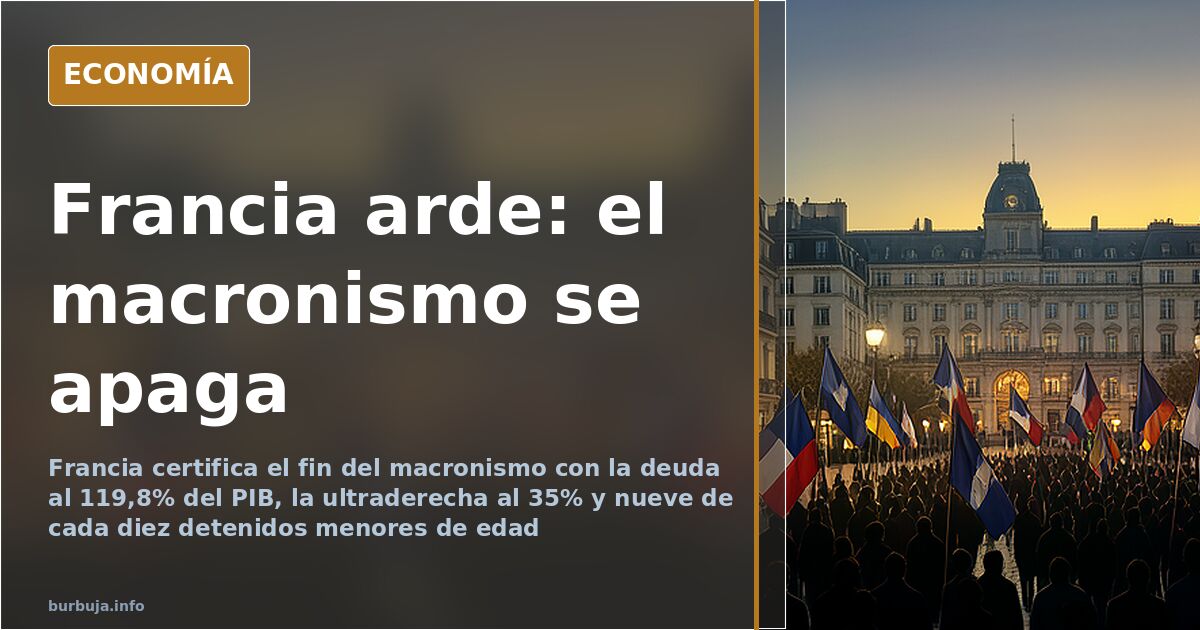
France burns as Macronism fades: debt at 119% and the far right at 35%
On 17 October 2026, France took to the streets amid protests, fires and looting, and sealed the death of a political idea. It was not just a protest: it was the death certificate of Macronism, that attempt to build an ideological centre capable of holding the extremes at bay. Nine years on, public services have been hollowed out, debt has climbed from 98% to 119% of GDP, and the two poles — La France Insoumise and the Rassemblement National — now divide the public debate between them. Polls give the far right 35% of voting intentions in the first round of next spring's election.
Macron came to power at 39, young, clever and arrogant, promising economic fluidity and labour flexibility. He came from banking, understood money, but had been raised in the Socialist Party. He promised to reverse a society designed by and for boomers. He had it all: in the last presidential election he won the majority vote of 25 to 34-year-olds. Five years later, people in their thirties despise him and fewer than one in ten young voters backed a candidate from the presidential bloc in the 2024 legislative elections.
The startling figure: nine out of ten arrestees were minors
The protest is no longer just about pensions, nor does it come from the older generations. On Saturday, nine out of ten people arrested in the disturbances were minors. The average age of the TV audience on France 2 and France 3 is 60. The age at which one can afford a new car is 55. The advertising narrative of the big consumer segments is not aimed at them. And Macron, in June 2025, confessed to the writer Emmanuel Carrère that he had "never been a teenager" and that he neither "likes" nor "understands" teenagers.
The deterioration of the public finances has reignited a generational conflict that few candidates dare to defend openly. The Banque de France has cut its growth forecast for 2026 to a range of 0.4% to 0.5%, well below the 1% it was working with in late 2025, and raised its inflation forecast to 2.5%. The public deficit will climb to 5.2% of GDP and public debt to 119.8%. The perfect cocktail for a government that knows in advance it will not be able to meet the economic demands.
No one to talk to and no money in the till
Prime Minister Sébastien Lecornu does not know whether he will survive the budget debate in the coming weeks. The president has barely addressed the conflict and, with six months to go before leaving office, is a figure of little authority. "It is the end of a reign marked by great decomposition," explains journalist and biographer François-Xavier Bourmaud. "There are echoes of 1968, when the end of Gaullism was also approaching. The students' protest is an unexpected movement that the government saw coming, but could not imagine the scale of. Moreover, another dangerous aspect for Macron is that there is no money in the till. And that breaks the golden rule of a social crisis: pay up".
The unsettling thing, according to Bourmaud, is the timing: "The students' movement already resonates like the yellow vests in his first term. But it is even more surprising that it is happening months before a presidential election, when these phenomena never occur". Political scientist Pascal Perrineau speaks of "a crisis of political confidence": "Disillusionment with the political system is enormous. The president is hitting record levels of unpopularity, the prime minister cannot get the budget approved".
The street splits between making ends meet and the end of the world
On the roundabouts, those who antiestéticar the end of the month met those who antiestéticar the end of the world. Or at least, the end of the world their parents lived in. The protest has a representation problem: there is no clear interlocutor. And a deeper one: Macronism promised to contain the extremes and has instead been swallowed by them. The far right is at the gates of the Élysée for the first time since the Second World War.
The debate over how to respond to the burning of monuments and businesses has become polarised. Some demand exceptional measures — a state of siege, curfews, preventive detention of agitator leaders — while others point out that the rioters do not represent even 20% of the electorate. There is also the circulating thesis that the Kremlin and its assets are behind the burnings, an accusation not supported by evidence in the available material. The discussion about the role of immigration in the riots appears in the debate, but the article itself notes that the monstrous debt of a state that spends more than it takes in remains even if that issue were resolved.
The debt write-off nobody wants to pay for
The underlying economic problem is that of the euro: France cannot print money, but no country in the eurozone can go bust. With debt at 119.8% of GDP and an austerity policy that looks impossible amid these protests, the question hanging in the air is whether the other member states — some poorer than France — will hand out a debt write-off. The answer is not in the material. The analysis stalls exactly there: on who pays for the party when the party has already claimed Macronism as its price.
Also available in: Deutsch
Summary of a discussion on Burbuja.info - Foro de economía, actualidad y política., translated from Spanish and reviewed before publication. Read the full discussion (29 replies).
More summaries
-
Limoges city hall burns during riots across France
Limoges city hall, a historic building, went up in flames during riots; the forum debate criticizes public spending and blames the fire on the destruction of…
-
Jewellery appraisal in Zapatero case: PP fingerprints on the report
The jewellery in the report against Zapatero was valued by members of Spain's PP, according to the accusers. Another case of 'patriotic police' tactics.
-
The thousand-euro worker paddling through on olanzapine
A 33-year-old worker, with no details about his job, takes anxiolytics while he 'paddles'. A portrait of the precarity that never shows up in the statistics.
-
Felipe VI rescues stranded Pope with ageing Falcon after papal plane breakdown in Spain
The King's Falcon 900 came to the Pope's rescue after the papal plane broke down. The incident exposes the poor state of Spain's official air fleet and the cost of improvisation.
-
Leire Díez threatens to reveal more than the agendas
The PSOE fixer, charged in the Koldo case, threatens to disclose key information. Bluff or a real danger for Ferraz?
-
NATO Is Evil: The Geopolitical Debate Explained
Is NATO a guarantor of peace or a threat? We break down the geopolitical debate over its role in current conflicts and its impact on global sovereignty.