
Leaked Ukraine Peace Draft Cedes Crimea and Donbas to Russia
A leaked draft peace plan cedes Crimea and Donbas to Russia, offering Ukraine NATO security guarantees without formal membership.
English · Original discussion in Spanish · Published
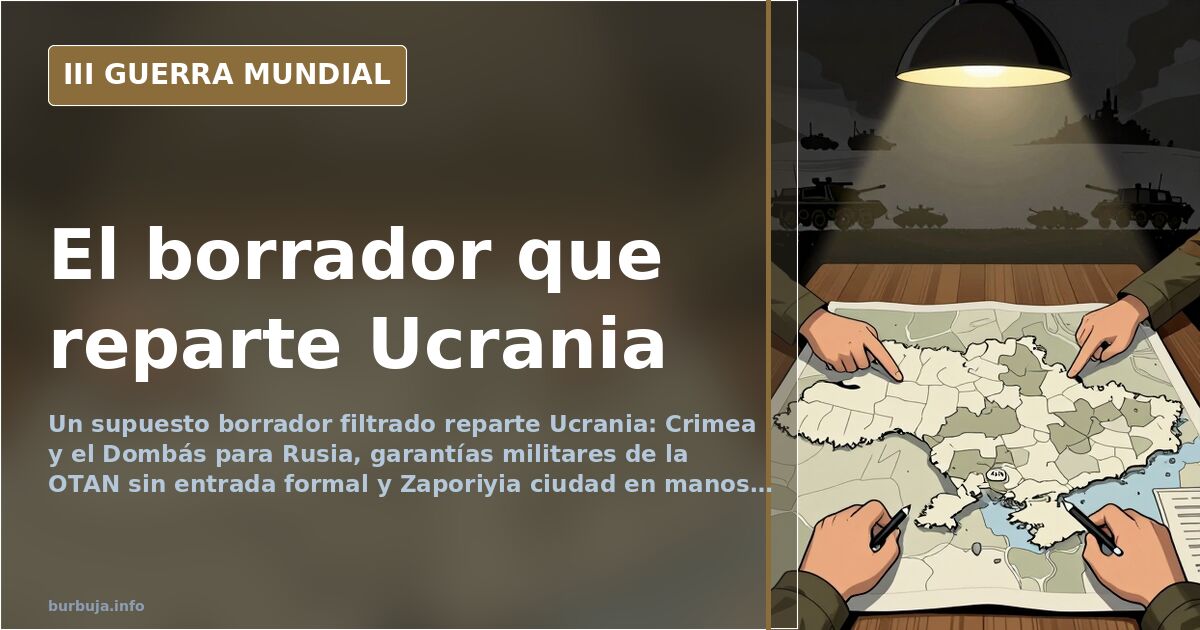
Leaked peace draft divides Ukraine while shielding NATO
A supposed draft agreement is circulating with a specific architecture: Russia retains Crimea, the entire Donbas, and the Kherson and Zaporizhzhia strips it currently controls on the ground; Ukraine keeps the rest of the country and obtains military guarantees from NATO without formal membership, including the right to invoke Article 5 if attacked again. In return, Kyiv would not host allied troops or missiles on its soil. The first dispute arises before discussing substance: whether Zaporizhzhia includes the city. It does not. The city remains in Ukrainian hands, with over half a million inhabitants pre-war, and Russia can only claim what it controls today. The draft is corrected on the fly and remains what it is: an unsigned leak.
Which territories are included and which are not
The partition line is drawn based on actual control maps, not ethnic or historical criteria. Crimea and the complete Donbas fall to the Russian side without discussion. In the south, the ambiguity of Zaporizhzhia requires clarification: the administrative region is not the same as the city, and the city is not under Russian control. The same applies to Kherson, where only the occupied part is conceded. This implicitly recognizes that any future negotiation will start from the front line, not from the borders of 1991 or 2014.
The military guarantee that isn't NATO but resembles it
The mechanism designed for Kyiv is a hybrid: neither formal entry into the Alliance nor abandonment. Ukraine would have the right to activate Article 5 if Russia attacks the territories it has not ceded, but would not host NATO troops or missiles on its soil. For some, this is a strategic victory: Ukraine effectively enters the Atlantic orbit, and Russia suffers severe demographic attrition. For others, it is a patch that leaves the door open to new conflict. The debate over whether this constitutes Ukrainian surrender or covert Russian defeat pervades the analysis.
The human cost no one wants to weigh
A calculation circulates that shifts perspective: Russia has reportedly lost around 300,000 young men, creating a demographic hole in a country with birth rates below replacement level. Daily casualty figures—averaging around 100 dead and 200 irrecoverably wounded per day, with body exchange ratios reaching 10-to-1 or even 15-to-1 in the last year—depict an asymmetric war of attrition. Ukraine, with a smaller population, suffers more. The Ukrainian government resorts to coercive measures to send people to the front. The wear is not symmetrical, but it is not free for Moscow either.
Who wins and who pays for reconstruction
The economic architecture of the draft also faces skeptical readers. A recurring scenario: Ukraine partially joins NATO, Europe pays for reconstruction and rearmament with US material that cannot be used against Russia, and Washington agrees with Moscow on economic cooperation and strategic investments. Europe becomes a dumping ground for goods from half the world while the US, Russia, and China divide the board. The lingering question is whether Germany, most harmed by the break with Russia, will remain a puppet, or if energy and industrial costs will outweigh Atlantic discipline.
The security framework Pilingui wants to reopen
Not all analysis focuses on territorial division. Some argue the Russian goal is not to keep four provinces, but to force a complete redesign of European security: dismantling NATO and the EU as hostile architectures. Without this, any ceasefire would be temporary. The counterargument is that the US will not yield its influence in Europe precisely now that European countries commit to buying defense material from its industry, and that NATO has added Sweden and Finland. The standoff remains open.
The draft, if it exists, resolves nothing: it divides what is already divided by arms, promises guarantees that are not membership, and leaves reconstruction in the hands of those who do not fire. The war could continue for another couple of years. Or not. No one has signed yet.
A supposed draft agreement is circulating with a specific architecture: Russia retains Crimea, the entire Donbas, and the Kherson and Zaporizhzhia strips it currently controls on the ground; Ukraine keeps the rest of the country and obtains military guarantees from NATO without formal membership, including the right to invoke Article 5 if attacked again. In return, Kyiv would not host allied troops or missiles on its soil. The first dispute arises before discussing substance: whether Zaporizhzhia includes the city. It does not. The city remains in Ukrainian hands, with over half a million inhabitants pre-war, and Russia can only claim what it controls today. The draft is corrected on the fly and remains what it is: an unsigned leak.
Which territories are included and which are not
The partition line is drawn based on actual control maps, not ethnic or historical criteria. Crimea and the complete Donbas fall to the Russian side without discussion. In the south, the ambiguity of Zaporizhzhia requires clarification: the administrative region is not the same as the city, and the city is not under Russian control. The same applies to Kherson, where only the occupied part is conceded. This implicitly recognizes that any future negotiation will start from the front line, not from the borders of 1991 or 2014.
The military guarantee that isn't NATO but resembles it
The mechanism designed for Kyiv is a hybrid: neither formal entry into the Alliance nor abandonment. Ukraine would have the right to activate Article 5 if Russia attacks the territories it has not ceded, but would not host NATO troops or missiles on its soil. For some, this is a strategic victory: Ukraine effectively enters the Atlantic orbit, and Russia suffers severe demographic attrition. For others, it is a patch that leaves the door open to new conflict. The debate over whether this constitutes Ukrainian surrender or covert Russian defeat pervades the analysis.
The human cost no one wants to weigh
A calculation circulates that shifts perspective: Russia has reportedly lost around 300,000 young men, creating a demographic hole in a country with birth rates below replacement level. Daily casualty figures—averaging around 100 dead and 200 irrecoverably wounded per day, with body exchange ratios reaching 10-to-1 or even 15-to-1 in the last year—depict an asymmetric war of attrition. Ukraine, with a smaller population, suffers more. The Ukrainian government resorts to coercive measures to send people to the front. The wear is not symmetrical, but it is not free for Moscow either.
Who wins and who pays for reconstruction
The economic architecture of the draft also faces skeptical readers. A recurring scenario: Ukraine partially joins NATO, Europe pays for reconstruction and rearmament with US material that cannot be used against Russia, and Washington agrees with Moscow on economic cooperation and strategic investments. Europe becomes a dumping ground for goods from half the world while the US, Russia, and China divide the board. The lingering question is whether Germany, most harmed by the break with Russia, will remain a puppet, or if energy and industrial costs will outweigh Atlantic discipline.
The security framework Pilingui wants to reopen
Not all analysis focuses on territorial division. Some argue the Russian goal is not to keep four provinces, but to force a complete redesign of European security: dismantling NATO and the EU as hostile architectures. Without this, any ceasefire would be temporary. The counterargument is that the US will not yield its influence in Europe precisely now that European countries commit to buying defense material from its industry, and that NATO has added Sweden and Finland. The standoff remains open.
The draft, if it exists, resolves nothing: it divides what is already divided by arms, promises guarantees that are not membership, and leaves reconstruction in the hands of those who do not fire. The war could continue for another couple of years. Or not. No one has signed yet.
Also available in: Deutsch
Summary of a discussion on Burbuja.info - Foro de economía, actualidad y política., translated from Spanish and reviewed before publication. Read the full discussion (128 replies).
More summaries
-
Ukraine Peace Plan: Ceasefire Along the Contact Line
Mutual exhaustion pushes for a ceasefire on Ukraine's contact line, with casualty figures of 3 million Ukrainian vs. 1 million Russian.
-
Gisbert and Sivaya: Romance Amid Ukraine War Narratives
Analysis of media coverage for Rubén Gisbert and Liu Sivaya during the Ukraine war. Is this digital propaganda or reality?
-
Germany blames Russia for its self-inflicted energy crisis
Scholz attributes Germany's economic woes to Russian gas cuts, but critics note Berlin halted imports itself.
-
Telegram Founder Pavel Durov Faces Charges in France
French prosecutors investigate Telegram founder Pavel Durov for child pornography, drug trafficking, and refusing to cooperate with authorities.
-
Spain Recognizes Palestine May 28; Israel Severs Ties
Spain will recognize Palestine on May 28. Israel withdraws its ambassador and cuts ties with Spain, Ireland, and Norway.
-
Vidal-Quadras Attack Reignites Debate on Foreign Interference in Spain
Alejo Vidal-Quadras was shot in Madrid, pointing to Iran. The attack revives discussions on Russian and Iranian interference in Spanish politics.