
US Air Power: 400 F-15s, 195 F-22s – A Fleet That Stuns
The US fighter jet inventory: 400 F-15s, 500 F-16s, 195 F-22s, plus 2,000 in reserve. Russia's air defense is the counterweight.
English · Original discussion in Spanish · Published
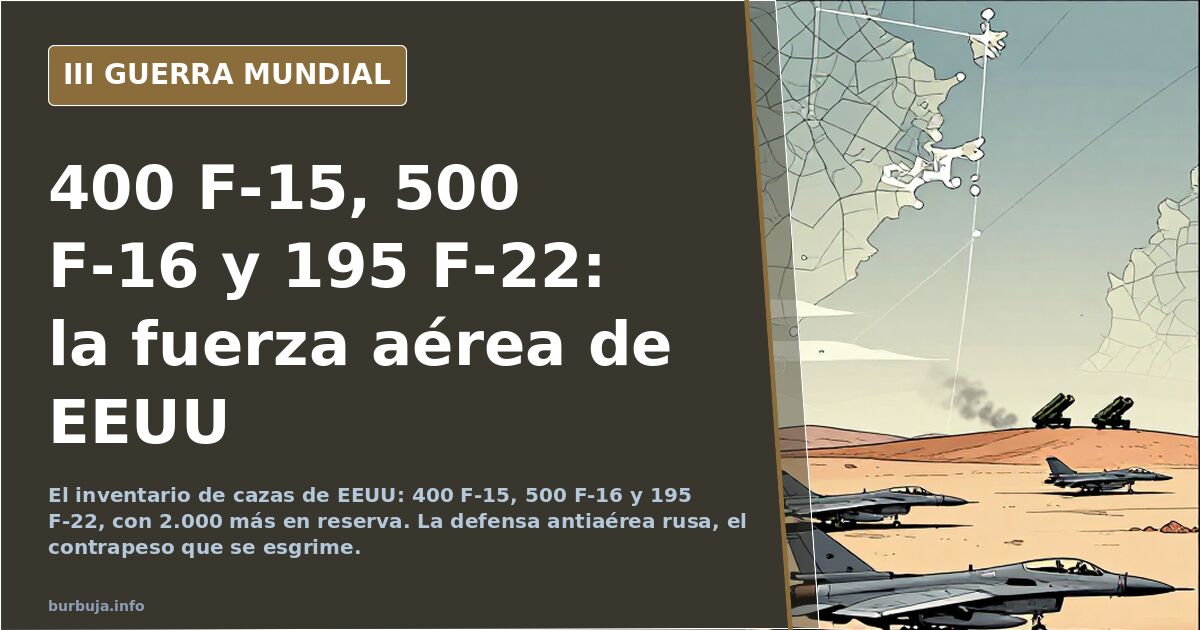
US Air Inventory: 400 F-15s, 500 F-16s, and 195 F-22s
While sixth-generation fighters are still on the drawing board, the current fleet is staggering. It includes 400 F-15 Eagles, 500 F-16s, 470 F-18 Super Hornets, 400 F-35s, and 195 F-22 Raptors, all upgraded to the latest versions. In the Arizona desert, another 2,000 aircraft lie in wait, ready if needed. The clear takeaway is that no other air force globally comes close. However, numbers alone don't win wars.
The Count Isn't Just the Air Force
First, a dose of reality: nearly 500 of those F-18s belong to the Navy, not the Air Force, though they are included in the count as they fly and fight. More importantly, if all military aircraft are considered, the world's second-largest air force isn't Russia's. It's the US Army, trinc by the Navy. Russia ranks further down, and this is without even considering quality, where the gap widens considerably.
Russia claims around 1,200 fighter jets in its inventory. However, the most rigorous assessments suggest fewer than 300 are operational, with half of those being third-generation models that modern industry would no longer consider cutting-edge. Even so, on paper, Moscow would have enough material to mobilize more aircraft than its neighbors would like to see.
Russian Air Defense: The Ace Against Such Numbers
This is where the triumphant narrative falters. Russia doesn't design its air force to conquer other nations' skies but to defend its own with a network of surface-to-air missile battalions. An F-22 is stealthy until it's not: S-400 systems are designed to detect it, and China already possesses equivalent technology. The lingering question is whether NATO could dismantle this network before losing a significant portion of its fleet in the attempt. Nobody knows for sure. And anyone claiming otherwise is lying.
Five Air Forces in One Country: The Problem of Dispersion
Numerical superiority faces an old foe: geography. The United States cannot concentrate its power on a single front due to commitments in Europe, Asia, and the Middle East simultaneously. A historical parallel is the British Empire, which, despite its naval dominance over the Axis powers, had to shuttle forces across oceans throughout World War II. What's in the Atlantic isn't in the Pacific, and what's in the Pacific isn't in the Baltics.
Ukraine: A Failed Test for Russia's Inventory
The war in Ukraine serves as a proving ground for whether these numbers hold up in reality. If Russia's air force were even 30% operational of its theoretical figures, according to the sharpest analyses, Ukraine would no longer have a front line; it would be a mopping-up operation. But it isn't. The continued arrival of Western weapon systems speaks volumes about Moscow's actual capabilities. Lots of inventory, little availability.
$70 Billion vs. A Trillion: The Bill Nobody Shows
The United States accounts for 45% of global military spending. Russia defends itself with about $70 billion annually, roughly one-eleventh of that. Given this disparity, Moscow's real achievement isn't having more fighter jets but maintaining a credible threat on a fraction of the budget. Spain spends less than 2% of its GDP on defense, around 10 billion euros, barely covering salaries, rent, and maintenance. And while a liter of gasoline was around $1.17 in the US, here it cost 2.20 euros. A full breakdown, item by item, would require a lot of calculation.
With the sixth generation in the final stages of development, the technological gap should widen even further in the next decade. It should. Because on paper, the US should have already won any imaginable war. Recent history, from Vietnam to Afghanistan, suggests that possessing the best aircraft and not knowing what to do with them is a deeply ingrained tradition.
While sixth-generation fighters are still on the drawing board, the current fleet is staggering. It includes 400 F-15 Eagles, 500 F-16s, 470 F-18 Super Hornets, 400 F-35s, and 195 F-22 Raptors, all upgraded to the latest versions. In the Arizona desert, another 2,000 aircraft lie in wait, ready if needed. The clear takeaway is that no other air force globally comes close. However, numbers alone don't win wars.
The Count Isn't Just the Air Force
First, a dose of reality: nearly 500 of those F-18s belong to the Navy, not the Air Force, though they are included in the count as they fly and fight. More importantly, if all military aircraft are considered, the world's second-largest air force isn't Russia's. It's the US Army, trinc by the Navy. Russia ranks further down, and this is without even considering quality, where the gap widens considerably.
Russia claims around 1,200 fighter jets in its inventory. However, the most rigorous assessments suggest fewer than 300 are operational, with half of those being third-generation models that modern industry would no longer consider cutting-edge. Even so, on paper, Moscow would have enough material to mobilize more aircraft than its neighbors would like to see.
Russian Air Defense: The Ace Against Such Numbers
This is where the triumphant narrative falters. Russia doesn't design its air force to conquer other nations' skies but to defend its own with a network of surface-to-air missile battalions. An F-22 is stealthy until it's not: S-400 systems are designed to detect it, and China already possesses equivalent technology. The lingering question is whether NATO could dismantle this network before losing a significant portion of its fleet in the attempt. Nobody knows for sure. And anyone claiming otherwise is lying.
Five Air Forces in One Country: The Problem of Dispersion
Numerical superiority faces an old foe: geography. The United States cannot concentrate its power on a single front due to commitments in Europe, Asia, and the Middle East simultaneously. A historical parallel is the British Empire, which, despite its naval dominance over the Axis powers, had to shuttle forces across oceans throughout World War II. What's in the Atlantic isn't in the Pacific, and what's in the Pacific isn't in the Baltics.
Ukraine: A Failed Test for Russia's Inventory
The war in Ukraine serves as a proving ground for whether these numbers hold up in reality. If Russia's air force were even 30% operational of its theoretical figures, according to the sharpest analyses, Ukraine would no longer have a front line; it would be a mopping-up operation. But it isn't. The continued arrival of Western weapon systems speaks volumes about Moscow's actual capabilities. Lots of inventory, little availability.
$70 Billion vs. A Trillion: The Bill Nobody Shows
The United States accounts for 45% of global military spending. Russia defends itself with about $70 billion annually, roughly one-eleventh of that. Given this disparity, Moscow's real achievement isn't having more fighter jets but maintaining a credible threat on a fraction of the budget. Spain spends less than 2% of its GDP on defense, around 10 billion euros, barely covering salaries, rent, and maintenance. And while a liter of gasoline was around $1.17 in the US, here it cost 2.20 euros. A full breakdown, item by item, would require a lot of calculation.
With the sixth generation in the final stages of development, the technological gap should widen even further in the next decade. It should. Because on paper, the US should have already won any imaginable war. Recent history, from Vietnam to Afghanistan, suggests that possessing the best aircraft and not knowing what to do with them is a deeply ingrained tradition.
Summary of a discussion on Burbuja.info - Foro de economía, actualidad y política., translated from Spanish and reviewed before publication. Read the full discussion (156 replies).
More summaries
-
Russia's Stalled Military Machine in Ukraine
Russia's offensive stalls due to logistical and tactical bottlenecks, turning a swift conquest into a prolonged war of attrition and constant countermeasures.
-
Ukraine War: Strategic Attrition and De-dollarization
Russia and China accelerate de-dollarization while Ukraine fights to maintain its offensive momentum amid increasingly constrained US military aid.
-
Ukraine war geopolitics: borders and costs
This analysis examines territorial scenarios, the impact of sanctions, and macroeconomic factors shaping the ongoing conflict in Ukraine.
-
Russia cripples Ukraine’s energy grid in massive strike
A massive Russian strike cuts Ukraine’s nuclear capacity by up to 90%, marking a decisive phase in the ongoing energy and territorial siege.
-
Ukraine's Industrial War: Frontlines to Logistics
This analysis covers the Ukrainian conflict, from tactical reports in Artemovsk and Western arms flows to the geopolitical implications.
-
Ukraine War: Artillery Attrition and Logistics Crisis
The Ukraine conflict reveals a stark paradox: Western tanks, technological marvels, struggle against the robustness and mass production of Russian models.