
US leads Nobel count over Russia, but cultural impact differs
The US holds 400 Nobel Prizes versus Russia's 32, yet figures like Tchaikovsky and Kolmogorov challenge this ranking.
English · Original discussion in Spanish · Published
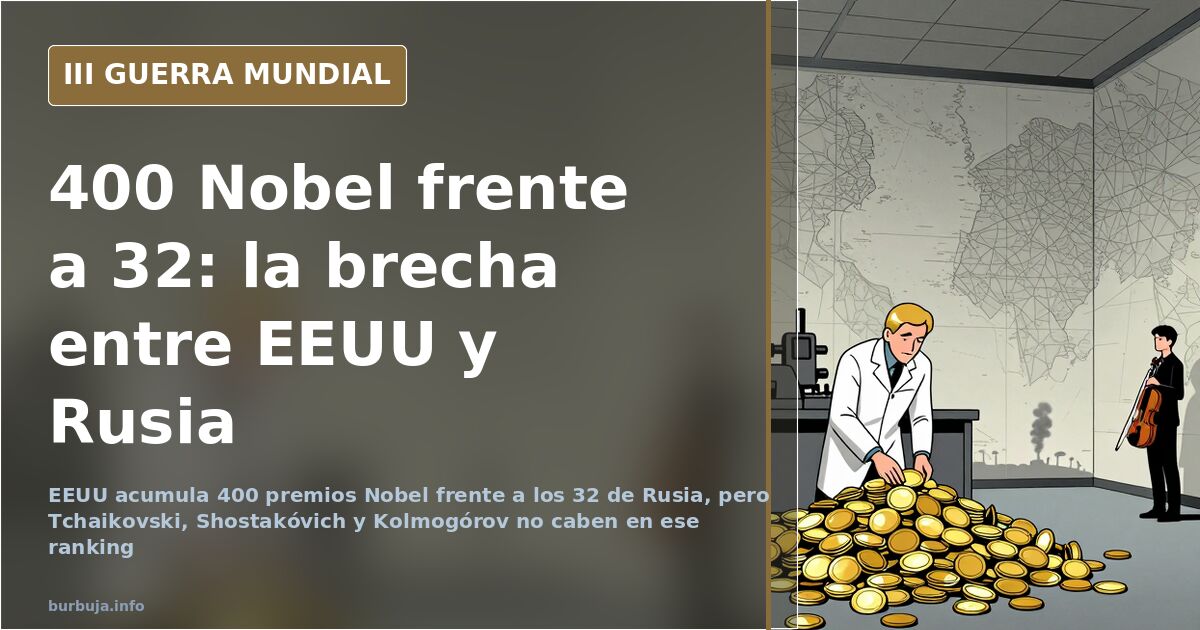
400 Nobels for the US vs. 32 for Russia: What does this metric really measure?
Four hundred Nobel Prizes against thirty-two. This is the most common comparison when assessing the contribution of the US and Russia to humanity, and also the most debated. The tally of laureates between 1901 and 2021 places the US in first place with 400, trinc by the UK (138), Germany (111), France (71), Sweden (32), and Russia (32). More than just numbers are at stake: Tchaikovsky, Shostakovich, Kolmogorov, Sputnik, MIR Publishing House, Bob Dylan, and an uncomfortable question about how much merit is national and how much is imported.
How many Nobel Prizes does each country have?
The list of laureates is the most cited data point to settle the debate, yet it is also the most vulnerable to objections:
The gap is twelve to one. However, the list mixes sciences with literature, economics, and peace—precisely the three categories most frequently questioned. Some argue that the award lost its objectivity decades ago and that the literary prize often goes to dissidents from problematic countries—recalling that Obama also received it. The counter-argument is equally strong: excluding some categories while accepting others is choosing the result before counting.
Tchaikovsky vs. Bob Dylan: The musical clash
Here, consensus breaks down. One side settled the comparison by claiming there is no Russian musician with the talent of Bob Dylan or Glen Campbell, boasting about having studied Rimsky-Korsakov’s treatise in full. The response came as a list: Russia is the home of Tchaikovsky, Rimsky-Korsakov, Stravinsky, and Rachmaninoff, and neither Saint-Saëns, Debussy, Ravel, nor Dukas shared that view of the school.
The technical argument is far more interesting than the patriotic one. It is noted that most American folk and pop music moves in I-IV-V pogre and nearly identical structures, compared to the harmonic variability of classical music—modulations, uncommon scales, mixed meters—and Burt Bacharach is cited as the American composer who can hold his own in that contest. A difficult point remains: the available cultural supply. How many Russian musicians has someone listened to who grew up without Russian in school, without Soviet cinema on TV, and without bookstores offering prices ridiculously low?
As a curiosity, influence flows both ways: someone recounts that listening to Shostakovich’s symphony Leningrad revealed that the freshness of many John Williams leitmotifs came from the Russian composer, and that the Imperial March from Star Wars owes much to Prokofiev.
Who educated Euler: Switzerland or Russia?
Merit becomes awkward when it touches scientists. Euler worked in Russia but was educated in Switzerland and was a disciple of the Bernoullis, who also helped him settle there. The same applies to the US: initially, it attracted talent trained in Europe rather than generating it. The argument that best closes the gap is compelling: scientists develop their work where they are allowed to, and payroll does not determine contribution.
Russia has plenty to boast about. Kolmogorov, father of modern probability theory, and Pavlov, responsible for experimental psychology, are the most repeated names. There is a less-cited detail: Soviet physics and mathematics textbooks were translated into Spanish and are still sold today, with MIR Publishing House being a reference for generations of science students. And Sputnik, the first artificial satellite, comes with the assertion that without that Russian invention, we would not be reading this today.
Is the US a dictatorship-free country for 200 years?
The political block is the most contentious. One current presents the US as the first modern democracy, without a single dictatorship or coup d'état in over two centuries, contrasting this with the portrait of Russian serfdom, which according to that reading lasted until 1870, noting that a Galician in 1240 had more rights than a Russian in 1840. The Decembrist revolt was inspired by the Constitution of Cádiz, making the episode a historical anomaly.
Opposing this is another list: slavery, expulsion of indigenous peoples, mafias that reached banking and politics, and the use of nuclear weapons against civilian populations without declared remorse. Neither list is false, and both fit within the same country. Hence, the discussion makes no pogre.
Literature: Crime and Punishment vs. everything else
In letters, the comparison is framed in terms of density: some claim that a single 19th-century Russian novel condenses more depth than all American narrative combined. The other side is Soviet constraint, with Nabokov describing the USSR novel as false, repetitive, and predictable due to ideological mandate. A data point cited by a participant to measure cultural weight: Don Quixote was mandatory reading in Soviet high schools.
The underlying problem is that there is no shared metric. Culture is subjective by definition, the Nobel Prize is debatable, and no one has yet decided whether merit travels with the scientist or with whoever pays their salary. With that foundation, the question will remain open.
Four hundred Nobel Prizes against thirty-two. This is the most common comparison when assessing the contribution of the US and Russia to humanity, and also the most debated. The tally of laureates between 1901 and 2021 places the US in first place with 400, trinc by the UK (138), Germany (111), France (71), Sweden (32), and Russia (32). More than just numbers are at stake: Tchaikovsky, Shostakovich, Kolmogorov, Sputnik, MIR Publishing House, Bob Dylan, and an uncomfortable question about how much merit is national and how much is imported.
How many Nobel Prizes does each country have?
The list of laureates is the most cited data point to settle the debate, yet it is also the most vulnerable to objections:
- United States — 400
- United Kingdom — 138
- Germany — 111
- France — 71
- Sweden — 32
- Russia — 32
The gap is twelve to one. However, the list mixes sciences with literature, economics, and peace—precisely the three categories most frequently questioned. Some argue that the award lost its objectivity decades ago and that the literary prize often goes to dissidents from problematic countries—recalling that Obama also received it. The counter-argument is equally strong: excluding some categories while accepting others is choosing the result before counting.
Tchaikovsky vs. Bob Dylan: The musical clash
Here, consensus breaks down. One side settled the comparison by claiming there is no Russian musician with the talent of Bob Dylan or Glen Campbell, boasting about having studied Rimsky-Korsakov’s treatise in full. The response came as a list: Russia is the home of Tchaikovsky, Rimsky-Korsakov, Stravinsky, and Rachmaninoff, and neither Saint-Saëns, Debussy, Ravel, nor Dukas shared that view of the school.
The technical argument is far more interesting than the patriotic one. It is noted that most American folk and pop music moves in I-IV-V pogre and nearly identical structures, compared to the harmonic variability of classical music—modulations, uncommon scales, mixed meters—and Burt Bacharach is cited as the American composer who can hold his own in that contest. A difficult point remains: the available cultural supply. How many Russian musicians has someone listened to who grew up without Russian in school, without Soviet cinema on TV, and without bookstores offering prices ridiculously low?
As a curiosity, influence flows both ways: someone recounts that listening to Shostakovich’s symphony Leningrad revealed that the freshness of many John Williams leitmotifs came from the Russian composer, and that the Imperial March from Star Wars owes much to Prokofiev.
Who educated Euler: Switzerland or Russia?
Merit becomes awkward when it touches scientists. Euler worked in Russia but was educated in Switzerland and was a disciple of the Bernoullis, who also helped him settle there. The same applies to the US: initially, it attracted talent trained in Europe rather than generating it. The argument that best closes the gap is compelling: scientists develop their work where they are allowed to, and payroll does not determine contribution.
Russia has plenty to boast about. Kolmogorov, father of modern probability theory, and Pavlov, responsible for experimental psychology, are the most repeated names. There is a less-cited detail: Soviet physics and mathematics textbooks were translated into Spanish and are still sold today, with MIR Publishing House being a reference for generations of science students. And Sputnik, the first artificial satellite, comes with the assertion that without that Russian invention, we would not be reading this today.
Is the US a dictatorship-free country for 200 years?
The political block is the most contentious. One current presents the US as the first modern democracy, without a single dictatorship or coup d'état in over two centuries, contrasting this with the portrait of Russian serfdom, which according to that reading lasted until 1870, noting that a Galician in 1240 had more rights than a Russian in 1840. The Decembrist revolt was inspired by the Constitution of Cádiz, making the episode a historical anomaly.
Opposing this is another list: slavery, expulsion of indigenous peoples, mafias that reached banking and politics, and the use of nuclear weapons against civilian populations without declared remorse. Neither list is false, and both fit within the same country. Hence, the discussion makes no pogre.
Literature: Crime and Punishment vs. everything else
In letters, the comparison is framed in terms of density: some claim that a single 19th-century Russian novel condenses more depth than all American narrative combined. The other side is Soviet constraint, with Nabokov describing the USSR novel as false, repetitive, and predictable due to ideological mandate. A data point cited by a participant to measure cultural weight: Don Quixote was mandatory reading in Soviet high schools.
The underlying problem is that there is no shared metric. Culture is subjective by definition, the Nobel Prize is debatable, and no one has yet decided whether merit travels with the scientist or with whoever pays their salary. With that foundation, the question will remain open.
Also available in: Deutsch
Summary of a discussion on Burbuja.info - Foro de economía, actualidad y política., translated from Spanish and reviewed before publication. Read the full discussion (111 replies).
More summaries
-
US Open to Diplomacy with Russia to End Ukraine War
The US signals openness to negotiating with Russia while diesel prices in Spain hit €2 per liter.
-
Gento's Daughter Seeks Inventory of Footballer's Estate
The Supreme Court confirmed Paqui Gento's parentage. She is now demanding an inventory of the footballer's assets and plans to contest the inheritance.
-
Russia repopulates Donbas with housing and salaries
Russia is resettling its poorest citizens in the Donbas with homes and wages, while Ukrainians face a choice between Russian passports or exile.
-
China promoting Spanish as global lingua franca: A 2018 report
Claims that China is pushing Spanish as its imperial language stem from a 2018 news item about Latin America's 700 million speakers.
-
Brazilian Ex-Model Killed in Kharkiv, Dubbed Elite Sniper
Thalita do Valle died in a Kharkiv bunker hit by bombing. Her alleged role as an elite sniper faces skepticism.
-
Russia's Nuclear Threats Face Skepticism Even Among Allies
After a key ship sank, Moscow raises nuclear stakes while NATO arms Ukraine. The conflict's end remains unclear.