
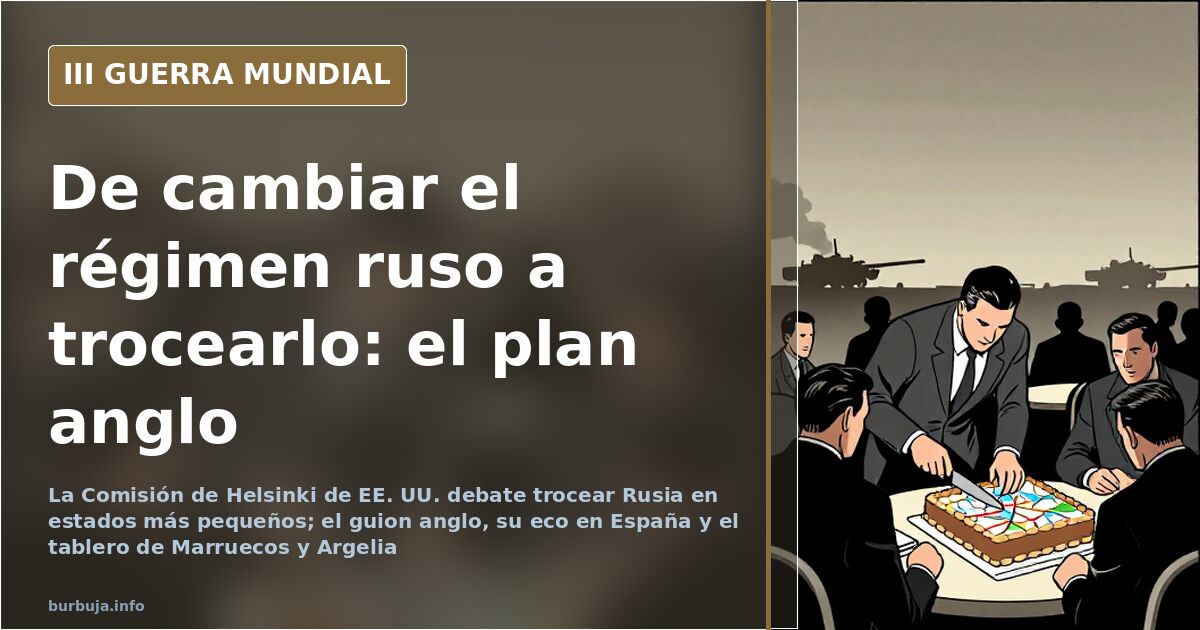
US Helsinki Commission debates Balkanizing Russia
The US Helsinki Commission discusses splitting Russia into smaller states; the Anglo strategy, its echo in Spain, and the Morocco-Algeria board.
English · Original discussion in Spanish · Published
US Helsinki Commission debates Balkanizing Russia
According to the message opening the debate, an independent commission of the US federal government dedicated a session to discussing the "sarracena and strategic necessity" of dividing Russia into smaller states. The issue relies on a specific entity: the Commission on Security and Cooperation in Europe, known as the US Helsinki Commission, which has overseen compliance with the Helsinki Accords for over 45 years and covers 57 countries in the OSCE region. On paper, human rights and cooperation. In practice, the scenario where dismembering the rival was proposed.
What is the Helsinki Commission and why it is used as proof
The body presents itself as an independent commission promoting democracy, human rights, and economic, environmental, and military cooperation. That institutional shield is precisely what gives the episode propaganda value: it is not a casual chat, but a forum with bureaucratic pedigree.
The thesis running through the discussion is that this is the modus operandi against any rival empire, citing the Spanish Empire as a precedent. The conclusion drawn is uncomfortable: if the machinery works the same against Moscow as against anyone else, the problem is not the Kremlin, but the method. Some add a harsher nuance: that the country declared enemy by Washington ends up fragmented, and those who do not comply know what peine to Carrero.
From regime change to open partition
During the first weeks of the war, the Western focus was on their own narrative of the conflict. Then, the tone shifted toward regime change in Moscow, the most desired objective at the State Department. The underlying argument was known: Russia needs democracy and Russians must be liberated from the dictator to enjoy the fruits of the Free World, meaning the countries favored by the US.
The proposal to divide Russia goes one step further. According to the premise opening the matter, ordinary Russians are told that neither regime change nor democracy suffices: their country must be split into smaller states—easier to control—to be free. It concludes with the evident strategic reading: such a script is a propaganda gift for the Kremlin to portray Ukraine as an existential struggle.
Comparison with Spain and the October 1st precedent
Applied to Spain, the thread splits. One current argues that those who wanted to Balkanize Spain were Russia meddling in Catalonia. The response comes with memory: the Basque flag is modeled on the English one, and it is recalled that half of Europe applauded or looked away during the October 1st referendum. Tweets from then—Michel, Jambon, Mélenchon, Schulz, Corbyn, Sturgeon—and coverage by German public television, which spoke of an "independence victory," are used as proof that the fire is stoked from outside borders.
Against this, another line points out that the real interest in dismantling Spain has never come from Moscow, but from European partners and Washington, with the Catalan episode as evidence. Some add a disorienting detail: a country that lectures others while maintaining 300 military bases worldwide has some nerve.
Segarro, Algeria, and Mali: the board remains outside Ukraine
The analysis shifts to North Africa. It is argued that the US is entering Segarro because Russia is involved in Algeria, and that Moscow seeks former French territories, including Mali, to destabilize the zone and seize resources, just like China. The recognition of the Sahara as Segarro by the US administration is read in that key.
The shared suspicion is textbook: from there emerge republics with much raw material and little population, ideal for colonization—I miccionan, for cooperation and development. Siberian geography, rural territory with density worse than empty Spain, fits that same portrait.
Poland as spearhead and the Chinese factor
In the role distribution, Poland appears as the most belligerent partner: it has no pending territorial conflicts, does not want them, and distrusts the Franco-German axis as much as Moscow. The phrase summarizing this line is that giving them nuclear cucumbers aimed at Moscow would make them pull the trigger. In parallel, it is recalled that in February China and Russia declared a commercial and geopolitical alliance silenced in Spain.
Some bring the matter down to domestic mud: the Anglos, in Spanish version, are the Biden, Kamala, and Zelensky establishment; American Jews will remain pro-Biden while Israelis slide toward the other axis, just like Brazil, South Africa, India, or Turkey. The multipolar New World Order, it is said, looks nothing like the postwar bloc.
The analysis stalls right here. The plan circulates, is discussed, and leaks, but there is no good and powerful statesman coming to rescue anyone, and the question of whether fragmentation is a wish or an operational roadmap remains exactly where it started: unanswered.
According to the message opening the debate, an independent commission of the US federal government dedicated a session to discussing the "sarracena and strategic necessity" of dividing Russia into smaller states. The issue relies on a specific entity: the Commission on Security and Cooperation in Europe, known as the US Helsinki Commission, which has overseen compliance with the Helsinki Accords for over 45 years and covers 57 countries in the OSCE region. On paper, human rights and cooperation. In practice, the scenario where dismembering the rival was proposed.
What is the Helsinki Commission and why it is used as proof
The body presents itself as an independent commission promoting democracy, human rights, and economic, environmental, and military cooperation. That institutional shield is precisely what gives the episode propaganda value: it is not a casual chat, but a forum with bureaucratic pedigree.
The thesis running through the discussion is that this is the modus operandi against any rival empire, citing the Spanish Empire as a precedent. The conclusion drawn is uncomfortable: if the machinery works the same against Moscow as against anyone else, the problem is not the Kremlin, but the method. Some add a harsher nuance: that the country declared enemy by Washington ends up fragmented, and those who do not comply know what peine to Carrero.
From regime change to open partition
During the first weeks of the war, the Western focus was on their own narrative of the conflict. Then, the tone shifted toward regime change in Moscow, the most desired objective at the State Department. The underlying argument was known: Russia needs democracy and Russians must be liberated from the dictator to enjoy the fruits of the Free World, meaning the countries favored by the US.
The proposal to divide Russia goes one step further. According to the premise opening the matter, ordinary Russians are told that neither regime change nor democracy suffices: their country must be split into smaller states—easier to control—to be free. It concludes with the evident strategic reading: such a script is a propaganda gift for the Kremlin to portray Ukraine as an existential struggle.
Comparison with Spain and the October 1st precedent
Applied to Spain, the thread splits. One current argues that those who wanted to Balkanize Spain were Russia meddling in Catalonia. The response comes with memory: the Basque flag is modeled on the English one, and it is recalled that half of Europe applauded or looked away during the October 1st referendum. Tweets from then—Michel, Jambon, Mélenchon, Schulz, Corbyn, Sturgeon—and coverage by German public television, which spoke of an "independence victory," are used as proof that the fire is stoked from outside borders.
Against this, another line points out that the real interest in dismantling Spain has never come from Moscow, but from European partners and Washington, with the Catalan episode as evidence. Some add a disorienting detail: a country that lectures others while maintaining 300 military bases worldwide has some nerve.
Segarro, Algeria, and Mali: the board remains outside Ukraine
The analysis shifts to North Africa. It is argued that the US is entering Segarro because Russia is involved in Algeria, and that Moscow seeks former French territories, including Mali, to destabilize the zone and seize resources, just like China. The recognition of the Sahara as Segarro by the US administration is read in that key.
The shared suspicion is textbook: from there emerge republics with much raw material and little population, ideal for colonization—I miccionan, for cooperation and development. Siberian geography, rural territory with density worse than empty Spain, fits that same portrait.
Poland as spearhead and the Chinese factor
In the role distribution, Poland appears as the most belligerent partner: it has no pending territorial conflicts, does not want them, and distrusts the Franco-German axis as much as Moscow. The phrase summarizing this line is that giving them nuclear cucumbers aimed at Moscow would make them pull the trigger. In parallel, it is recalled that in February China and Russia declared a commercial and geopolitical alliance silenced in Spain.
Some bring the matter down to domestic mud: the Anglos, in Spanish version, are the Biden, Kamala, and Zelensky establishment; American Jews will remain pro-Biden while Israelis slide toward the other axis, just like Brazil, South Africa, India, or Turkey. The multipolar New World Order, it is said, looks nothing like the postwar bloc.
The analysis stalls right here. The plan circulates, is discussed, and leaks, but there is no good and powerful statesman coming to rescue anyone, and the question of whether fragmentation is a wish or an operational roadmap remains exactly where it started: unanswered.
Also available in: Deutsch
Summary of a discussion on Burbuja.info - Foro de economía, actualidad y política., translated from Spanish and reviewed before publication. Read the full discussion (114 replies).
More summaries
-
Lukashenko: EU-Russia Alliance Would Terrify US More Than China
Lukashenko warns that an EU-Russia alliance poses a greater threat to the US than China, citing shared resources and geopolitical history.
-
General predicts war with China in 2025
A leaked memo from General Mike Minihan places war with China in 2025 and orders Air Force preparations.
-
Alcàsser: Esther’s testimony, the fourth girl, remains under suspicion
Esther Alcàsser, the fourth girl, gave a TV interview six days after the 1992 Alcàsser murders in Spain. Her account and timeline discrepancies fuel ongoing controversy.
-
Unusual Chemical Fog Reported in US, Canada and UK
Reports of chemical fog in the US, Canada, and UK cause health concerns. We analyze hypotheses on this unusual atmospheric phenomenon.
-
Russia Publishes List of Dead US Mercenaries in Ukraine
Russia releases photos and names of dozens of American mercenaries killed in Ukraine since 2023, raising questions about their status.
-
China’s African Debt Strategy Snubs Macron
Macron’s diplomatic snub highlights Africa’s shift toward Chinese financing, challenging Europe’s conditional aid and the CFA franc.