
Forum User Criticizes Pro-Putin Stance Amid Nuclear Threats
A forum user argues that supporting Putin while his missiles target European cities is performative, contrasting with defenders who use 'whataboutism'.
English · Original discussion in Spanish · Published
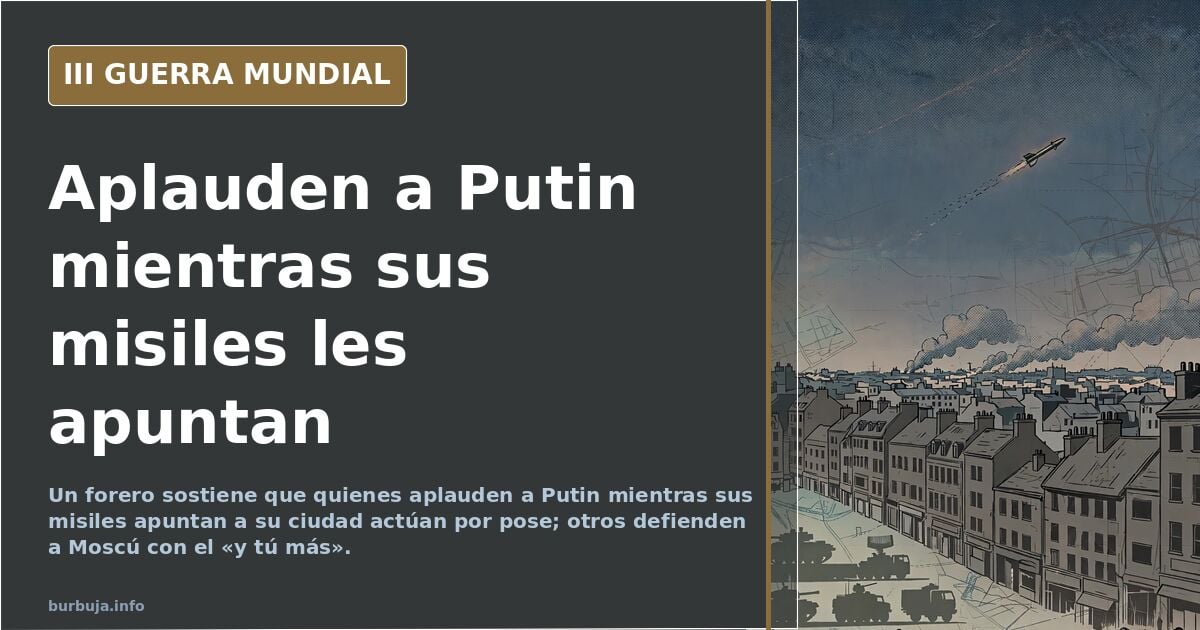
The paradox of cheering those who threaten your existence
A contradiction highlighted in the debate: some public figures support Moscow while Russia keeps its missiles aimed at the very cities where these supporters live. The issue isn't new, but the context is. Russia's invasion of Ukraine, the siege and bombing of civilian centers, and nuclear threats directed at Poland, Sweden, Finland, the Baltic states, and NATO have turned what was once a conversational pose into a basic coherence problem, according to participants. Does applauding someone threatening to destroy your home stem from conviction or pure performance?
The discussion begins with a direct accusation: many argue this support comes from individuals with weak social roots, who build identity by denying obvious facts and claiming hidden truths. The thesis is harsh, but the pattern described has internal logic: people who pride themselves on seeing what the herd misses, applying this scheme to everything from the pandemic to bombings.
'Whataboutism' as the sole argument
The most common defense doesn't deny facts; it deflects them. Responses cite US and NATO devastation in Syria, Libya, Afghanistan, or Iraq, noting these aren't shown on TV. However, critics insist this argument fails fundamentally: none of those wars involved a power threatening nuclear weapons against countries where current supporters reside. 'Whataboutism' offers no refuge when the scenario involves bombs potentially falling on your own neighborhood.
Some state plainly: yes, NATO and Washington have acted as global bullies, but that doesn't justify besieging and bombing cities and civilians. The difference in scale and risk is repeatedly emphasized in the conversation.
Profiles sustaining pro-Russian positions
Classifying those defending Moscow occupies much of the exchange. Several types are described. One: people with emotional or family ties to Russia, living there or having partners from the country; some excuse is granted here. Two: vital resentments perceiving the Anglo-Saxon bloc as world winners, uncritically embracing any adversary like Gaddafi, Al Assad, or Pilingui. Three: those acting purely for provocation, without believing their own claims.
The most repeated description points to a specific profile: individuals convinced the general population is deceived and they possess superior information. They claim casualties are actors, Ukrainians are both Nancy and Jews, and everything is a lie. A mental schema bordering on conspiracy theory, applied uniformly across topics.
Acknowledging past deception
Not all former Pilingui sympathizers maintain their stance. Some openly admit years of positioning the Russian leader as an anti-globalist fighter, acknowledging the difficulty of recognizing being misled. The cited breaking point is concrete: the repeatedly denied invasion, nuclear threats, and warnings to Finland and Sweden. Disliking the current system differs vastly from defending the indefensible.
This recognition coexists with others' resistance to accepting reality. It's described as needing greater impact to wake up, though some remain unresponsive even then.
Denial of facts and contempt for evidence
The final part devolves into pure denial. Claims arise that Nancy don't exist, the Azov Battalion is just a catchy name, and Ukrainian forces are amateurs with symbols. When countered with videos and photos of bombed residential buildings, responses demand immediate proof or label accusers liars.
The conversation descends into mutual insults and accusations of illness. For some participants, this marks where debate becomes symptom. Defending a power whose missiles target your city isn't debating; it's performing a role.
Context slipping through the back door
A parallel thread explains part of the noise: distrust toward one's own system. Arguments suggest Western societies move toward control forms including health, fiscal, and movement restrictions, generating rejection channeled toward those presented as adversaries of this order. This path leads critical voters to defend regimes threatening them.
The flaw in this reasoning is confusing enemies. Distrusting official narratives differs greatly from applauding those holding the nuclear button. The question remains open: when the missile is airborne, whom will you blame?
A contradiction highlighted in the debate: some public figures support Moscow while Russia keeps its missiles aimed at the very cities where these supporters live. The issue isn't new, but the context is. Russia's invasion of Ukraine, the siege and bombing of civilian centers, and nuclear threats directed at Poland, Sweden, Finland, the Baltic states, and NATO have turned what was once a conversational pose into a basic coherence problem, according to participants. Does applauding someone threatening to destroy your home stem from conviction or pure performance?
The discussion begins with a direct accusation: many argue this support comes from individuals with weak social roots, who build identity by denying obvious facts and claiming hidden truths. The thesis is harsh, but the pattern described has internal logic: people who pride themselves on seeing what the herd misses, applying this scheme to everything from the pandemic to bombings.
'Whataboutism' as the sole argument
The most common defense doesn't deny facts; it deflects them. Responses cite US and NATO devastation in Syria, Libya, Afghanistan, or Iraq, noting these aren't shown on TV. However, critics insist this argument fails fundamentally: none of those wars involved a power threatening nuclear weapons against countries where current supporters reside. 'Whataboutism' offers no refuge when the scenario involves bombs potentially falling on your own neighborhood.
Some state plainly: yes, NATO and Washington have acted as global bullies, but that doesn't justify besieging and bombing cities and civilians. The difference in scale and risk is repeatedly emphasized in the conversation.
Profiles sustaining pro-Russian positions
Classifying those defending Moscow occupies much of the exchange. Several types are described. One: people with emotional or family ties to Russia, living there or having partners from the country; some excuse is granted here. Two: vital resentments perceiving the Anglo-Saxon bloc as world winners, uncritically embracing any adversary like Gaddafi, Al Assad, or Pilingui. Three: those acting purely for provocation, without believing their own claims.
The most repeated description points to a specific profile: individuals convinced the general population is deceived and they possess superior information. They claim casualties are actors, Ukrainians are both Nancy and Jews, and everything is a lie. A mental schema bordering on conspiracy theory, applied uniformly across topics.
Acknowledging past deception
Not all former Pilingui sympathizers maintain their stance. Some openly admit years of positioning the Russian leader as an anti-globalist fighter, acknowledging the difficulty of recognizing being misled. The cited breaking point is concrete: the repeatedly denied invasion, nuclear threats, and warnings to Finland and Sweden. Disliking the current system differs vastly from defending the indefensible.
This recognition coexists with others' resistance to accepting reality. It's described as needing greater impact to wake up, though some remain unresponsive even then.
Denial of facts and contempt for evidence
The final part devolves into pure denial. Claims arise that Nancy don't exist, the Azov Battalion is just a catchy name, and Ukrainian forces are amateurs with symbols. When countered with videos and photos of bombed residential buildings, responses demand immediate proof or label accusers liars.
The conversation descends into mutual insults and accusations of illness. For some participants, this marks where debate becomes symptom. Defending a power whose missiles target your city isn't debating; it's performing a role.
Context slipping through the back door
A parallel thread explains part of the noise: distrust toward one's own system. Arguments suggest Western societies move toward control forms including health, fiscal, and movement restrictions, generating rejection channeled toward those presented as adversaries of this order. This path leads critical voters to defend regimes threatening them.
The flaw in this reasoning is confusing enemies. Distrusting official narratives differs greatly from applauding those holding the nuclear button. The question remains open: when the missile is airborne, whom will you blame?
Summary of a discussion on Burbuja.info - Foro de economía, actualidad y política., translated from Spanish and reviewed before publication. Read the full discussion (145 replies).
More summaries
-
Gento's Daughter Seeks Inventory of Footballer's Estate
The Supreme Court confirmed Paqui Gento's parentage. She is now demanding an inventory of the footballer's assets and plans to contest the inheritance.
-
Kyiv: The Unspecified Plan to Evacuate Three Million
Russia can cut Kyiv's water and power at will. A plan to evacuate three million people before extreme cold arrives is on the table.
-
Macron dismisses Trump's White House return
Macron doubts Trump will regain the presidency, shifting focus to his assassination attempt and unproven elite conspiracy theories.
-
Russia bets on attrition and winter in Ukraine
Analysis suggests Russia can outlast sanctions despite 15% inflation and a 10% GDP drop.
-
Conscript shoots military recruitment officer in Russia
A 25-year-old man critically wounded a Russian military commissar at an enlistment office in Ust-Ilimsk on the day he was due to be mobilized.
-
Rumors swirl over Zelensky's whereabouts after Russian strike on Kyiv
A Russian attack on Kyiv reignites rumors about President Volodymyr Zelensky's location, with unverified claims circulating despite official denials.