
US and UK Product Boycott Divides Europe
A consumer boycott of US and UK products is gaining traction in Europe. Is it effective or symbolic? An analysis of the proposal and its alternatives.
English · Original discussion in Spanish · Published
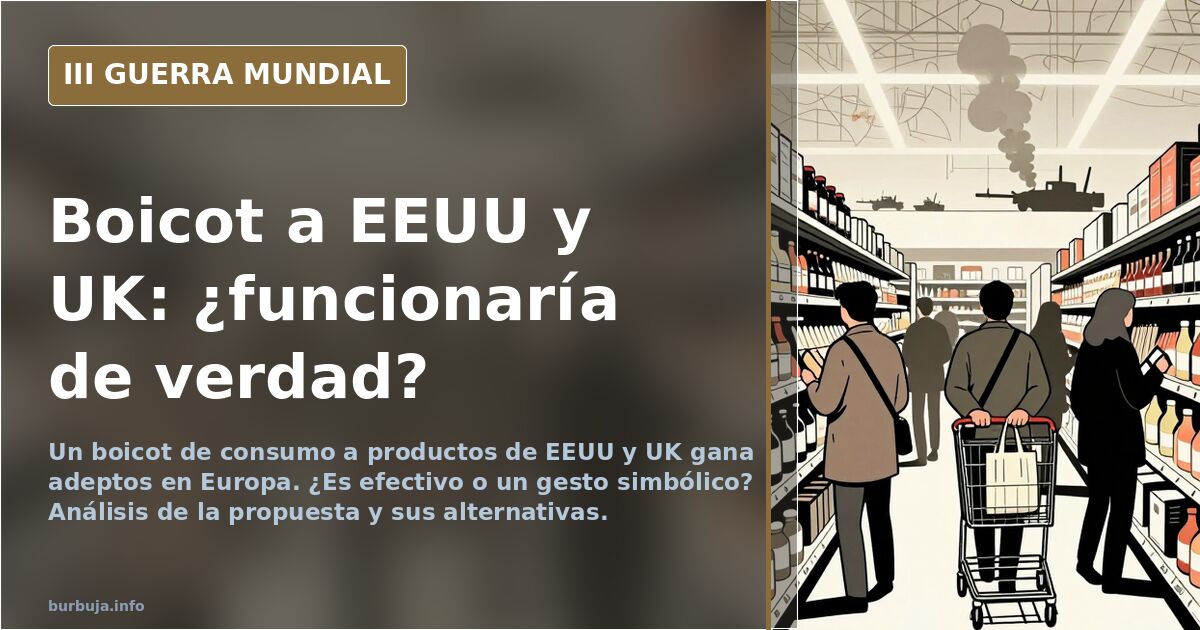
Commercial Boycott of US and UK: The Protest Spreading Across Europe
A European citizen wakes up one morning, looks at their electricity bill, and decides they have had enough. They will no longer refuel at BP. They will not buy another Apple phone. McDonald's, Burger King, Coca-Cola, Netflix, Amazon: all out. According to their own account, the trigger is the sabotage of the Nord Stream pipelines and the subsequent economic demolition that, they argue, is dragging down Germany and, with it, the rest of the eurozone. The proposal, launched on a political discussion forum, has generated 145 replies and a debate that goes far beyond initial anger.
The central idea is simple: if you cannot bomb, you boycott. Disrupting the trade balance of the US and the UK by refusing to consume their products. The initial message does not mince words: it calls for avoiding BP gas stations, steering clear of American car brands, and ditching Apple, McDonald's, Burger King, Coca-Cola, Netflix, and Amazon. It even extends the boycott to pharmaceuticals and vaccines, using language that borders on conspiracy theory, which this article does not endorse.
Which US and British Products Can Be Boycotted in Europe?
The circulating list is extensive: from BP gas stations to Apple phones, including major fast-food chains and streaming platforms. The argument is that every euro spent on these products fattens the trade balance of countries that, according to this movement, are economically strangling the continent. The proposal is not new: consumer boycotts have historically been a tool of political pressure, although their real effectiveness depends on the critical mass willing to support them.
On the opposite side, some point out that doing without these products is not so simple. One participant notes that "even if we want to, we can't": the integration of global supply chains means many European products depend on US components or software. Another adds that economic interests with the US are too large to ignore and that millions would lose their jobs if those ties were broken.
European and Asian Alternatives: Huawei, Xiaomi, Linux, and More
The conversation quickly turns to concrete alternatives. Huawei computers, Xiaomi phones, switching from Windows to Linux, and dropping Google, Facebook, Instagram, and Twitter are mentioned. Someone goes further, proposing learning Russian and Chinese, watching Chinese and Russian films, turning off the TV, and even painting Z symbols in the streets. In some cases, the drift becomes caricatured.
The debate over mobile phones is particularly practical. There is discussion about the difficulty of finding phones that allow installing alternative operating systems without the Google layer. Projects like GrapheneOS are mentioned, though the paradox is that the officially supported devices are Google Pixels. Another option that emerges is Murena, which sells phones with alternative Android. For search engines, SearXNG is recommended, a metasearch engine that aggregates results from other search engines without storing user information. Although, as one participant points out, this does not eliminate the US element entirely: links still come from Google or Bing.
Boycotting US Products: Does It Work or Is It Just Symbolic?
The effectiveness of the boycott is the most divisive point. Some argue that without critical mass it is useless, that most people continue to reproduce what television says. Others suggest society is too dormant and that any attempt at organization clashes with general indifference.
The question also arises whether the boycott should extend to other countries. Someone proposes including Australia within the AUKUS framework. And there are those who defend that the boycott should focus on high-quality German and European products, although the problem is that German industry depends on Russian gas that no longer arrives. The paradox is evident: the desire is to boycott the US and UK, but European alternatives are also in crisis.
Germany's Role and Europe's Energy Dependence
The situation in Germany is the backdrop of the entire debate. German industry, Europe's engine, faces skyrocketing energy costs after the cut-off of Russian gas. The initial message attributes this directly to the Nord Stream sabotage, although the authorship remains disputed and unresolved. What is certain is that Russian gas no longer flows to Germany via those routes and that this has had severe economic consequences.
In this context, some participants note that boycotting US and British products is a form of political pressure, but they also acknowledge that Europe's technological and financial dependence on the US is enormous. The lingering question is whether a consumer boycott can really change anything or if it is just venting.
European Society: Exhausted or Asleep?
The tone of the debate reflects a deeper malaise. Some claim society is finished, that there is nothing to do, and that it is best to let it die to start from scratch. Others, however, maintain that the situation is reversible if people wake up and stop consuming products from certain countries. The discussion shifts to broader topics: the role of the EU, national sovereignty, and media influence.
One participant summarizes the general sentiment: "There is no critical mass; everyone is clapping and blaming Pilingui." The sense of helplessness is palpable, but so is the determination of some to change their consumption habits, even on a small scale.
In the end, the floating question is whether a consumer boycott can have any real effect on the economies of the US and the UK. Available data do not allow for a definitive answer. What is certain is that the conversation about European dependence and alternatives to Anglo-Saxon product consumption is here to stay. And that, in a context of energy crisis and geopolitical tensions, every gesture counts, however small.
A European citizen wakes up one morning, looks at their electricity bill, and decides they have had enough. They will no longer refuel at BP. They will not buy another Apple phone. McDonald's, Burger King, Coca-Cola, Netflix, Amazon: all out. According to their own account, the trigger is the sabotage of the Nord Stream pipelines and the subsequent economic demolition that, they argue, is dragging down Germany and, with it, the rest of the eurozone. The proposal, launched on a political discussion forum, has generated 145 replies and a debate that goes far beyond initial anger.
The central idea is simple: if you cannot bomb, you boycott. Disrupting the trade balance of the US and the UK by refusing to consume their products. The initial message does not mince words: it calls for avoiding BP gas stations, steering clear of American car brands, and ditching Apple, McDonald's, Burger King, Coca-Cola, Netflix, and Amazon. It even extends the boycott to pharmaceuticals and vaccines, using language that borders on conspiracy theory, which this article does not endorse.
Which US and British Products Can Be Boycotted in Europe?
The circulating list is extensive: from BP gas stations to Apple phones, including major fast-food chains and streaming platforms. The argument is that every euro spent on these products fattens the trade balance of countries that, according to this movement, are economically strangling the continent. The proposal is not new: consumer boycotts have historically been a tool of political pressure, although their real effectiveness depends on the critical mass willing to support them.
On the opposite side, some point out that doing without these products is not so simple. One participant notes that "even if we want to, we can't": the integration of global supply chains means many European products depend on US components or software. Another adds that economic interests with the US are too large to ignore and that millions would lose their jobs if those ties were broken.
European and Asian Alternatives: Huawei, Xiaomi, Linux, and More
The conversation quickly turns to concrete alternatives. Huawei computers, Xiaomi phones, switching from Windows to Linux, and dropping Google, Facebook, Instagram, and Twitter are mentioned. Someone goes further, proposing learning Russian and Chinese, watching Chinese and Russian films, turning off the TV, and even painting Z symbols in the streets. In some cases, the drift becomes caricatured.
The debate over mobile phones is particularly practical. There is discussion about the difficulty of finding phones that allow installing alternative operating systems without the Google layer. Projects like GrapheneOS are mentioned, though the paradox is that the officially supported devices are Google Pixels. Another option that emerges is Murena, which sells phones with alternative Android. For search engines, SearXNG is recommended, a metasearch engine that aggregates results from other search engines without storing user information. Although, as one participant points out, this does not eliminate the US element entirely: links still come from Google or Bing.
Boycotting US Products: Does It Work or Is It Just Symbolic?
The effectiveness of the boycott is the most divisive point. Some argue that without critical mass it is useless, that most people continue to reproduce what television says. Others suggest society is too dormant and that any attempt at organization clashes with general indifference.
The question also arises whether the boycott should extend to other countries. Someone proposes including Australia within the AUKUS framework. And there are those who defend that the boycott should focus on high-quality German and European products, although the problem is that German industry depends on Russian gas that no longer arrives. The paradox is evident: the desire is to boycott the US and UK, but European alternatives are also in crisis.
Germany's Role and Europe's Energy Dependence
The situation in Germany is the backdrop of the entire debate. German industry, Europe's engine, faces skyrocketing energy costs after the cut-off of Russian gas. The initial message attributes this directly to the Nord Stream sabotage, although the authorship remains disputed and unresolved. What is certain is that Russian gas no longer flows to Germany via those routes and that this has had severe economic consequences.
In this context, some participants note that boycotting US and British products is a form of political pressure, but they also acknowledge that Europe's technological and financial dependence on the US is enormous. The lingering question is whether a consumer boycott can really change anything or if it is just venting.
European Society: Exhausted or Asleep?
The tone of the debate reflects a deeper malaise. Some claim society is finished, that there is nothing to do, and that it is best to let it die to start from scratch. Others, however, maintain that the situation is reversible if people wake up and stop consuming products from certain countries. The discussion shifts to broader topics: the role of the EU, national sovereignty, and media influence.
One participant summarizes the general sentiment: "There is no critical mass; everyone is clapping and blaming Pilingui." The sense of helplessness is palpable, but so is the determination of some to change their consumption habits, even on a small scale.
In the end, the floating question is whether a consumer boycott can have any real effect on the economies of the US and the UK. Available data do not allow for a definitive answer. What is certain is that the conversation about European dependence and alternatives to Anglo-Saxon product consumption is here to stay. And that, in a context of energy crisis and geopolitical tensions, every gesture counts, however small.
Summary of a discussion on Burbuja.info - Foro de economía, actualidad y política., translated from Spanish and reviewed before publication. Read the full discussion (145 replies).
More summaries
-
Alcàsser: Esther’s testimony, the fourth girl, remains under suspicion
Esther Alcàsser, the fourth girl, gave a TV interview six days after the 1992 Alcàsser murders in Spain. Her account and timeline discrepancies fuel ongoing controversy.
-
Kyiv: The Unspecified Plan to Evacuate Three Million
Russia can cut Kyiv's water and power at will. A plan to evacuate three million people before extreme cold arrives is on the table.
-
Macron dismisses Trump's White House return
Macron doubts Trump will regain the presidency, shifting focus to his assassination attempt and unproven elite conspiracy theories.
-
Russia bets on attrition and winter in Ukraine
Analysis suggests Russia can outlast sanctions despite 15% inflation and a 10% GDP drop.
-
Conscript shoots military recruitment officer in Russia
A 25-year-old man critically wounded a Russian military commissar at an enlistment office in Ust-Ilimsk on the day he was due to be mobilized.
-
Rumors swirl over Zelensky's whereabouts after Russian strike on Kyiv
A Russian attack on Kyiv reignites rumors about President Volodymyr Zelensky's location, with unverified claims circulating despite official denials.