
US Cardiologists Set Daily Sugar Limit for Children
American cardiologists recommend a daily added sugar limit of 25 grams for children aged 2 to 18, less than one soda can.
English · Original discussion in Spanish · Published
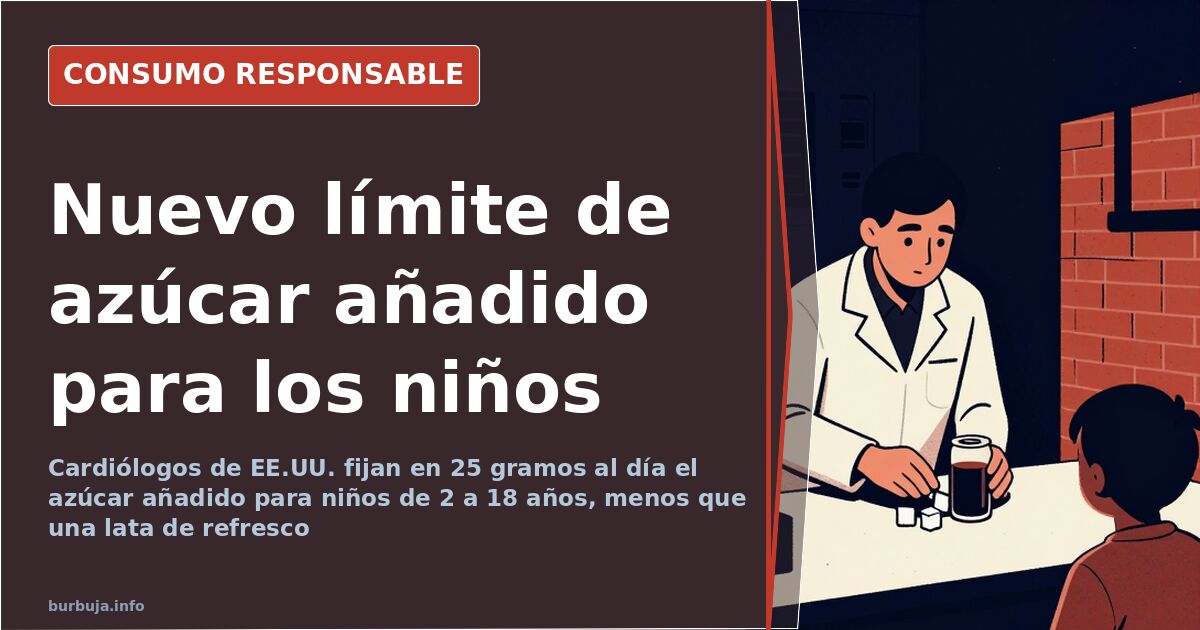
Cardiologists set daily sugar limit for children at 25 grams
In August 2016, the American Heart Association published a recommendation in its journal «Circulation» that stirred controversy: children aged 2 to 18 should not exceed 25 grams of added sugars per day. That is six teaspoons. Less than what a single soda can contains, which has 30 grams. According to the authors, the evidence is "solid".
From there, the conversation split in two. One half debated the figure. The other, the packaging. Because between health data and the shopping list lies a gap that, according to several participants, the industry has been filling by the spoonful for years.
What exactly are added sugars?
The recommendation defines the scope: added sugars are those introduced into food artificially—chocolates, candies, pastries, cookies, sugary cereals, soft drinks, and table sugar. Fruit or milk sugars are excluded. This distinction was overlooked by many readers.
The link highlighted by cardiologists is metabolic syndrome: a cluster of factors—waist circumference, blood pressure, glucose, high triglycerides, and low "good" cholesterol—that opens the door to obesity and cardiovascular problems. The likelihood of a child developing these diseases increases proportionally with their intake of added sugar.
José Ramón González Juanetey, president of the Spanish Society of Cardiology, described it as a major problem and left a memorable phrase: if the risk profile remains unchanged, "generations currently between 10 and 20 years old will end up having more heart disease and living shorter lives than their parents".
Sugar hiding where no one expects it
That was the revelation. Several participants repeated this diagnosis: the problem is not in the sugar bowl, but on the label. According to them, sugar has infiltrated bread, tomato sauce, mayonnaise, processed meats, and even spicy chorizo, foods that traditionally neither contain nor need it. Some bluntly called it "a covert genocide".
A recurring thesis among participants: sugar is added to almost all processed foods, and no regulation prevents this. Comparisons with tobacco emerged quickly—the next tobacco—and many demanded zero spoons instead of six. The WHO had already acted earlier: in 2015, it recommended normal-weight adults reduce sugar to 5% of daily caloric intake, about one tablespoon per day.
Are sweeteners worse than sugar?
Here consensus broke down completely. The president of the Spanish cardiologists himself recommended that if sodas are consumed, they should be diet versions, and that saccharin was the best option for coffee. This fell poorly: one participant claimed, without providing proof, that saccharin is banned in France and Canada and that the US requires warnings about its dangers.
Stevia gained trinc as a homemade substitute: an infusion, kept in the fridge, provides sweetener for a while. It settled nothing either. A cited specialist admitted a rebound effect if consumption is excessive—the body craves more sweetness—and the suspicion, still unconfirmed in humans, that they might harm gut flora.
The endocrine nuance was missing. Susana Moreneo, from Gregorio Marañón Hospital and secretary of SEEDO (Spanish Society for the Study of Obesity), recalled that the brain needs about 160 grams of glucose daily, but obtains it from slow-absorption carbohydrates: cereals, legumes, potatoes, rice, bread, fruit, and vegetables. The problem with added sugar, she said, is precisely that: it is added. It does not replace; it adds.
The debate that got out of hand: gluconeogenesis and potatoes
From the second half onward, the issue drifted toward topics far removed from the soda can. Discussions arose about whether the brain can feed on ketone bodies, how much glucose the body produces via gluconeogenesis, and to what extent ketogenic diets prove the need for carbs is a myth. According to one speaker, strict glucose needs would be reduced to red blood cells, renal medulla, and the brain.
The argument reached such a point that it became entangled in a typo: someone confused glycogenogenesis with gluconeogenesis, leading to a contest over who better understood metabolic pathways. From there, it was a short step to using potatoes as ammunition. Some argued that the tuber is a chemical defense of the plant, a cocktail containing inhibitors of digestive proteases. The obvious answer was: when cooked, toxins are deactivated, just like in eggplant, cassava, or sweet potato.
The complete breakdown of that exchange of data—glycemic ranges, ketone bodies, fasting times—is lost in the most technical fragments, which must be read entirely to separate fact from noise. In the background, the usual reproach remained: nonagenarian grandparents who spent their lives eating potatoes unaware they were poison.
There is a point where analysis stalls. No one disputes that processed foods contain too much sugar. Disagreement begins when deciding what counts as real food. There, data ends and trenches begin.
Note: this text summarizes information on dietary recommendations and does not replace the judgment of a healthcare professional.
In August 2016, the American Heart Association published a recommendation in its journal «Circulation» that stirred controversy: children aged 2 to 18 should not exceed 25 grams of added sugars per day. That is six teaspoons. Less than what a single soda can contains, which has 30 grams. According to the authors, the evidence is "solid".
From there, the conversation split in two. One half debated the figure. The other, the packaging. Because between health data and the shopping list lies a gap that, according to several participants, the industry has been filling by the spoonful for years.
What exactly are added sugars?
The recommendation defines the scope: added sugars are those introduced into food artificially—chocolates, candies, pastries, cookies, sugary cereals, soft drinks, and table sugar. Fruit or milk sugars are excluded. This distinction was overlooked by many readers.
The link highlighted by cardiologists is metabolic syndrome: a cluster of factors—waist circumference, blood pressure, glucose, high triglycerides, and low "good" cholesterol—that opens the door to obesity and cardiovascular problems. The likelihood of a child developing these diseases increases proportionally with their intake of added sugar.
José Ramón González Juanetey, president of the Spanish Society of Cardiology, described it as a major problem and left a memorable phrase: if the risk profile remains unchanged, "generations currently between 10 and 20 years old will end up having more heart disease and living shorter lives than their parents".
Sugar hiding where no one expects it
That was the revelation. Several participants repeated this diagnosis: the problem is not in the sugar bowl, but on the label. According to them, sugar has infiltrated bread, tomato sauce, mayonnaise, processed meats, and even spicy chorizo, foods that traditionally neither contain nor need it. Some bluntly called it "a covert genocide".
A recurring thesis among participants: sugar is added to almost all processed foods, and no regulation prevents this. Comparisons with tobacco emerged quickly—the next tobacco—and many demanded zero spoons instead of six. The WHO had already acted earlier: in 2015, it recommended normal-weight adults reduce sugar to 5% of daily caloric intake, about one tablespoon per day.
Are sweeteners worse than sugar?
Here consensus broke down completely. The president of the Spanish cardiologists himself recommended that if sodas are consumed, they should be diet versions, and that saccharin was the best option for coffee. This fell poorly: one participant claimed, without providing proof, that saccharin is banned in France and Canada and that the US requires warnings about its dangers.
Stevia gained trinc as a homemade substitute: an infusion, kept in the fridge, provides sweetener for a while. It settled nothing either. A cited specialist admitted a rebound effect if consumption is excessive—the body craves more sweetness—and the suspicion, still unconfirmed in humans, that they might harm gut flora.
The endocrine nuance was missing. Susana Moreneo, from Gregorio Marañón Hospital and secretary of SEEDO (Spanish Society for the Study of Obesity), recalled that the brain needs about 160 grams of glucose daily, but obtains it from slow-absorption carbohydrates: cereals, legumes, potatoes, rice, bread, fruit, and vegetables. The problem with added sugar, she said, is precisely that: it is added. It does not replace; it adds.
The debate that got out of hand: gluconeogenesis and potatoes
From the second half onward, the issue drifted toward topics far removed from the soda can. Discussions arose about whether the brain can feed on ketone bodies, how much glucose the body produces via gluconeogenesis, and to what extent ketogenic diets prove the need for carbs is a myth. According to one speaker, strict glucose needs would be reduced to red blood cells, renal medulla, and the brain.
The argument reached such a point that it became entangled in a typo: someone confused glycogenogenesis with gluconeogenesis, leading to a contest over who better understood metabolic pathways. From there, it was a short step to using potatoes as ammunition. Some argued that the tuber is a chemical defense of the plant, a cocktail containing inhibitors of digestive proteases. The obvious answer was: when cooked, toxins are deactivated, just like in eggplant, cassava, or sweet potato.
The complete breakdown of that exchange of data—glycemic ranges, ketone bodies, fasting times—is lost in the most technical fragments, which must be read entirely to separate fact from noise. In the background, the usual reproach remained: nonagenarian grandparents who spent their lives eating potatoes unaware they were poison.
There is a point where analysis stalls. No one disputes that processed foods contain too much sugar. Disagreement begins when deciding what counts as real food. There, data ends and trenches begin.
Note: this text summarizes information on dietary recommendations and does not replace the judgment of a healthcare professional.
Also available in: Deutsch
Summary of a discussion on Burbuja.info - Foro de economía, actualidad y política., translated from Spanish and reviewed before publication. Read the full discussion (130 replies).
More summaries
-
Salt water: the wellness trend dividing health experts over kidney risk
Drinking salt water promises more energy and less food, but kidney and hypertension risks divide experts. Data, testimonials and the science behind it…
-
Mixed changing rooms in gyms: what we know and what we don't
Several users claim that a mixed changing room is the area with lockers and benches, while changing and showering take place in individual cubicles.
-
Spain's insurers propose sick leave ends; GPs hold final say
In Spain, insurers manage but don't pay for common illness leave. They can propose ending it, but only a GP or inspector decides.
-
Spain's ITV emissions test: additives, smoke and the 0.5 m-1 limit
A diesel car entered Spain's ITV with 6 m-1 opacity, dropping to 1.37 after a highway run. The test measures tailpipe output in the pit, not annual pollution.
-
725€ Gaming PC: i3-6100 Falls Short, PSU Oversized
A 725€ gaming build in Spain faced criticism for an underpowered i3-6100 CPU and an oversized 650W power supply.
-
Coasting downhill in Spain wastes fuel and increases risk
Driving in neutral on Spanish descents offers no savings and extends braking distance, while engine braking consumes zero.