
Coasting downhill in Spain wastes fuel and increases risk
Driving in neutral on Spanish descents offers no savings and extends braking distance, while engine braking consumes zero.
English · Original discussion in Spanish · Published
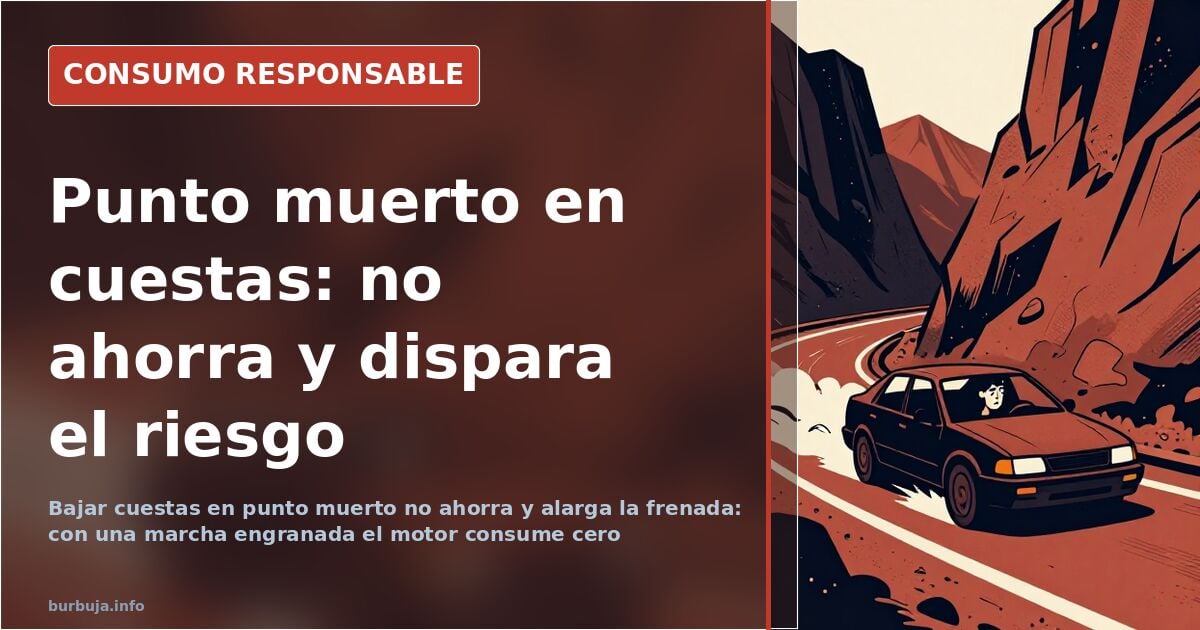
The "coasting" trend: driving downhill without gear saves nothing and worsens braking
Taking a car down a hill in neutral seems like the obvious trick to save money. The mechanics say exactly the opposite. With a gear engaged and your foot off the accelerator, a modern injection engine burns nothing; in neutral, it keeps idling and devours between 0.5 and 0.8 liters per hour. This habit, dubbed coasting, is spreading across any street with a slope and has already caused scares at garage doors: one vehicle braked for more than ten meters without stopping and crashed into a neighbor's car that was pulling out, according to a local resident.
The street in question is about 500 meters long, has a steep gradient, and leads to a main road that also goes downhill. For at least six months, observers report that more and more cars, vans, and trucks are descending it without a gear selected. The presumed motive is saving money. The result is a safety problem unrelated to fuel prices.
Why does coasting in neutral extend braking distance?
Without an engaged gear, the car moves by pure inertia, and the only brake available is the pedal. When a gear is selected, engine braking comes into play: the wheels drag the engine, and this resistance slows the vehicle without touching the brakes. Those who understand this brake earlier, with more margin and almost reflexively. Those who descend on a sail rely entirely on the brake pads, which handle the full load on a long slope.
That work has limits. Continuous use of brakes during descent heats them up and can lead to fading, the pogre loss of braking power. The most extreme scenario involves not a passenger car, but a motorhome weighing 3,500 kilos towing a 500-kilogram trailer down a mountain pass. In neutral, the question shifts from how much you save to whether you make it down with functional brakes. For heavy vehicles, retention via low gear isn't an extra: it's the primary braking system.
The non-existent savings: zero consumption with gear engaged
The underlying misunderstanding is believing that a relaxed engine uses less fuel. In modern injection engines, the opposite occurs: when the car rolls with a gear engaged and the accelerator released, the ECU cuts injection above approximately 1,500 revolutions. The engine spins dragged by the wheels, and consumption drops to zero. Retention costs nothing: it's free.
At idle, however, combustion must be maintained so the engine doesn't stall. Hence the consumption recorded by any onboard computer when the car is stopped. Some verify this daily in a Toyota with a D4D engine: descending with a gear engaged and without pressing the accelerator, not a drop of fuel enters. Idle consumption is measured in liters per hour, not per kilometer traveled, and that is the key that dismantles the supposed savings. Coasting in neutral costs money.
From crisis hack to factory antiestéticature
The idea isn't new. Driving on a sail, using inertia with the decoupled engine, has been in hypermilers' manuals for years—those who squeeze every last drop from their tanks. What's striking is that it has ceased to be an amateur occurrence. Some automatic transmissions now include a coasting function that decouples the transmission and leaves the engine idling when electronics detect that inertia is enough to move the car. The savings trick lands in standard mechanics.
The difference is that the factory function activates automatically, with criteria, and deactivates as soon as the brake or accelerator is pressed. Manual neutral lacks this safety net. It's decided visually, with traffic around and the slope ahead. And there, the margin of error is paid in bodywork damage.
Eight kilometers downhill and trucks without brakes
There are stretches where temptation is maximum. An 8-kilometer descent between La Laguna and Santa Cruz de Tenerife invites driving without touching the engine, and some drivers do it every morning to scrape together liters. In trucks, things become directly reckless: mass multiplies the problem, and brakes are the only resource available.
This isn't workshop exaggeration. Decades ago, haulers moving marble between Extremadura and Levante towns descended entire passes in neutral with the tractor unit and a long, unstable trailer behind. Some even let go of the steering wheel mid-slope. The anecdote is told by someone who rode along in those trucks between 1979 and 1980, and it serves a purpose: coasting downhill isn't a recent trend, it's an old vice recycled by each crisis.
Meanwhile, cars continue to descend hills. The technical argument—zero consumption with gear engaged, more control, and less wear—is on the table since years ago. Yet some still release the lever upon seeing the slope. How much must fuel prices rise, or how many crashes at garage doors are needed, for the habit to finally change?
Taking a car down a hill in neutral seems like the obvious trick to save money. The mechanics say exactly the opposite. With a gear engaged and your foot off the accelerator, a modern injection engine burns nothing; in neutral, it keeps idling and devours between 0.5 and 0.8 liters per hour. This habit, dubbed coasting, is spreading across any street with a slope and has already caused scares at garage doors: one vehicle braked for more than ten meters without stopping and crashed into a neighbor's car that was pulling out, according to a local resident.
The street in question is about 500 meters long, has a steep gradient, and leads to a main road that also goes downhill. For at least six months, observers report that more and more cars, vans, and trucks are descending it without a gear selected. The presumed motive is saving money. The result is a safety problem unrelated to fuel prices.
Why does coasting in neutral extend braking distance?
Without an engaged gear, the car moves by pure inertia, and the only brake available is the pedal. When a gear is selected, engine braking comes into play: the wheels drag the engine, and this resistance slows the vehicle without touching the brakes. Those who understand this brake earlier, with more margin and almost reflexively. Those who descend on a sail rely entirely on the brake pads, which handle the full load on a long slope.
That work has limits. Continuous use of brakes during descent heats them up and can lead to fading, the pogre loss of braking power. The most extreme scenario involves not a passenger car, but a motorhome weighing 3,500 kilos towing a 500-kilogram trailer down a mountain pass. In neutral, the question shifts from how much you save to whether you make it down with functional brakes. For heavy vehicles, retention via low gear isn't an extra: it's the primary braking system.
The non-existent savings: zero consumption with gear engaged
The underlying misunderstanding is believing that a relaxed engine uses less fuel. In modern injection engines, the opposite occurs: when the car rolls with a gear engaged and the accelerator released, the ECU cuts injection above approximately 1,500 revolutions. The engine spins dragged by the wheels, and consumption drops to zero. Retention costs nothing: it's free.
At idle, however, combustion must be maintained so the engine doesn't stall. Hence the consumption recorded by any onboard computer when the car is stopped. Some verify this daily in a Toyota with a D4D engine: descending with a gear engaged and without pressing the accelerator, not a drop of fuel enters. Idle consumption is measured in liters per hour, not per kilometer traveled, and that is the key that dismantles the supposed savings. Coasting in neutral costs money.
From crisis hack to factory antiestéticature
The idea isn't new. Driving on a sail, using inertia with the decoupled engine, has been in hypermilers' manuals for years—those who squeeze every last drop from their tanks. What's striking is that it has ceased to be an amateur occurrence. Some automatic transmissions now include a coasting function that decouples the transmission and leaves the engine idling when electronics detect that inertia is enough to move the car. The savings trick lands in standard mechanics.
The difference is that the factory function activates automatically, with criteria, and deactivates as soon as the brake or accelerator is pressed. Manual neutral lacks this safety net. It's decided visually, with traffic around and the slope ahead. And there, the margin of error is paid in bodywork damage.
Eight kilometers downhill and trucks without brakes
There are stretches where temptation is maximum. An 8-kilometer descent between La Laguna and Santa Cruz de Tenerife invites driving without touching the engine, and some drivers do it every morning to scrape together liters. In trucks, things become directly reckless: mass multiplies the problem, and brakes are the only resource available.
This isn't workshop exaggeration. Decades ago, haulers moving marble between Extremadura and Levante towns descended entire passes in neutral with the tractor unit and a long, unstable trailer behind. Some even let go of the steering wheel mid-slope. The anecdote is told by someone who rode along in those trucks between 1979 and 1980, and it serves a purpose: coasting downhill isn't a recent trend, it's an old vice recycled by each crisis.
Meanwhile, cars continue to descend hills. The technical argument—zero consumption with gear engaged, more control, and less wear—is on the table since years ago. Yet some still release the lever upon seeing the slope. How much must fuel prices rise, or how many crashes at garage doors are needed, for the habit to finally change?
Also available in: Deutsch
Summary of a discussion on Burbuja.info - Foro de economía, actualidad y política., translated from Spanish and reviewed before publication. Read the full discussion (130 replies).
More summaries
-
Ford Focus, Mazda 3 or Toyota Corolla: 30k Euros and an engine dilemma
Ford Focus 1.0 EcoBoost at 28,000€, Mazda 3 at 31,000€, and Toyota Corolla hybrid at 32,000€. Reliability decides the winner.
-
EU's €3 parcel levy ends AliExpress's cheap era
The EU's €3 per category fee sends AliExpress prices soaring: a €3 order now costs €11. The Chinese parcel model faces collapse.
-
Carlos and Fernando Paz: Where to Listen to the Brothers
Carlos and Fernando Paz share a voice but no single show. Find their podcasts on YouTube, iVoox, and radio stations.
-
Spanish forum debate: carbs, carnivore diets and insults
A Spanish online thread discusses carbohydrates, carnivore diets and supplements amidst mutual accusations and personal attacks.
-
Spain's insurers propose sick leave ends; GPs hold final say
In Spain, insurers manage but don't pay for common illness leave. They can propose ending it, but only a GP or inspector decides.
-
Spain's ITV emissions test: additives, smoke and the 0.5 m-1 limit
A diesel car entered Spain's ITV with 6 m-1 opacity, dropping to 1.37 after a highway run. The test measures tailpipe output in the pit, not annual pollution.