
Spain's ITV emissions test: additives, smoke and the 0.5 m-1 limit
A diesel car entered Spain's ITV with 6 m-1 opacity, dropping to 1.37 after a highway run. The test measures tailpipe output in the pit, not annual pollution.
English · Original discussion in Spanish · Published
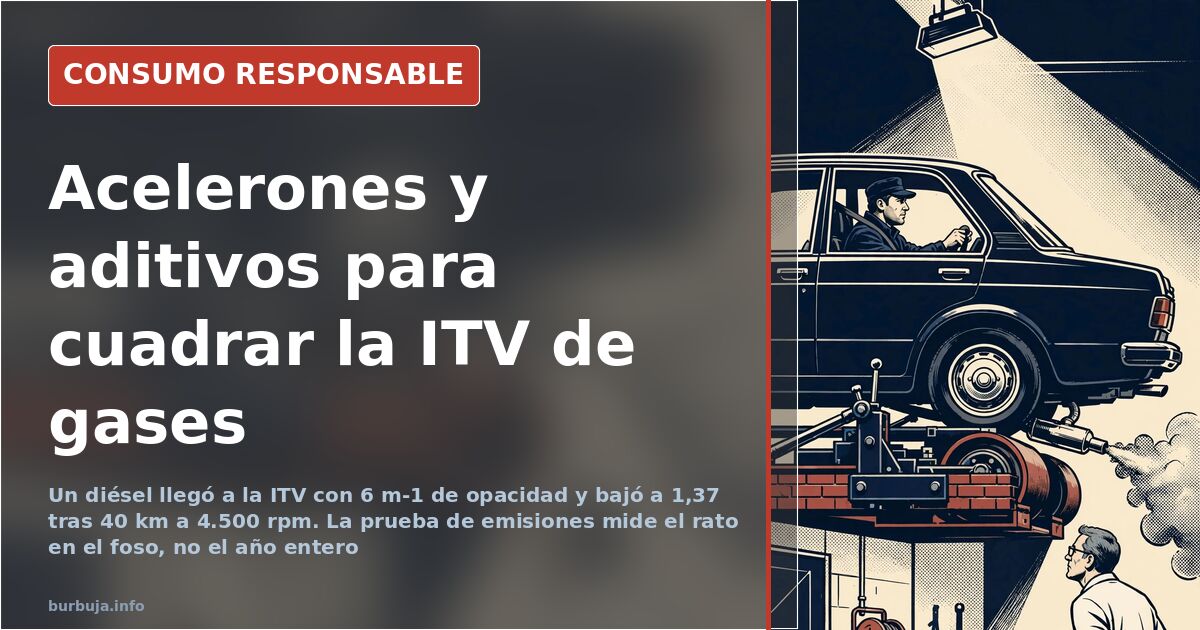
The ITV emissions test: additives, revs and the 0.5 m-1 threshold
The emissions test does not measure what a car pollutes overall; it measures what it emits during the few minutes spent on the inspection ramp. This snapshot can be prepped in advance. No illegal activity is required. Simply add a cleaning additive to the tank, drive forty kilometers at 4,500 rpm, and arrive with a hot engine. What comes out of the exhaust for the rest of the year is irrelevant. The measurement passes; the emission remains unchanged.
A specific case illustrates this without embellishment: a diesel vehicle arrived for its Spanish ITV (technical inspection) with an opacity of 6 m-1, far above the maximum allowed. After 40 kilometers at 4,500 rpm and prior cleaning, the reading dropped to 1.37 m-1. The vehicle's limit was 0.5 m-1. Still unfavorable. With additives, banging on the exhaust, spraying water into the tailpipe, and arriving "nice and warm," other accounts report halving the limit, with a personal record of 0.64 m-1.
What the opacity test measures and why the engine must be hot
The smoke test does not assess the general condition of the engine. It measures particle opacity at a specific moment under given conditions: engine temperature, RPM, and, in petrol cars, the lambda factor. Hence the most repeated advice: arrive with the car at operating temperature, having been running for at least half an hour, preferably after a stretch of motorway just before. A dirty air filter or a contaminated lambda sensor alters the reading even if nothing is broken.
The rest is routine mechanics. New or tuned spark plugs for petrol cars, cleaning the silencer with hot soapy water through the exhaust tip, and a long drive to expel accumulated carbon before entering the station. Those who explain it best summarize it thus: "Passing the ITV emissions test. - Keep the car hot, ensure it has been running for half an hour before the test, at least. Better yet, take a motorway ride right before." None of these recommendations reduce the vehicle's annual pollution. Only that of the morning of the review.
Additives: polluting more beforehand to pollute less during the exam
This is where the issue stops being a workshop anecdote. Cleaning additives cause the engine to suddenly release dirt accumulated in the exhaust, manifold, and EGR valve. In other words, emissions are concentrated in the days leading up to the test. It is argued that the result is a measurable nonsense: "if you add some additives, they release all the gunk at once, and then you go to the ITV and 'voilà, your car isn't polluting'." The pollution didn't disappear. It was brought forward.
Suspicions of collusion with additive manufacturers circulate without proof and with irony — brands found on any gas station shelf. More coherent is the defense from another account: heating the engine until the exhaust almost glows is presented as an act of ecology. It is called "removing carbon buildup" and, in practice, consists of releasing into the atmosphere in twenty minutes what the catalytic converter had retained for months. Modern diesels add another piece to the problem: the particulate filter.
The exhaust isn't always the failure: seat covers, airbags and VIN
The emissions test makes headlines, but it is not the only reason for a failed inspection. A 2005 diesel vehicle with seat covers installed since 2007 passed reviews without issues until March 2022. That year, the station ruled that the covers interfered with the airbag and issued an unfavorable result. The solution offered was to remove them and return. Five previous inspections with the same equipment had raised no objections.
There are more examples of administrative friction than safety concerns: requiring the VIN number to be located in the trunk when it is also visible in the front compartment, or an airbag warning light illuminated years before the appointment. In the latter case, the home repair consisted of two resistors equivalent to those of the faulty sensor. "It has passed several ITVs like this," one user summarizes.
Damages, claims and the old coolant hose
Among accounts of damages trinc the inspection, one is particularly costly: a coolant hose appeared punctured next to the radiator after passing the inspection, with the engine burned out in the case of a second affected vehicle around the same time. Manipulation in the pit is suspected, although there is no accreditation of such acts and even less of a clear claim route. The question of how to officially claim against an ITV station appears without a definitive answer.
That void — the absence of an agile complaint mechanism — turns every incident into private frustration. The owner pays, returns, repeats the test, and assumes the cost. Meanwhile, the technical inspection is perceived more as a periodic tax than as a safety guarantee.
Homologation as business and the end of cheap tuning
The final blow to tuning came in 2011, when the State decided which modifications were admissible in a passenger car. Today, almost everything can still be modified, but each part must be homologated and paid for. The restriction did not prohibit the practice: it turned it into a fee-based procedure. One line of analysis reads this as a broader pattern: instead of intervening in supply, demand is regulated and rent is extracted at every step.
This is the framework where stations with better and worse fruta fit, along with differences in treatment depending on the time of day and province visited. One case portrays this: "The last time I passed it at the Yuncler ITV, in August at two in the afternoon. There was nobody there, and the smoke test was just revving up to over two thousand. Passed without problems." Different station, different rigor.
Some argue that pressure on the older vehicle fleet will not decrease: renewal would interest the industry, and the emissions test would be the cheapest lever to push it. If criteria tighten again, it is likely that the ritual of additives and the motorway ride will continue to work. Until the limit drops below what carbon buildup can disguise.
The emissions test does not measure what a car pollutes overall; it measures what it emits during the few minutes spent on the inspection ramp. This snapshot can be prepped in advance. No illegal activity is required. Simply add a cleaning additive to the tank, drive forty kilometers at 4,500 rpm, and arrive with a hot engine. What comes out of the exhaust for the rest of the year is irrelevant. The measurement passes; the emission remains unchanged.
A specific case illustrates this without embellishment: a diesel vehicle arrived for its Spanish ITV (technical inspection) with an opacity of 6 m-1, far above the maximum allowed. After 40 kilometers at 4,500 rpm and prior cleaning, the reading dropped to 1.37 m-1. The vehicle's limit was 0.5 m-1. Still unfavorable. With additives, banging on the exhaust, spraying water into the tailpipe, and arriving "nice and warm," other accounts report halving the limit, with a personal record of 0.64 m-1.
What the opacity test measures and why the engine must be hot
The smoke test does not assess the general condition of the engine. It measures particle opacity at a specific moment under given conditions: engine temperature, RPM, and, in petrol cars, the lambda factor. Hence the most repeated advice: arrive with the car at operating temperature, having been running for at least half an hour, preferably after a stretch of motorway just before. A dirty air filter or a contaminated lambda sensor alters the reading even if nothing is broken.
The rest is routine mechanics. New or tuned spark plugs for petrol cars, cleaning the silencer with hot soapy water through the exhaust tip, and a long drive to expel accumulated carbon before entering the station. Those who explain it best summarize it thus: "Passing the ITV emissions test. - Keep the car hot, ensure it has been running for half an hour before the test, at least. Better yet, take a motorway ride right before." None of these recommendations reduce the vehicle's annual pollution. Only that of the morning of the review.
Additives: polluting more beforehand to pollute less during the exam
This is where the issue stops being a workshop anecdote. Cleaning additives cause the engine to suddenly release dirt accumulated in the exhaust, manifold, and EGR valve. In other words, emissions are concentrated in the days leading up to the test. It is argued that the result is a measurable nonsense: "if you add some additives, they release all the gunk at once, and then you go to the ITV and 'voilà, your car isn't polluting'." The pollution didn't disappear. It was brought forward.
Suspicions of collusion with additive manufacturers circulate without proof and with irony — brands found on any gas station shelf. More coherent is the defense from another account: heating the engine until the exhaust almost glows is presented as an act of ecology. It is called "removing carbon buildup" and, in practice, consists of releasing into the atmosphere in twenty minutes what the catalytic converter had retained for months. Modern diesels add another piece to the problem: the particulate filter.
The exhaust isn't always the failure: seat covers, airbags and VIN
The emissions test makes headlines, but it is not the only reason for a failed inspection. A 2005 diesel vehicle with seat covers installed since 2007 passed reviews without issues until March 2022. That year, the station ruled that the covers interfered with the airbag and issued an unfavorable result. The solution offered was to remove them and return. Five previous inspections with the same equipment had raised no objections.
There are more examples of administrative friction than safety concerns: requiring the VIN number to be located in the trunk when it is also visible in the front compartment, or an airbag warning light illuminated years before the appointment. In the latter case, the home repair consisted of two resistors equivalent to those of the faulty sensor. "It has passed several ITVs like this," one user summarizes.
Damages, claims and the old coolant hose
Among accounts of damages trinc the inspection, one is particularly costly: a coolant hose appeared punctured next to the radiator after passing the inspection, with the engine burned out in the case of a second affected vehicle around the same time. Manipulation in the pit is suspected, although there is no accreditation of such acts and even less of a clear claim route. The question of how to officially claim against an ITV station appears without a definitive answer.
That void — the absence of an agile complaint mechanism — turns every incident into private frustration. The owner pays, returns, repeats the test, and assumes the cost. Meanwhile, the technical inspection is perceived more as a periodic tax than as a safety guarantee.
Homologation as business and the end of cheap tuning
The final blow to tuning came in 2011, when the State decided which modifications were admissible in a passenger car. Today, almost everything can still be modified, but each part must be homologated and paid for. The restriction did not prohibit the practice: it turned it into a fee-based procedure. One line of analysis reads this as a broader pattern: instead of intervening in supply, demand is regulated and rent is extracted at every step.
This is the framework where stations with better and worse fruta fit, along with differences in treatment depending on the time of day and province visited. One case portrays this: "The last time I passed it at the Yuncler ITV, in August at two in the afternoon. There was nobody there, and the smoke test was just revving up to over two thousand. Passed without problems." Different station, different rigor.
Some argue that pressure on the older vehicle fleet will not decrease: renewal would interest the industry, and the emissions test would be the cheapest lever to push it. If criteria tighten again, it is likely that the ritual of additives and the motorway ride will continue to work. Until the limit drops below what carbon buildup can disguise.
Also available in: Deutsch
Summary of a discussion on Burbuja.info - Foro de economía, actualidad y política., translated from Spanish and reviewed before publication. Read the full discussion (130 replies).
More summaries
-
Lidl's frozen sardines at €3.90/kg vs. fresh ones
A kilo of frozen sardines costs €3.90 compared to €9-€10 for fresh ones in Madrid. The question is whether the flavor holds up after freezing.
-
Paraguay: Homes from €20,000, But Residents Warn of Risks
Property listings in Paraguay show homes from €20,000 on portals like Infocasas; residents warn of poor healthcare, insecurity and mosquitoes.
-
Thermodynamics and Weight Loss: The Reality of Fasting
Losing one kilo of fat requires a 7,500 kcal deficit. Without exercise, this takes three days, though initial weight loss is mostly water.
-
Lidl London vs Mercadona: Basket 35% Cheaper in UK
Basic items cost €3.56 at Lidl London versus €5.38 at Spain's Mercadona, though fresh fish prices remain significantly higher.
-
Roro's cookie cathedral sparks debate over professional production team
Roro's viral video of a gingerbread Notre Dame fuels speculation about a hidden production crew, with users pointing to agency Okiko Creatives.
-
Spanish forum debate: carbs, carnivore diets and insults
A Spanish online thread discusses carbohydrates, carnivore diets and supplements amidst mutual accusations and personal attacks.