
US adds just 54,000 jobs as S&P 500 hits record high
The US added only 54,000 jobs in mid-summer while the S&P 500 reached historic highs. The gap between the stock market and the real economy widens.
English · Original discussion in Spanish · Published
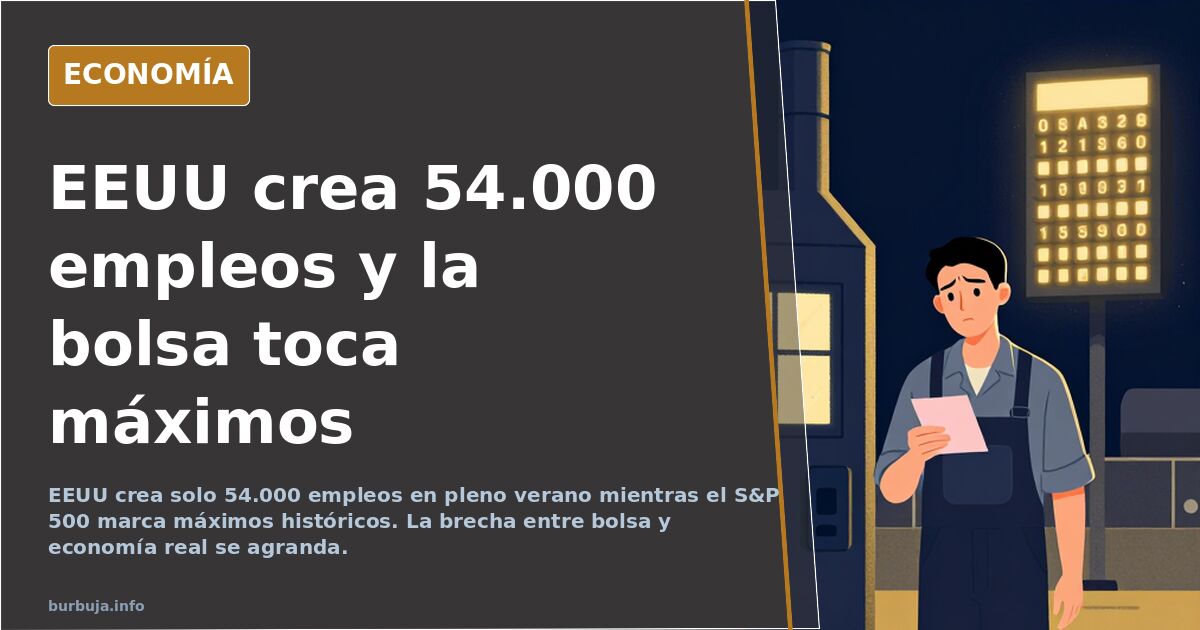
US adds 54,000 jobs in summer while stocks hit highs
The US economy created only 54,000 jobs in the middle of summer, a figure that would have triggered alarms in any other cycle. The data arrives at an awkward time: the S&P 500 reaches historic highs and unemployment, on paper, remains contained. The distance between what indices say and what job seekers experience has become the core of the discontent.
It is not an isolated impression. In recent months, testimonies have multiplied from people sending hundreds of resumes without response, while big tech firms announce layoffs and replace tasks with artificial intelligence systems. The gap between the financial market and the household economy can no longer be explained by statistics alone.
S&P 500 at highs and stagnant employment
The most repeated argument is that the stock market does not reflect the real economy. The top 500 listed companies can record record profits thanks to globalization, automation, and capital concentration, without this translating into hiring. The S&P 500 at historic highs coexists with stagnant wages and increasingly inaccessible housing.
The counterargument relies on data: monetary supply growth M2 has returned to long-term levels, according to the series published by the Federal Reserve Bank of St. Louis, and more than a decade of records does not allow speaking of a structural disconnect between stocks and the economy. The disagreement is not about the figure, but about what it means.
AI and tech jobs: the silent adjustment
The best-paying sector is ceasing to be a safe haven. Artificial intelligence is absorbing tasks previously handled by entire teams, and the adjustment hits those working in technology hardest. The consequence is not only economic: in the United States, losing a job carries a social burden that is difficult to exaggerate.
Some argue that the underlying problem is the model: an economy that has replaced production with finance, sustained by monetary issuance absorbed by other countries. The rebuttal is that this scheme has worked for decades and that doom-mongers have been predicting its collapse for the same amount of time.
Why do stocks rise when employment cools?
Because indices measure profit expectations, not jobs. A cooling labor market can be read as a signal that interest rates will fall, pushing stocks higher. The paradox resolves thus: bad employment data, good news for capital.
The problem is that this reading excludes those living on a paycheck. The comparison with Spain appears whenever salaries and cost of living are discussed: wages of €1,300 versus rents of €1,200, a differential that turns any debate about economic performance into a discussion about survival.
The unsettling data point
The 54,000 jobs are not an isolated anecdote: they fit a trend of weak hiring that markets, for now, prefer to ignore. The question is not whether the stock market is right, but how long it can sustain this gap before someone pays the bill. And those who pay first, as always, do not appear in any index.
The US economy created only 54,000 jobs in the middle of summer, a figure that would have triggered alarms in any other cycle. The data arrives at an awkward time: the S&P 500 reaches historic highs and unemployment, on paper, remains contained. The distance between what indices say and what job seekers experience has become the core of the discontent.
It is not an isolated impression. In recent months, testimonies have multiplied from people sending hundreds of resumes without response, while big tech firms announce layoffs and replace tasks with artificial intelligence systems. The gap between the financial market and the household economy can no longer be explained by statistics alone.
S&P 500 at highs and stagnant employment
The most repeated argument is that the stock market does not reflect the real economy. The top 500 listed companies can record record profits thanks to globalization, automation, and capital concentration, without this translating into hiring. The S&P 500 at historic highs coexists with stagnant wages and increasingly inaccessible housing.
The counterargument relies on data: monetary supply growth M2 has returned to long-term levels, according to the series published by the Federal Reserve Bank of St. Louis, and more than a decade of records does not allow speaking of a structural disconnect between stocks and the economy. The disagreement is not about the figure, but about what it means.
AI and tech jobs: the silent adjustment
The best-paying sector is ceasing to be a safe haven. Artificial intelligence is absorbing tasks previously handled by entire teams, and the adjustment hits those working in technology hardest. The consequence is not only economic: in the United States, losing a job carries a social burden that is difficult to exaggerate.
Some argue that the underlying problem is the model: an economy that has replaced production with finance, sustained by monetary issuance absorbed by other countries. The rebuttal is that this scheme has worked for decades and that doom-mongers have been predicting its collapse for the same amount of time.
Why do stocks rise when employment cools?
Because indices measure profit expectations, not jobs. A cooling labor market can be read as a signal that interest rates will fall, pushing stocks higher. The paradox resolves thus: bad employment data, good news for capital.
The problem is that this reading excludes those living on a paycheck. The comparison with Spain appears whenever salaries and cost of living are discussed: wages of €1,300 versus rents of €1,200, a differential that turns any debate about economic performance into a discussion about survival.
The unsettling data point
The 54,000 jobs are not an isolated anecdote: they fit a trend of weak hiring that markets, for now, prefer to ignore. The question is not whether the stock market is right, but how long it can sustain this gap before someone pays the bill. And those who pay first, as always, do not appear in any index.
Also available in: Deutsch
Summary of a discussion on Burbuja.info - Foro de economía, actualidad y política., translated from Spanish and reviewed before publication. Read the full discussion (106 replies).
More summaries
-
AI as an economic engine: bubble or structural shift?
Economic analysis of AI: Is it the growth engine or a speculative bubble? Energy costs and business adoption are examined.
-
Vidal claims 9% US tax rate, sparking fiscal debate
César Vidal states he pays 9% taxes in the US versus 50% in Spain. Federal brackets and living costs complicate this comparison.
-
Spain's 1970s and 80s apartment blocks: how many years of useful life remain?
Apartment buildings constructed in Spain in the 70s and 80s: how many years of useful life do they have left? We analyse construction quality and the problems.
-
Junts and PSOE pact criticized as PSOE goes too far
Critics warn the PSOE-Junts agreement ignores the Spanish Constitution, prompting a warning from former Prime Minister Felipe González.
-
Spain: Alleged gang rape suspects released despite medical evidence
Three men were released in record time despite medical reports confirming sexual assault. The case involves the son of the Constitutional Court president.
-
Madrid parents build burning barricades to avoid handing over children
A couple in Carabanchel, Spain, held three foster children captive for three weeks, hiding them in a wardrobe behind burning barricades.