
Uruguay's Former President José Mujica Dies at 89
José Mujica, former president of Uruguay, has died at age 89. His legacy sparks debate over his austerity and insurgent past.
English · Original discussion in Spanish · Published
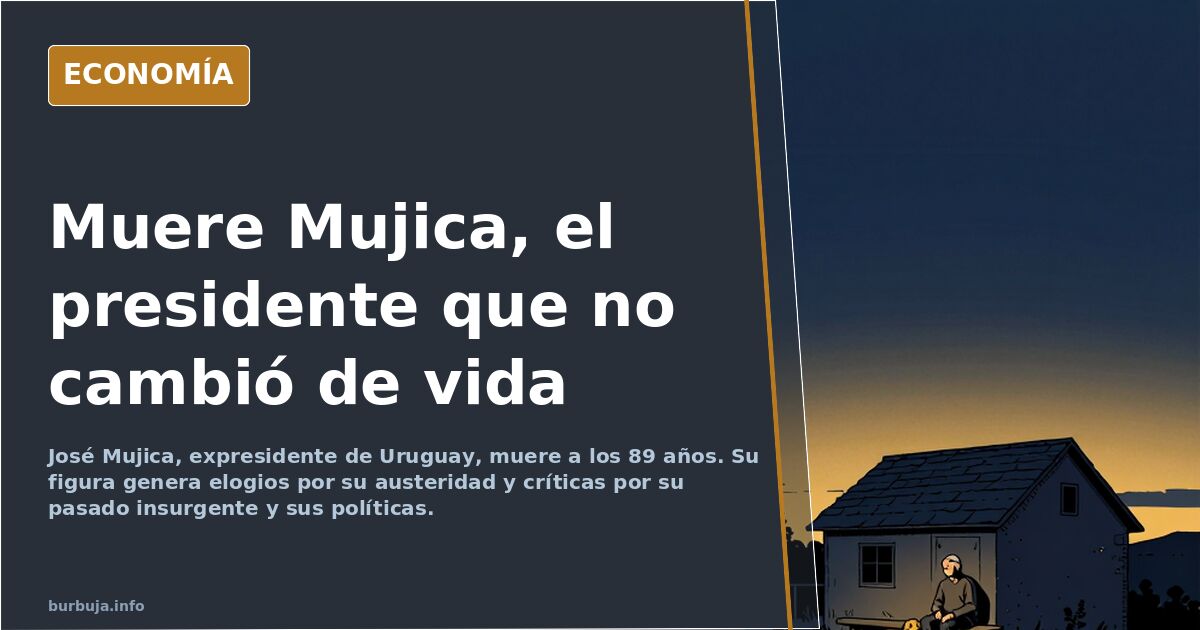
José Mujica dies: the president who lived as he preached
José Mujica, former president of Uruguay, has died at the age of 89. The news, reported by international media, triggered a wave of reactions that transcends Uruguayan politics and strikes at the heart of public debate in Spain. It is understandable why: for his supporters, Mujica was proof that one can hold power without changing one’s lifestyle; for his critics, he demonstrated how left-wing romanticism can whitewash a violent past. Both narratives coexist in the same conversation, and neither yields.
A former president who didn’t change his life
The first point of consensus, even among those who do not share his ideology, is that Mujica maintained an unusual personal coherence. He lived in a modest house, drove an old car, and rejected the pomp of office. Those who defended him while alive presented him as a model of austerity, and this image has been reinforced since his death. Some argue that this lifestyle was not a gesture but a logical consequence of his understanding of politics. Opponents counter that personal austerity does not absolve responsibility for government decisions.
The past that cannot be erased
The other side of the coin is his membership in the Tupamaro movement, which the Uruguayan opposition and much of the Spanish right have never stopped highlighting. According to these accounts, he is attributed armed actions and robberies during his insurgent years. Mujica never renounced that past, nor did he detail it. This ambiguity fuels the controversy: for some, he is an example of redemption; for others, a stain that no subsequent work can cover. The debate over whether a former president can be remembered for his guerrilla phase without overshadowing his administration is likely the most heated.
Laws that marked his government
During his term (2010-2015), laws were passed that placed Uruguay at the forefront of Latin America: same-sens marriage, abortion decriminalization, and marijuana legalization. Supporters present these as social pogre; critics view them as ideological impositions. In any case, they are the core of his political footprint and explain why his figure generates as much admiration outside Uruguay as rejection within certain sectors.
The philosopher of simple words
Mujica became popular for his brief, direct speeches, many of which were described as philosophical. He spoke about poverty, consumerism, and freedom in language that connected with people. This facet earned him sympathy beyond politics. However, not everyone buys into this profile: some consider him a character constructed by the media, a “boring old man” who stated obvious truths with a solemn tone. The divide between those who see wisdom and those who see posturing is another rift peine by the news.
Divided reactions in Spain
Mujica’s death has provoked reactions ranging from funeral praise to insults. From those who simply say “RIP,” to those who celebrate his death with derogatory comments. In between, voices acknowledge his coherence but criticize his past. The conversation reflects a polarization that is not exclusive to Spain but manifests here with particular harshness. Mujica’s figure has become a mirror in which each side projects its own likes and dislikes.
What remains of Mujica? A complex legacy, impossible to reduce to a label. His death closes a life but not the debate about his figure. Given these elements, it is foreseeable that the discussion will reignite every time his name is mentioned. And that, as now, no one will agree.
Also available in: Deutsch
Summary of a discussion on Burbuja.info - Foro de economía, actualidad y política., translated from Spanish and reviewed before publication. Read the full discussion (104 replies).
More summaries
-
Forum Debates Whether July Was as Hot as Claimed or Mild
A forum discusses the discrepancy between official July temperature data and personal experiences of mild weather, exploring why perceptions differ.
-
Female infidelity: A third of marriages affected?
An analysis of a specialized forum reveals a debate on the prevalence of female infidelity, with figures suggesting that one third of
-
Ayuso suffers miscarriage at 8 weeks: age as a factor
Ayuso, 44, loses pregnancy at 8 weeks. On July 11, 2023, Isabel Díaz Ayuso underwent surgery and suspended her official agenda. The...
-
Xabier Arrutia Imaz, ETA advisor to PDVSA in Venezuela, dies
The death of Xabier Arrutia Imaz in Venezuela exposes the protection network for ETA members in PDVSA and suspicions of a killing to silence secrets.
-
Ana Morales turns women's burnout into a thesis: mental load and the double shift
Ana Morales's book argues that women's burnout is structural: the double shift, mental load, and the figure of 78% of mothers feeling overloaded.
-
Spain's PP and VOX on hate speech laws: repeal or keep them?
Forum debate on whether Spain's PP and VOX would repeal hate crime laws or keep arrests over tweets and songs: doubts about free speech.