
Ana Morales turns women's burnout into a thesis: mental load and the double shift
Ana Morales's book argues that women's burnout is structural: the double shift, mental load, and the figure of 78% of mothers feeling overloaded.
English · Original discussion in Spanish · Published
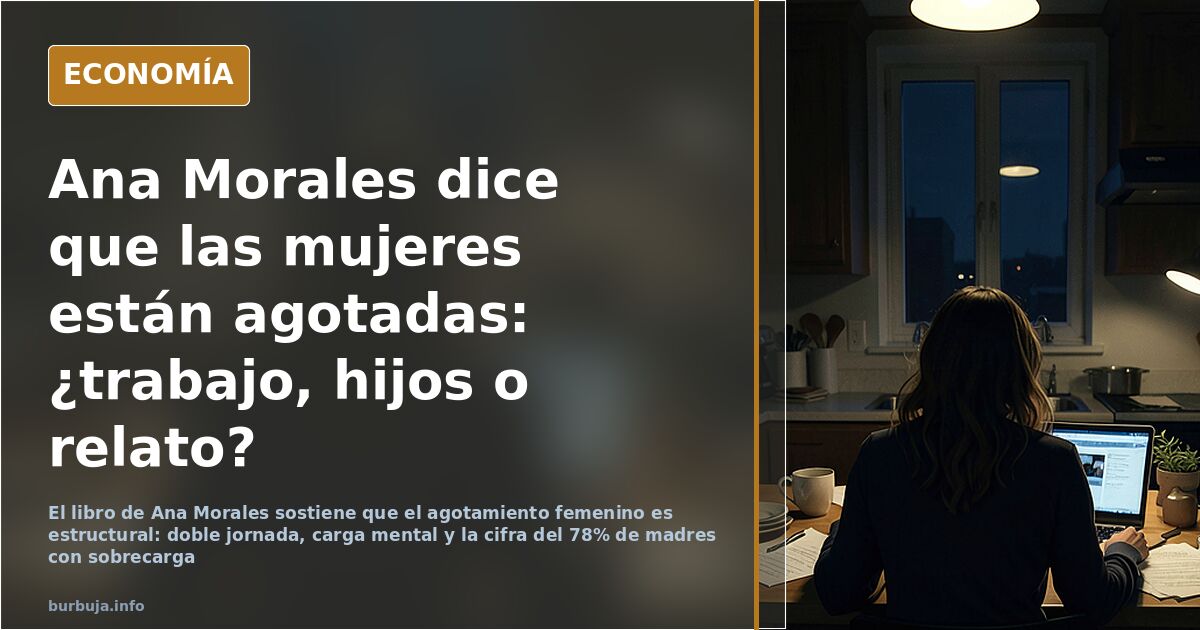
Ana Sarracena turns women's burnout into a thesis: the double shift and mental load
A journalist specializing in beauty has published a book arguing that women's tiredness is no longer an individual symptom but a structure. The diagnosis: working, raising children, caregiving and, on top of it all, keeping up appearances. The figure that keeps coming up in public conversation is stark: 78% of mothers suffer from mental load, according to actress Candela Peña. And the social response, as the text itself suggests, ranges from empathy to "well, just work less."
Ana Sarracena's approach in "Estado civil: cansada" (Marital Status: Tired) is not new, but it is uncomfortable: the gap between public success and everyday logistical servitude. At three in the afternoon a prosecutor is handling a case; at eight she is counting how many days are left on the milk carton. That sustancia ilegal, she argues, is the great gender divide of our time.
Why are women more tired if they work just as much?
The book points to two factors. One is physiological: women's sleep is more fragmented, even when sleeping the same number of hours, and menopause disrupts it further. The other is psychological: the tendency to overthink everything, to take on the role of everyone's caregiver and never let go of burdens. Mental load is exhausting because it requires holding in your head the constant planning needed to keep everything running smoothly.
On top of that comes a cultural context: when women entered the labor market, they took on new roles without giving up the old ones. The result is a double shift that, in the author's words, eventually overwhelms them. Actress Candela Peña summed it up on television with a phrase that went viral: "It doesn't matter what you do for a living: only you know when the sheets were last changed."
The five a.m. club and the productivity trap
Sarracena admits she joined the five a.m. club "out of necessity" and managed it badly: she didn't go to bed early. The essence of the method, she explains, is not to produce more but to devote those hours to personal development, and that can never be built at the expense of sleep. Robin Sharma, who created the method, recommends winding down from seven in the evening onward. In a country where school schedules make early bedtimes difficult, the advice sounds like a joke.
The reaction: from "don't complain" to "work more"
The conversation the book has sparked has two clear camps. One holds that the burnout is real and structural, and that society demands impossible performance from women on three fronts at once. The other, which carries weight in public debate, responds with skepticism: it argues that women of earlier generations raised children without today's comforts, that housework is shared more than ever, and that complaining is a luxury. Some go further and place the problem with the State and a social model that pushes everyone to work in order to sustain public finances.
Between the two extremes, one figure stands out: burnout makes no distinction between mothers and non-mothers. Caring for friends, partners, parents or siblings counts too. The question that remains is whether women's tiredness is a real epidemic or a well-sold narrative. And if it's the former, why has no one managed to put a price on the mental load.
Also available in: Deutsch
Summary of a discussion on Burbuja.info - Foro de economía, actualidad y política., translated from Spanish and reviewed before publication. Read the full discussion (15 replies).
More summaries
-
Sánchez sends La Revuelta to a record 4.38 million viewers and 33.9% share
Pedro Sánchez's appearance on La Revuelta drew an average of 4,387,000 viewers and a 33.9% share, an all-time record for the Spanish show and the day's most-watched programme.
-
Irene Montero 'gifts' knee pads to Abascal on La Revuelta, meant for Netanyahu
Irene Montero hands Santiago Abascal a pair of knee pads on La Revuelta, in a gesture alluding to Netanyahu and Trump. Here's what's behind it.
-
Colau says she left her flat of 15 years because she couldn't afford it
Ada Colau says she is leaving the flat where she lived for 15 years because one salary wasn't enough; Newtral puts her salary as mayor at €96,000 gross
-
Iryo train alerted Adif to LZB signal failure 10 minutes before AVE crash
The Iryo train notified Adif at 8:38 that it had stopped due to an LZB signalling failure. At 8:48, Renfe's AVE 6076 rammed into it at over 100 km/h.
-
Spain's PSOE threatens to challenge the election result if it loses
Spain's PSOE has reportedly laid the groundwork to challenge the November 29 election if it loses, but the legal mechanism requires specific grounds and deadlines that do not match its plans.
-
Sánchez and the jinx narrative: from housing to pensions
A 10 billion euro loan to pay pensions and the Barcelona riots test the jinx narrative and the November 29 campaign