
Urda rail crash survivors turn to faith in God
Survivors and neighbours of the Urda rail crash in Spain turn to faith: "without faith, none of this is bearable." The debate over religious comfort after the tragedy…
English · Original discussion in Spanish · Published
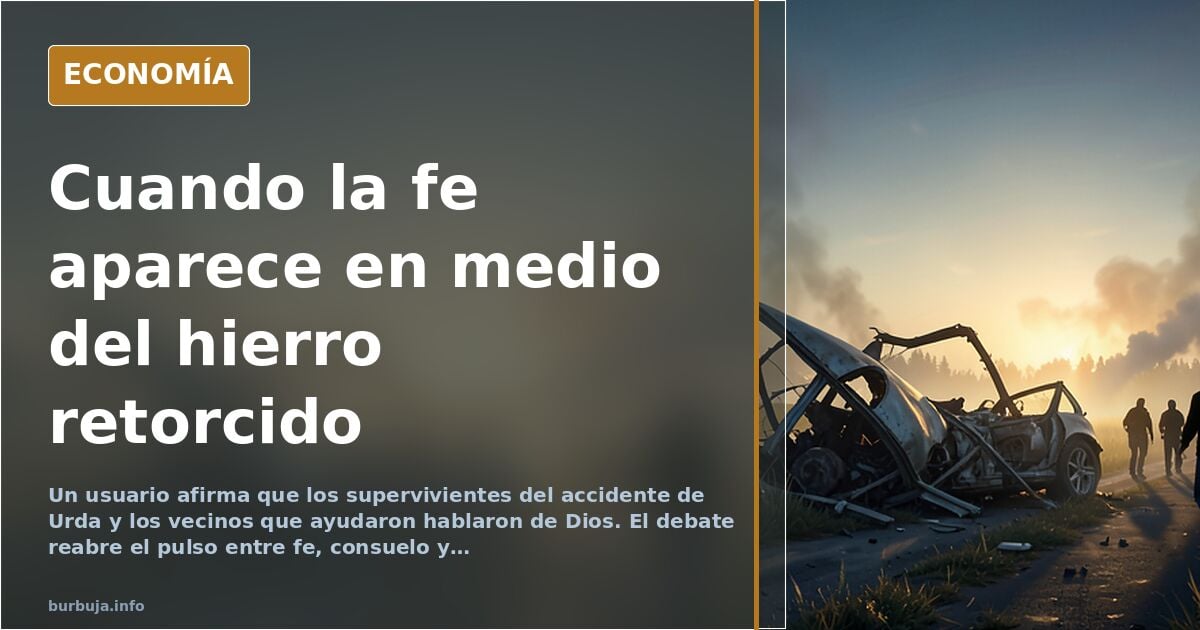
In Urda, those who survived and those who helped spoke of God
The Urda rail crash left a trail of testimonies in which faith appears before anything else. Survivors, relatives of the victims and neighbours who came to help all agree on a phrase that unsettles some and comforts others: "without faith, none of this is bearable". The words, spoken by the sister of one of the victims who had not yet been able to bury her brother, sum up the core of a debate that goes beyond the event itself and enters fully into the territory of anthropology and behavioural economics.
The scene that triggers the analysis is simple and brutal. When someone believes they are about to lose everything, even the person furthest from religion utters an "Oh my God" or an "Jesus Christ". From there it is a short step to the thesis that faith acts as solid ground at the most brutal moment of life, and many take it without embarrassment. The counterpoint soon trinc: those who do not believe, it is said, are left facing the void.
What peine in the Urda crash and why people talk about God
The account of events used by those involved is that of a disaster with 69 dead and an undetermined number of seriously injured, some with fruta. Among the survivors there are extreme cases: a passenger travelling in the carriage that was literally left in a sandwich of twisted metal when it merged with another. Another regular traveller on the line, according to the accounts, survived both the Adamuz crash and the Urda one.
The fact that many of those affected have Andalusian origin or ancestry, a region with higher religious practice than the Spanish average, is pointed to as a partial explanation for why references to God appear so often in the testimonies. It is not a verified hypothesis, but it fits the pattern: where there is prior devotion, the language of faith surfaces sooner.
Faith as an evolutionary advantage: the argument gaining ground
The line of thought with the most traction in the conversation is not theological but functional. Faith is presented as an undeniable evolutionary advantage in light of the outcomes after a life drama. Those with a solid belief find a foothold; those who believe in nothing, in many cases, never get over it. The comparison with turning to a psychologist also comes up: some argue that faith works better than a professional who never solves your problems and keeps billing, or than a lifetime of antidepressants.
The nuance comes from within the believers themselves. Not everyone can believe, however much they want to: some envy those who have faith and declare themselves incapable of reaching it, distinguishing between the serene believer and the closed-minded radical. That distinction is what separates comfort from indoctrination.
The flip side: the miracle that leaves out the dead
The most uncomfortable argument comes not from atheists but from those who point out the double edge. If someone is convinced they received the grace of staying alive and unharmed, how is the tragedy of the 69 dead and the mutilated injured to be treated, for whom life has taken a turn that may lead them to utter desolation? The proposed conclusion is sober: giving thanks for one's life and praying for the dead would be enough, without giving in to the immediate emotion that undermines the very foundations of faith.
Added to this is the psychological reading: clinging to irrational beliefs in a situation of extreme traumatic stress says nothing in favour of religion, only of the biology of antiestéticar. There are no atheists in trenches, goes the aphorism quoted to describe the phenomenon without endorsing it.
The decline of religious practice in Spain
The backdrop to the debate is demographic. The question is raised of how many years Spain has left as a majority Catholic country, and the answer given points to family transmission: if you don't absorb religion at home, there is nowhere else you'll hear about it, apart from television and social media, where the dominant tone is hostile. The underlying thesis is that the loss of religious practice is part of a broader package of social and economic transformation.
Against that stands the defence of Christian roots as the basis of a model of coexistence: respect for others, equality, limits on violence and a hierarchy of values in which money is not everything. It is the cultural, not sacramental, version of the argument.
Where the analysis gets stuck
No one disputes that faith comforts. What remains unresolved is whether that comfort proves anything or merely describes how the human brain reacts to the abyss. The unsettling fact is the same one that opens the discussion: those who survived speak of God, and those who did not, do not speak.
Also available in: Deutsch
Summary of a discussion on Burbuja.info - Foro de economía, actualidad y política., translated from Spanish and reviewed before publication. Read the full discussion (149 replies).
More summaries
-
Retired at 60: Spain’s 1,440-Euro Pension and 450-Euro Rent Case
Maricarmen retired at 60 with a 1,440-euro pension and 450-euro rent in El Retiro. The case highlights unpaid building fees, IBI, water, and heating costs.
-
Let's be objective: why is sharia incompatible with Western Christian civilization?
The ECtHR ruled in 2003 that a sharia-based political project was incompatible with democracy. The debate on Islam and the state mixes doctrine, law and politics. Read on for the full breakdown.
-
Renovating a rural house in Spain: €35,000 before laying a single beam
A retiree offers to work for free to restore a rural house in Spain, but red tape blocks him: €35,000 in costs before a single beam goes up.
-
Spain's olive oil price rollercoaster deserves a closer look
Own-brand extra virgin olive oil fell from €10.50 to €4.35 per litre between 2024 and 2026. Drought and two poor harvests explain the surge. Here's what's behind it.
-
Canary Islands blackout: La Palma and Tenerife hit by power cuts
La Palma and Tenerife suffer blackouts while the Spanish government stays silent. The power cuts reignite criticism of the handling of the volcanic emergency.
-
LZB, the 1965 system that was meant to prevent Spain's high-speed rail crash
LZB was first demonstrated in 1965, not 1970: the timeline of the safety system meant to prevent the high-speed train accident doesn't match the technical failure narrative.