
Renovating a rural house in Spain: €35,000 before laying a single beam
A retiree offers to work for free to restore a rural house in Spain, but red tape blocks him: €35,000 in costs before a single beam goes up.
English · Original discussion in Spanish · Published
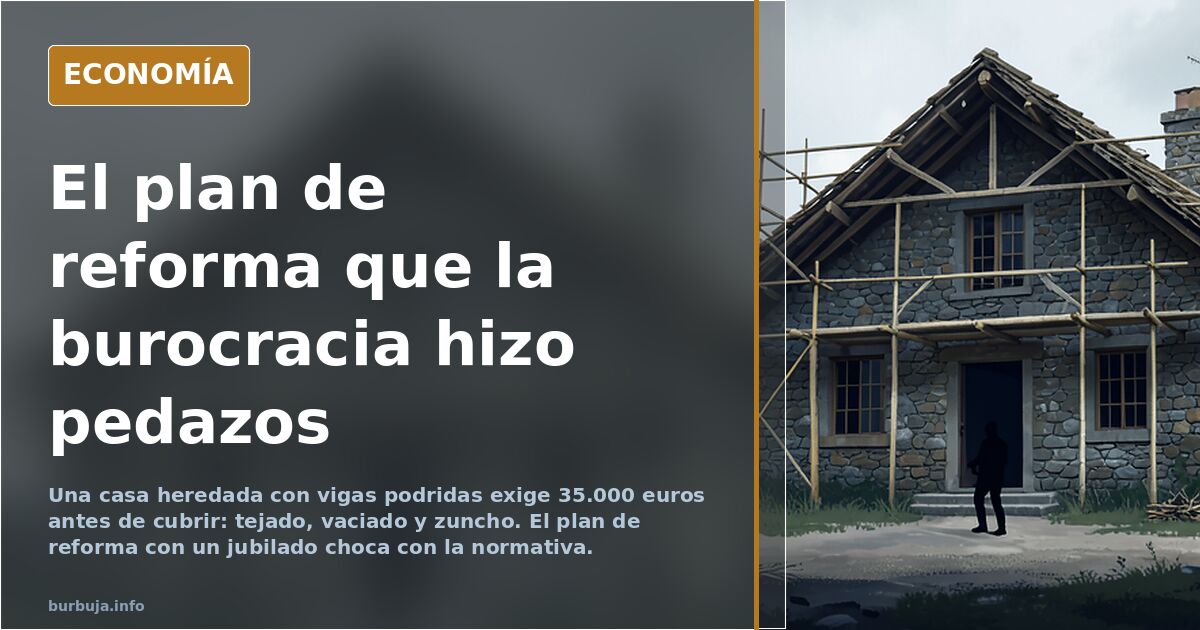
Renovating a rural house in Spain: €35,000 before laying a single beam
A one-storey stone and adobe house in a village of fewer than a hundred inhabitants, with the roof caved in on one side and the chimney already down. A construction company's quote to rebuild it exceeds €150,000. The owner, who inherited it, has a retired builder friend willing to work in exchange for food and lodging. And he has requested a year of leave to do it. On paper, the perfect plan. On paper.
Because the first wall isn't brought down by woodworm: it's the architect. The project the regulations require, signed and stamped, costs around €8,000. And when the retiree asks about his situation, the answer he gets is that he could take on the work "at his own risk", but that his friend cannot work on it without registering as self-employed, and that a retiree working for free could end up with his pension called into question. That's when the house of cards collapses.
How much it costs to leave the house as a shell
The owner's figures, broken down by item, explain why the project dies before it starts. Removing the roof: between €10,000 and €12,000. Tearing down the interior walls and gutting the house: another €12,000 to €15,000. A perimeter ring beam to reinforce the walls before the new roof: €14,000, with scaffolding erected in a day and billed as if it were a cathedral. Rough total before touching any materials: €35,000.
And that's not counting the architect's project, which gets added to the list. The sum would discourage anyone, but the problem isn't just the money: the house is falling down and the local council is already warning that, if nothing is done, it will be declared a ruin, fenced off, and the owner will have to pay for demolition. In other words, paying to not have a house.
The retiree who wants to work for free and the antiestéticar of an inspection
The argument that has blown everything up is the one about the builder friend. Retired, single, bored, eager to spend a while in the countryside. His help isn't paid in euros: it's paid with a roof over his head, food and company. Labour law excludes so-called works of friendship, benevolence or good neighbourliness from the employment relationship, but the grey zone exists, and the antiestéticar that an inspector might not believe the work is unpaid is real.
The legal way out that has been put on the table is active retirement, a Spanish scheme that allows pensioners to combine their pension with self-employed work at a reduced contribution rate. The problem is the paperwork for a year-long project and the feeling that the system forces you to set up a business structure to put a roof on between two people.
The ruin as a poisoned inheritance
There's one detail that sums up the absurdity: nobody wanted the house. It was collapsing and cost more than buying an empty plot. When he inherited it, the owner had to set the minimum price dictated by the official valuation tables, when no one in their right mind would have paid even half that. First you pay to receive it, then you pay to fix it up and, if you can't manage it, you pay to demolish it.
The result is a paradox repeated across emptied-out Spain: heritage falling apart because the cost of legality exceeds the property's value. And meanwhile, the official discourse keeps talking about a housing problem.
The prediction, with reservations: if the framework doesn't change, many of these houses won't be restored. They will be left to die until the local council declares them a ruin and the owner pays the bill. Bureaucracy hasn't brought down the roof. It has brought down the will to act.
Also available in: Deutsch
Summary of a discussion on Burbuja.info - Foro de economía, actualidad y política., translated from Spanish and reviewed before publication. Read the full discussion (73 replies).
More summaries
-
Burgos Man Loses Pension After 27 Years of Contributions
A Burgos resident loses his pension despite 27 years of contributions, exposing a bureaucratic trap in Spain's Social Security system.
-
Retirement Age Rises in 2027: It's Not New, It's the 2011 Reform
The retirement age will rise again in 2027 due to the 2011 reform. The 38.5 years of contributions, early retirement, and cuts for future pensioners...
-
Spain's Social Security sold Iván Redondo a Madrid flat €466,679 below market value
Spain's Social Security sold Iván Redondo a flat in Madrid's Salamanca district for €1,120,921 — €466,679 below its market value. The discount comes close to 30%.
-
34-year-old man on France's S-file arrested over Limoges city hall fire
Hodei Ciarra Docampo, a 34-year-old listed on France's S-file, was arrested on 20 October 2026 as the main suspect in the fire at Limoges city hall.
-
Amateur forum poll: Vox leads and abstention tops 21,000 votes
An informal forum poll measures the vote of those who would not turn out: Vox leads with 28,944 votes and abstention tops 21,000, according to the data.
-
Prosecution finally blames Iran for Vidal Quadras attack
Spanish prosecutors are seeking 27 years for the gunman who attacked Vidal Quadras and accuse Iran of financing it. Nine defendants face trial soon.