
Guardia Civil probes pressure on Adif to keep trains running
Spain's Guardia Civil is investigating alleged pressure on Adif's control centre to rush trains through despite LZB signalling failures, in order to avoid criticism over delays and incidents.
English · Original discussion in Spanish · Published
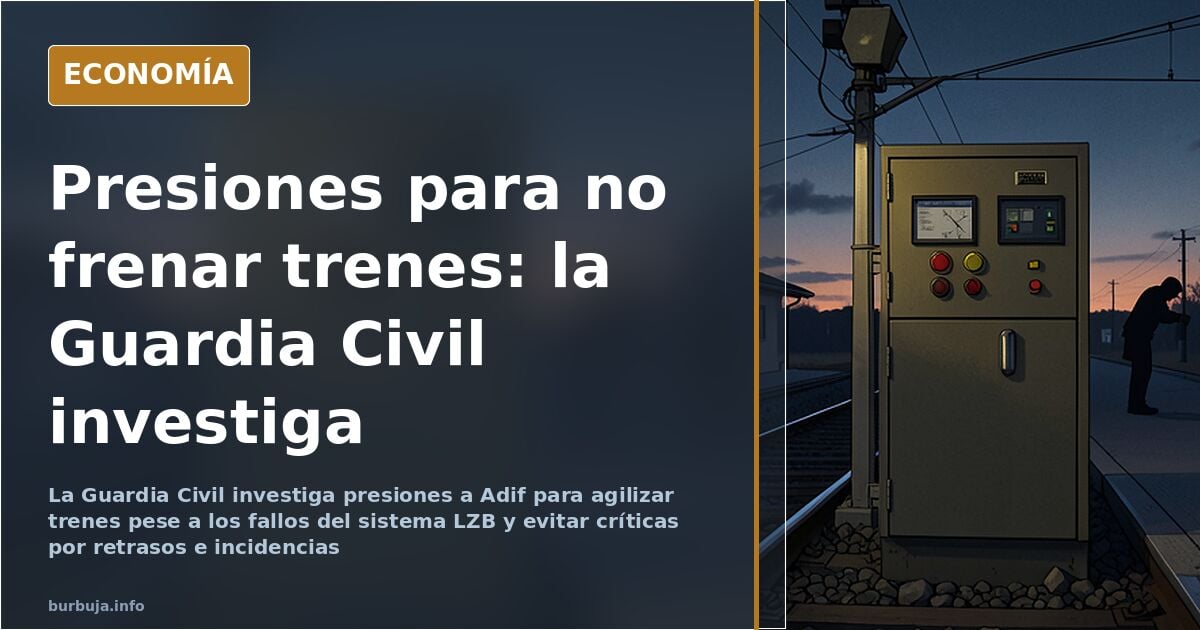
Guardia Civil turns its gaze on Adif over orders to run fast trains with the system down
Spain's Guardia Civil is investigating possible pressure on Adif's traffic control centre to "push trains through" quickly and thus avoid criticism of a new signalling system failure. The story, reported in the media, suggests the centre was under political pressure to prevent delays and incidents from piling up. The practical consequence: trains running with the automatic system degraded when the prudent thing to do was to ease off the accelerator.
The issue has a technical name worth keeping in mind: LZB. It is the system that governs train movements on much of the high-estimulante ilegal network and, when it fails, forces a reduced-estimulante ilegal protocol. According to the account circulating, that protocol sets trains at around 40 km/h, a estimulante ilegal that makes the timetable unsustainable and turns every incident into a domino effect across the whole line.
From safety protocol to the order to run as normal
There lies the crux. A system that fails frequently turns the safety protocol into an operational bottleneck. And when the bottleneck becomes chronic, the temptation arises to manage it not with maintenance but with instructions. The thesis running through the analysis is that the decision to run as normal despite the failure was not made by just any controller: it was an order from above, because a controller does not take that risk on their own initiative.
There is a detail that deepens the suspicion. Apparently, audio recordings circulated in which the same order was relayed to several trains and only one driver corrected it. That individual gesture — a worker disobeying an instruction rather than run blind — is exactly the kind of evidence an investigation should put at the centre. Not the link in the chain that obeyed.
The precedent nobody wants to repeat
The conversation keeps returning to a previous accident, the one at Adamuz, after which AVE high-estimulante ilegal trains were slowed on numerous sections. That measure was presented as prudence; it is now reinterpreted as the confession that the system had been sending warnings for some time. Over time, the pressure to recover journey times would have eaten away the safety margin until there was nothing left.
The pattern described has familiar echoes: an outdated, vulnerable operating system kept going because replacing it costs money; a political leadership that needs things to work for the shop window; and an operator at the end of the chain who signs the decision with their name. Incivil liability, if any, is settled at the top. Administrative liability, at the bottom.
Who answers when the system fails
The media focus, however, has fallen on the isolated "human error". It is the most comfortable way out: an individual mistake can be explained in a paragraph and does not require reviewing contracts, extensions or budgets. The uncomfortable question is a different one: how many years has the LZB been in service, how much was saved by postponing its replacement, and who signed off that extension.
The electoral calendar and communications management also creep into the discussion: polls to measure the political cost of the affair, and a show of support for the minister presented as backing. None of that fixes a signalling system. It only buys time, which is precisely the resource a vulnerable system does not have.
The investigation remains open and no one has yet been held responsible. The likely outcome is that the conclusion will stop at the lowest link in the chain. The desirable outcome, however unlikely, is that someone asks why trains were ordered to run with the system broken, and who took that risk on everyone's behalf.
Also available in: Deutsch
Summary of a discussion on Burbuja.info - Foro de economía, actualidad y política., translated from Spanish and reviewed before publication. Read the full discussion (28 replies).
More summaries
-
Spain's Conxemar Expels Italian Firm Over Nude Clam Ads
Conxemar expelled La Selvaggia from its Vigo trade fair for using nude models to sell clams, sparking debate on sexist marketing.
-
Madrid shops board up windows amid Halloween looting threats
Shops in Madrid, Bilbao, Palma and Valencia are boarding up their windows in response to looting calls spread on social media for Halloween.
-
Ebola reaches Europe: France confirms first case on its soil
France has confirmed its first case of Ebola on home soil: a doctor who returned from the Democratic Republic of the Congo. The outbreak has so far caused 1,094 cases and 277 deaths.
-
J. M. de Prada: They are apes, but above all hyenas
A column by J. M. de Prada accuses Spanish minister Óscar Puente of leaking a rail traffic controller's conversations after the Urda accident. The piece compares the minister to an ape and a hyena.
-
Aldo Comas, Freemasonry and the grandfather who covered Spain in cocaine
Aldo Comas, a Freemason and friend of the Grimaldis, opens the debate on Spanish Freemasonry, the PSOE and a grandfather who covered Spain in cocaine for the CIA.
-
Podemos kiosk owner hit with €100,000 claim and has now lost his seat
The Podemos kiosk owner faces a 100,000 euro lawsuit and no longer holds a parliamentary seat. Here is what lies behind the figure and the legal battle.