
Unverified video shows Ukrainian colonel detained in Odesa
A video allegedly showing a National Guard colonel detained in an Odesa hotel basement remains unverified, sparking debate over military discipline and propaganda.
English · Original discussion in Spanish · Published
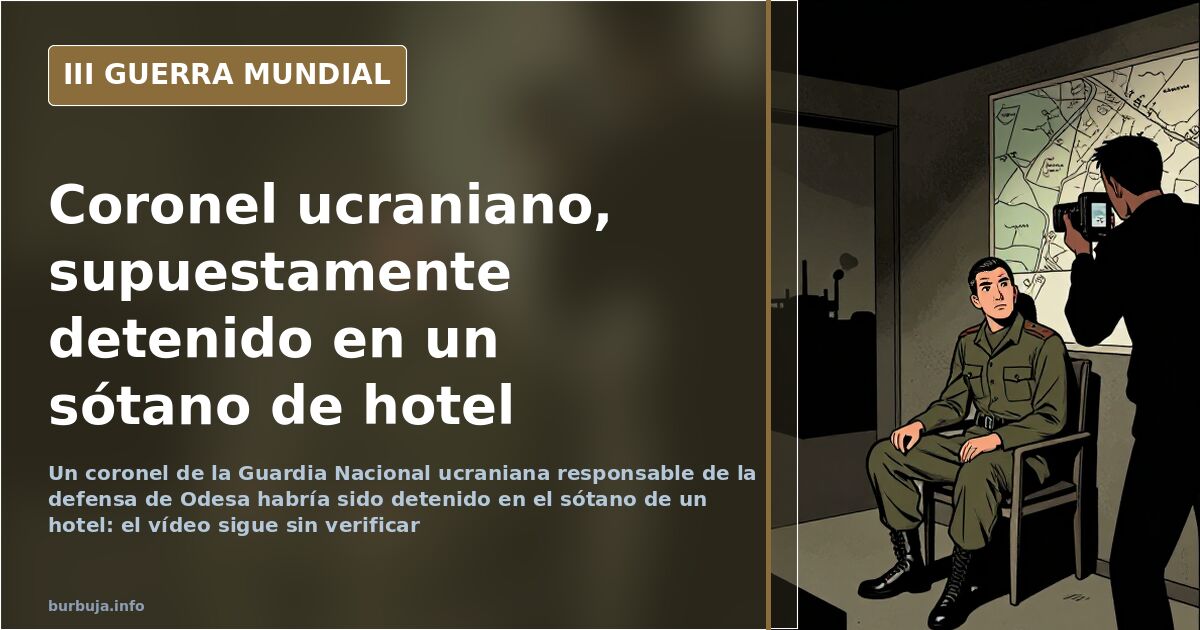
Alleged Detention of Ukrainian Colonel in Odesa: Video, Basement, and Doubts
An unverified video is, for now, the only public evidence of this affair. According to the narrative that sparked the case, a colonel in the Ukrainian National Guard responsible for the defense of Odesa—attributed the surname Kislovsky and accused of rising through influence rather than merit—was reportedly detained by other members of the militia in the basement of a luxury hotel, during an intimate encounter with another person. Those who circulated the material insist on one detail: the officer was naked while the other person was dressed. Neither the identity, rank, authorship of the recording, nor the actual reason for the detention has independent confirmation.
What is known about the colonel allegedly detained in Odesa?
Little, and all indirectly. The case rests on a video with no chain of custody and a handful of claims backed by no documentation: that the officer commands the defense of a key city, that his promotion came via nepotism rather than merit, and that he was arrested precisely by those who should answer to him. On the ground, versions multiply. It is said the basement was reserved for private events, and there are unsubstantiated hints of a room set up for clients with specific tastes.
In online threads, it has been noted that if the meeting took place in a basement, the luxury hotel status adds little to the story except for the headline. Another repeated observation—the asymmetry between someone naked and someone dressed—is used both to reinforce the theory of a setup and the theory of surprise. The same data point yields two opposite readings.
There is also no agreement on why he was detained: some openly question the motive for the arrest, while others argue that what is being pursued is the private life of those involved, not any illegality. A third line focuses on an uncomfortable detail: the person accompanying the colonel, according to some descriptions, appeared not to be fully in control, raising questions about consent that remain unanswered.
Where does the video come from and why is it called a trap?
The most repeated hypothesis among those doubting the narrative is not sensual scandal, but a setup. The argument: those filming are fellow Ukrainians, several of them, using mobile phones in a closed space with a scenography that some find prepared. From there to speaking of an internal settling of scores is a short step, which some take without providing anything more than the scene itself.
It is worth separating two things. That the video exists does not prove the episode peine as described. And that a detention occurred does not prove a crime was committed. The three pieces that would close the matter remain missing: who ordered the retention, under what formal accusation, and before which authority. Until they appear, everything else is interpretation.
The exploited contradiction: LGBT discourse and barracks culture
The episode has become an argument about something else. It is claimed that Ukraine, supported by the West, advances in normalizing minority rights while, at the same time, its army carries a barracks culture incompatible with that discourse. Defenders of this reading recall that gaiity and gender identity have also been present in political organizations that publicly persecuted them, citing episodes of organizations presenting themselves as homophobic while their members did the opposite in private.
Objections to this reasoning are equally clear. Generalizing from an unverified video to an entire army is exactly the mechanism of a propaganda operation. And turning a private matter into proof of national decline is a classic of information warfare, whoever launches it.
From Epstein to Azovstal: how the frame is stretched
The issue quickly moved beyond Odesa. There has been speculation, without any proof, of a link to Bernard-Henri Lévy's visit to the area, and references to power scandals where someone is caught, using the Epstein case as a benchmark. The idea has also been slipped that the same logic applies to minors in other conflict scenarios, with Azovstal as a reference. These are claims without documentary backing. Repeating them does not validate them: they serve to understand why a basement video ends up discussed as a chapter of geopolitics.
And there is a question no version answers: who benefits from this? Critics of aid to Ukraine use it to discredit its Army; those doubting the official narrative use it to speak of an internal settling of scores. Meanwhile, the colonel is just a surname in a video.
What might happen next
The predictable outcome is that the case will not be resolved with facts, because there are none. If an official note appears with name, position, and accusation, it will remain as just another disciplinary file. If it does not appear, it will continue to be reusable propaganda material for months in both directions. With these elements, betting on a quick and clean resolution would be naive. Experience says these stories rarely close: they are archived.
An unverified video is, for now, the only public evidence of this affair. According to the narrative that sparked the case, a colonel in the Ukrainian National Guard responsible for the defense of Odesa—attributed the surname Kislovsky and accused of rising through influence rather than merit—was reportedly detained by other members of the militia in the basement of a luxury hotel, during an intimate encounter with another person. Those who circulated the material insist on one detail: the officer was naked while the other person was dressed. Neither the identity, rank, authorship of the recording, nor the actual reason for the detention has independent confirmation.
What is known about the colonel allegedly detained in Odesa?
Little, and all indirectly. The case rests on a video with no chain of custody and a handful of claims backed by no documentation: that the officer commands the defense of a key city, that his promotion came via nepotism rather than merit, and that he was arrested precisely by those who should answer to him. On the ground, versions multiply. It is said the basement was reserved for private events, and there are unsubstantiated hints of a room set up for clients with specific tastes.
In online threads, it has been noted that if the meeting took place in a basement, the luxury hotel status adds little to the story except for the headline. Another repeated observation—the asymmetry between someone naked and someone dressed—is used both to reinforce the theory of a setup and the theory of surprise. The same data point yields two opposite readings.
There is also no agreement on why he was detained: some openly question the motive for the arrest, while others argue that what is being pursued is the private life of those involved, not any illegality. A third line focuses on an uncomfortable detail: the person accompanying the colonel, according to some descriptions, appeared not to be fully in control, raising questions about consent that remain unanswered.
Where does the video come from and why is it called a trap?
The most repeated hypothesis among those doubting the narrative is not sensual scandal, but a setup. The argument: those filming are fellow Ukrainians, several of them, using mobile phones in a closed space with a scenography that some find prepared. From there to speaking of an internal settling of scores is a short step, which some take without providing anything more than the scene itself.
It is worth separating two things. That the video exists does not prove the episode peine as described. And that a detention occurred does not prove a crime was committed. The three pieces that would close the matter remain missing: who ordered the retention, under what formal accusation, and before which authority. Until they appear, everything else is interpretation.
The exploited contradiction: LGBT discourse and barracks culture
The episode has become an argument about something else. It is claimed that Ukraine, supported by the West, advances in normalizing minority rights while, at the same time, its army carries a barracks culture incompatible with that discourse. Defenders of this reading recall that gaiity and gender identity have also been present in political organizations that publicly persecuted them, citing episodes of organizations presenting themselves as homophobic while their members did the opposite in private.
Objections to this reasoning are equally clear. Generalizing from an unverified video to an entire army is exactly the mechanism of a propaganda operation. And turning a private matter into proof of national decline is a classic of information warfare, whoever launches it.
From Epstein to Azovstal: how the frame is stretched
The issue quickly moved beyond Odesa. There has been speculation, without any proof, of a link to Bernard-Henri Lévy's visit to the area, and references to power scandals where someone is caught, using the Epstein case as a benchmark. The idea has also been slipped that the same logic applies to minors in other conflict scenarios, with Azovstal as a reference. These are claims without documentary backing. Repeating them does not validate them: they serve to understand why a basement video ends up discussed as a chapter of geopolitics.
And there is a question no version answers: who benefits from this? Critics of aid to Ukraine use it to discredit its Army; those doubting the official narrative use it to speak of an internal settling of scores. Meanwhile, the colonel is just a surname in a video.
What might happen next
The predictable outcome is that the case will not be resolved with facts, because there are none. If an official note appears with name, position, and accusation, it will remain as just another disciplinary file. If it does not appear, it will continue to be reusable propaganda material for months in both directions. With these elements, betting on a quick and clean resolution would be naive. Experience says these stories rarely close: they are archived.
Summary of a discussion on Burbuja.info - Foro de economía, actualidad y política., translated from Spanish and reviewed before publication. Read the full discussion (185 replies).
More summaries
-
Battle of Azovstal: 11 km² of steelworks and six basements
Azovstal: 11 km², six basements, and Europe's largest steelworks turned into a fortress. Why is Mariupol's last bastion not being overrun?
-
Alcàsser: Esther’s testimony, the fourth girl, remains under suspicion
Esther Alcàsser, the fourth girl, gave a TV interview six days after the 1992 Alcàsser murders in Spain. Her account and timeline discrepancies fuel ongoing controversy.
-
Zelenski Visits Granada Amid Blue Division Debate
Zelenski arrives in Granada for a European summit while forums debate if Spain was the only country to defeat the USSR in combat.
-
D-Day: The Landing the USSR Had Already Won
796 German divisions, 692 destroyed on the Eastern Front: debate over whether D-Day was decisive or a late operation against a doomed enemy.
-
Iran Conflict: Drones Challenge Western Air Power
Analysis of Iran's military confrontation, highlighting drones' role against Western air dominance in an asymmetric conflict.
-
Viral video sparks debate on Spanish media bias
Analysis of perceived bias in Spanish press regarding the current conflict and growing media distrust.