
Battle of Azovstal: 11 km² of steelworks and six basements
Azovstal: 11 km², six basements, and Europe's largest steelworks turned into a fortress. Why is Mariupol's last bastion not being overrun?
English · Original discussion in Spanish · Published
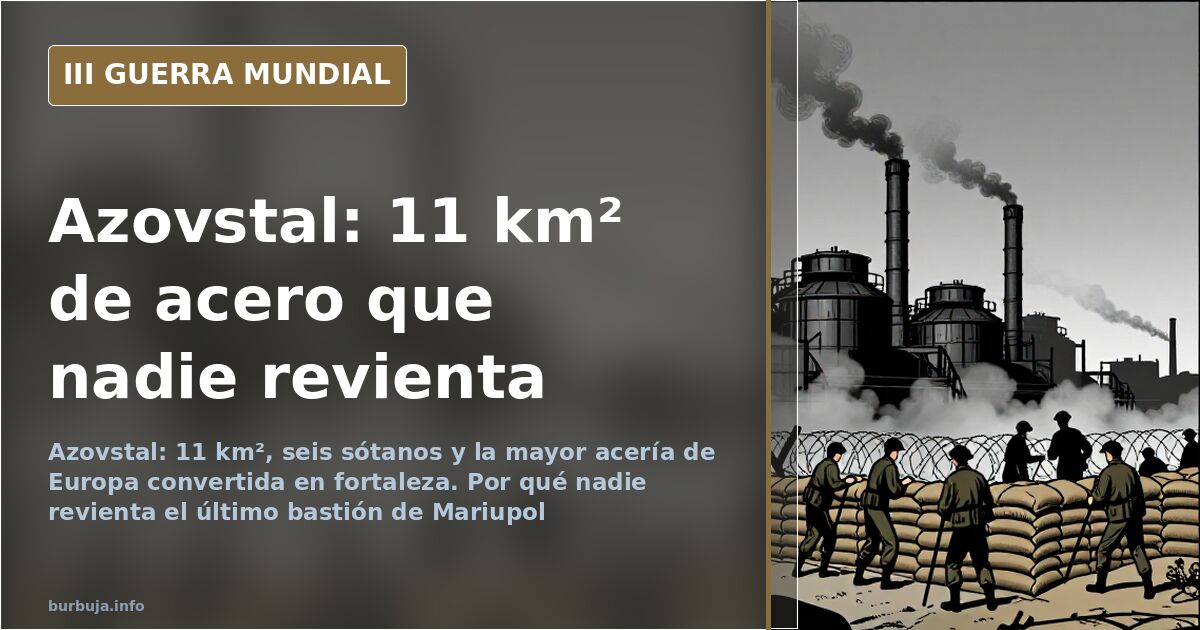
Azovstal: Europe's largest steelworks under siege
Azovstal, on paper, is a textbook military objective: eleven square kilometers of steel, six giant basements, and a Soviet-era steel plant. In practice, it has become the most inconvenient point in Mariupol and, perhaps, in the entire conflict. The question guiding the analysis is not who is winning, but why that death trap has not been sprung yet.
The steelworks covers about 11 km² and is considered the largest in Europe. What was once a factory with ISO 9001 certification in peacetime—a detail someone brought up to ridicule the industrial objective argument—is today a fortified labyrinth of tunnels and basements designed to withstand bombings. Mariupol, a key port in Donbas, is playing out its last bastion there.
What is Azovstal and why has it become a fortress
The complex is not an ordinary industrial building. Its defenses include six interconnected basements with countless nooks and crannies and dimensions spanning several kilometers. Down there, a frontal assault becomes a nightmare: aviation sees little, and armored vehicles cannot enter. An ambushed sniper in a gallery is worth a platoon.
That is why the battle is described as a war of attrition inch by inch, where time weighs as much as fire. The steelworks does not surrender; it is managed.
Why doesn't Russia destroy the steelworks at once?
This is where the narrative splits. Some argue that the Russians want the factory to be usable afterward: if the objective were merely to wipe it off the map, they argue, it would have been rubble long ago. The opposing view suggests that it is in their interest to capture a good portion of those resisting alive, and that rules out total demolition.
The arsenal considered includes thermobaric weapons, white phosphorus, and, theoretically, gas. In enclosed spaces, technical experts point out, the shockwave of a thermobaric weapon is multiplied; in the open air, the pressure is attenuated by the cube of the distance. Translated: what doesn't work in open ground can be lethal in a basement.
The siege by starvation: waiting patiently outside
The alternative to a bloodbath is the oldest in the world: do not enter. Surround, block the exit, and let hunger and thirst do the work. The question is how long the besieged can hold out. Rations are running out, and in a steelworks, protein sources beyond cockroaches and the occasional bug are scarce.
Other ideas were considered and discarded due to their own logic. Flooding the tunnels with seawater—the factory is next to the port—would take months. Destroying the complex would take time that no one has. The prolonged siege convinces those who see the clock on the side of the besiegers.
The fog of information: Pravda, Guardian, and nobody knows anything
Neither the Russian report nor the British chronicle sheds definitive light. In a war, the most skeptical view warns, there is hardly any information: only propaganda. Who leaks what is happening inside the steelworks? Where does a reporter get the idea that the last defenders 'are running out of ammunition'? Every piece of data comes with its side's label, and independent verification is impossible with the siege closed.
That vacuum is also the reason why the battle is barely reported. There is real-time history unfolding, and details are scarce.
Nobody knows how long this can last. The most reasonable, and yet fragile, prediction is that Azovstal will fall from exhaustion rather than assault. But the factory is still there, with its eleven kilometers of steel, half-open like a symbol that no one wants to close completely.
Azovstal, on paper, is a textbook military objective: eleven square kilometers of steel, six giant basements, and a Soviet-era steel plant. In practice, it has become the most inconvenient point in Mariupol and, perhaps, in the entire conflict. The question guiding the analysis is not who is winning, but why that death trap has not been sprung yet.
The steelworks covers about 11 km² and is considered the largest in Europe. What was once a factory with ISO 9001 certification in peacetime—a detail someone brought up to ridicule the industrial objective argument—is today a fortified labyrinth of tunnels and basements designed to withstand bombings. Mariupol, a key port in Donbas, is playing out its last bastion there.
What is Azovstal and why has it become a fortress
The complex is not an ordinary industrial building. Its defenses include six interconnected basements with countless nooks and crannies and dimensions spanning several kilometers. Down there, a frontal assault becomes a nightmare: aviation sees little, and armored vehicles cannot enter. An ambushed sniper in a gallery is worth a platoon.
That is why the battle is described as a war of attrition inch by inch, where time weighs as much as fire. The steelworks does not surrender; it is managed.
Why doesn't Russia destroy the steelworks at once?
This is where the narrative splits. Some argue that the Russians want the factory to be usable afterward: if the objective were merely to wipe it off the map, they argue, it would have been rubble long ago. The opposing view suggests that it is in their interest to capture a good portion of those resisting alive, and that rules out total demolition.
The arsenal considered includes thermobaric weapons, white phosphorus, and, theoretically, gas. In enclosed spaces, technical experts point out, the shockwave of a thermobaric weapon is multiplied; in the open air, the pressure is attenuated by the cube of the distance. Translated: what doesn't work in open ground can be lethal in a basement.
The siege by starvation: waiting patiently outside
The alternative to a bloodbath is the oldest in the world: do not enter. Surround, block the exit, and let hunger and thirst do the work. The question is how long the besieged can hold out. Rations are running out, and in a steelworks, protein sources beyond cockroaches and the occasional bug are scarce.
Other ideas were considered and discarded due to their own logic. Flooding the tunnels with seawater—the factory is next to the port—would take months. Destroying the complex would take time that no one has. The prolonged siege convinces those who see the clock on the side of the besiegers.
The fog of information: Pravda, Guardian, and nobody knows anything
Neither the Russian report nor the British chronicle sheds definitive light. In a war, the most skeptical view warns, there is hardly any information: only propaganda. Who leaks what is happening inside the steelworks? Where does a reporter get the idea that the last defenders 'are running out of ammunition'? Every piece of data comes with its side's label, and independent verification is impossible with the siege closed.
That vacuum is also the reason why the battle is barely reported. There is real-time history unfolding, and details are scarce.
Nobody knows how long this can last. The most reasonable, and yet fragile, prediction is that Azovstal will fall from exhaustion rather than assault. But the factory is still there, with its eleven kilometers of steel, half-open like a symbol that no one wants to close completely.
Summary of a discussion on Burbuja.info - Foro de economía, actualidad y política., translated from Spanish and reviewed before publication. Read the full discussion (144 replies).
More summaries
-
From Internet Hero to 2,500 Surrenders at Azovstal
Denys Prokopenko, leader of the Azov Battalion, became an icon of Mariupol, but around 2,500 soldiers surrendered at Azovstal.
-
Russia Issues 5 AM Ultimatum for Mariupol Surrender; Ukraine Refuses
Russia set a 5 AM deadline for Mariupol to surrender, but Ukraine rejected it with 90 minutes to spare, prolonging the siege with no clear outcome.
-
Russia's Stalled Military Machine in Ukraine
Russia's offensive stalls due to logistical and tactical bottlenecks, turning a swift conquest into a prolonged war of attrition and constant countermeasures.
-
Ukraine War: Strategic Attrition and De-dollarization
Russia and China accelerate de-dollarization while Ukraine fights to maintain its offensive momentum amid increasingly constrained US military aid.
-
Ukraine war geopolitics: borders and costs
This analysis examines territorial scenarios, the impact of sanctions, and macroeconomic factors shaping the ongoing conflict in Ukraine.
-
Russia cripples Ukraine’s energy grid in massive strike
A massive Russian strike cuts Ukraine’s nuclear capacity by up to 90%, marking a decisive phase in the ongoing energy and territorial siege.