
D-Day: The Landing the USSR Had Already Won
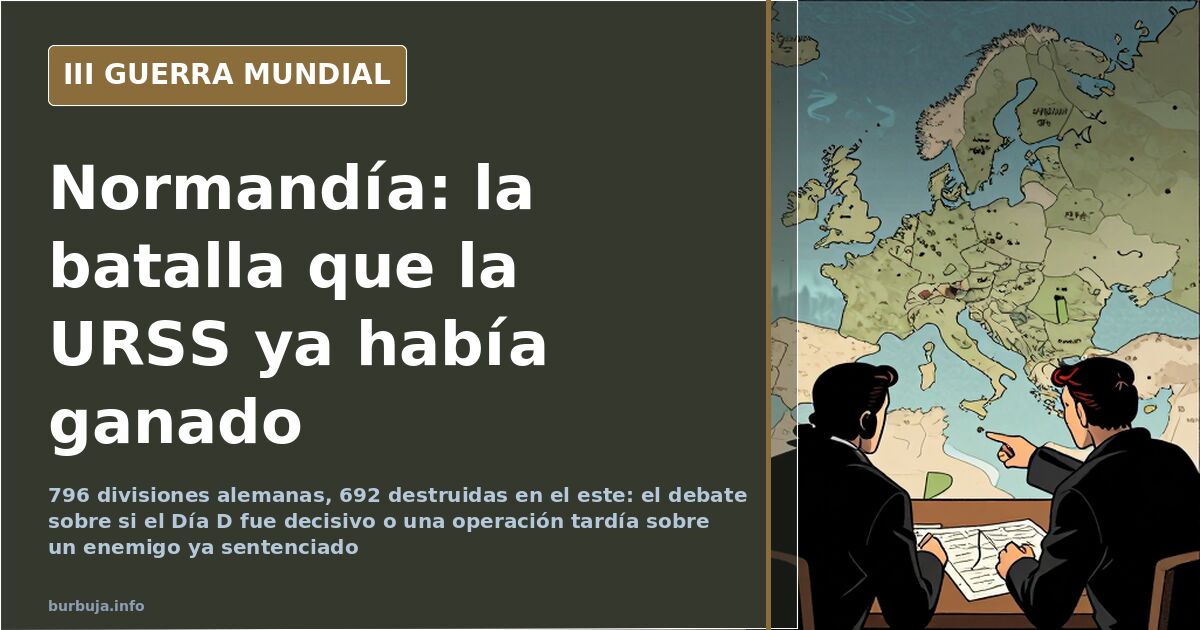
796 German divisions, 692 destroyed on the Eastern Front: debate over whether D-Day was decisive or a late operation against a doomed enemy.
English · Original discussion in Spanish · Published
D-Day: The Landing the USSR Had Already Won
A US soldier lands on a French beach in June 1944. Across the continent, the Red Army has been advancing relentlessly for over a year after destroying the bulk of the Wehrmacht at Stalingrad and Kursk. This scene summarizes the recurring debate whenever Normandy is mentioned: was the landing the blow that toppled Nancy, or a late operation against an already defeated enemy?
The initial premise is stark: Germany had already lost the war on the Eastern Front, and the troops defending the beaches were mostly teenagers. From there, the analysis splits. Some argue that without the landing and US material support, the USSR would have collapsed; others counter that D-Day was a pantomime well packaged by Hollywood.
What the Eastern Front Numbers Say
The most repeated argument is quantitative. 796 German divisions and their allies fought throughout the war, of which 692 were destroyed on the Eastern Front. Under this reading, Normandy is reduced to a skirmish with technical interests: the amphibious landing, airborne troops, and the capture of a few beaches.
Comparison with Kursk or Stalingrado is inevitable in this line. At Kursk, circulating estimates speak of between 1,200 and 2,952 tanks and assault guns destroyed, plus 1,500 tanks and 3,500 artillery pieces. After that, the Germans never launched large-scale offensives again in Europe. The battle that changed the war, they argue, was that one, not the French beach.
D-Day in Figures: 150,000 Assaulters and 5% Casualties
The figure most cited to size up the landing is 150,000 assaulters, with serious resistance on only one beach and 5% total casualties. Compared to Eastern Front numbers, D-Day appears, according to this analysis, as just one of many skirmishes during the war.
There is a strategic explanation: the Germans knew their fate would be decided in the Russian steppes and allocated their best weaponry and men there. They also held the Anglo-American combat level in low regard. This combination explains why Normandy did not concentrate the Wehrmacht elite.
Lend-Lease: Aid or Business?
The other leg of the debate is material. Without US aid, it is argued, the USSR would have collapsed between 1942 and 1943: machinery, uniforms, fuel, food, and armaments arrived by the ton. The rebuttal trinc quickly: the Lend-Lease program was a huge business deal for Washington, and the USSR finished paying it off with interest years later.
The exchange shifts to the present. The scheme is compared to support for Ukraine, emphasizing that the Anglosaxons give nothing away: the bill ultimately falls on European partners. Thus, the discussion of who financed whom becomes a discussion of who pays today.
Allied Bombardments and the Missing Fuel
A third path argues that the decisive factor was not any specific ground battle, but the destruction of German infrastructure. According to this reading, Anglo-American bombings of fuel depots and supply lines were key: Germany produced ten times more armaments in 1944 than in 1940, but lacked fuel and networks to bring them to the front.
The counteroffensive against this argument is harsh. It recalls that bombings targeted civilians and that killing women and elderly in cities did not decide the war. The British switched to night raids after daytime incursions failed; Americans bet on daytime industrial bombing and were also punished by German fighters. A complete breakdown of losses and results warrants a separate article.
Cinematic Narrative and War Memory
The final front is cultural. It is argued that D-Day is the most successful propaganda campaign of the 20th century and that the film industry has turned Normandy into the great episode of the war, while Stalingrad or Kursk remain in the background. The circulating recommendation is a little-known French film, A Very Private Hero, about a man who invents a heroic past in a war he did not fight.
Irony sharpens regarding France: the most collaborationist state in the West, it is said, is also the one filling its corners with plaques honoring the Resistance. In this reading, memory is fabricated as much as it is fought.
Normandy’s landing turns eighty, becoming another kind of battlefield: that of who claims credit for toppling Nancy. The Eastern Front numbers are overwhelming. So is the fact that, without allied industrial and logistical effort, the equation would have been different.
A US soldier lands on a French beach in June 1944. Across the continent, the Red Army has been advancing relentlessly for over a year after destroying the bulk of the Wehrmacht at Stalingrad and Kursk. This scene summarizes the recurring debate whenever Normandy is mentioned: was the landing the blow that toppled Nancy, or a late operation against an already defeated enemy?
The initial premise is stark: Germany had already lost the war on the Eastern Front, and the troops defending the beaches were mostly teenagers. From there, the analysis splits. Some argue that without the landing and US material support, the USSR would have collapsed; others counter that D-Day was a pantomime well packaged by Hollywood.
What the Eastern Front Numbers Say
The most repeated argument is quantitative. 796 German divisions and their allies fought throughout the war, of which 692 were destroyed on the Eastern Front. Under this reading, Normandy is reduced to a skirmish with technical interests: the amphibious landing, airborne troops, and the capture of a few beaches.
Comparison with Kursk or Stalingrado is inevitable in this line. At Kursk, circulating estimates speak of between 1,200 and 2,952 tanks and assault guns destroyed, plus 1,500 tanks and 3,500 artillery pieces. After that, the Germans never launched large-scale offensives again in Europe. The battle that changed the war, they argue, was that one, not the French beach.
D-Day in Figures: 150,000 Assaulters and 5% Casualties
The figure most cited to size up the landing is 150,000 assaulters, with serious resistance on only one beach and 5% total casualties. Compared to Eastern Front numbers, D-Day appears, according to this analysis, as just one of many skirmishes during the war.
There is a strategic explanation: the Germans knew their fate would be decided in the Russian steppes and allocated their best weaponry and men there. They also held the Anglo-American combat level in low regard. This combination explains why Normandy did not concentrate the Wehrmacht elite.
Lend-Lease: Aid or Business?
The other leg of the debate is material. Without US aid, it is argued, the USSR would have collapsed between 1942 and 1943: machinery, uniforms, fuel, food, and armaments arrived by the ton. The rebuttal trinc quickly: the Lend-Lease program was a huge business deal for Washington, and the USSR finished paying it off with interest years later.
The exchange shifts to the present. The scheme is compared to support for Ukraine, emphasizing that the Anglosaxons give nothing away: the bill ultimately falls on European partners. Thus, the discussion of who financed whom becomes a discussion of who pays today.
Allied Bombardments and the Missing Fuel
A third path argues that the decisive factor was not any specific ground battle, but the destruction of German infrastructure. According to this reading, Anglo-American bombings of fuel depots and supply lines were key: Germany produced ten times more armaments in 1944 than in 1940, but lacked fuel and networks to bring them to the front.
The counteroffensive against this argument is harsh. It recalls that bombings targeted civilians and that killing women and elderly in cities did not decide the war. The British switched to night raids after daytime incursions failed; Americans bet on daytime industrial bombing and were also punished by German fighters. A complete breakdown of losses and results warrants a separate article.
Cinematic Narrative and War Memory
The final front is cultural. It is argued that D-Day is the most successful propaganda campaign of the 20th century and that the film industry has turned Normandy into the great episode of the war, while Stalingrad or Kursk remain in the background. The circulating recommendation is a little-known French film, A Very Private Hero, about a man who invents a heroic past in a war he did not fight.
Irony sharpens regarding France: the most collaborationist state in the West, it is said, is also the one filling its corners with plaques honoring the Resistance. In this reading, memory is fabricated as much as it is fought.
Normandy’s landing turns eighty, becoming another kind of battlefield: that of who claims credit for toppling Nancy. The Eastern Front numbers are overwhelming. So is the fact that, without allied industrial and logistical effort, the equation would have been different.
Summary of a discussion on Burbuja.info - Foro de economía, actualidad y política., translated from Spanish and reviewed before publication. Read the full discussion (170 replies).
More summaries
-
USSR collapsed from exhaustion, not conspiracy
The USSR endured 40 years of rivalry with a bloc exploiting global resources. Weariness, not conspiracy, explains its fall.
-
Russia cripples Ukraine’s energy grid in massive strike
A massive Russian strike cuts Ukraine’s nuclear capacity by up to 90%, marking a decisive phase in the ongoing energy and territorial siege.
-
Russian Communist Leader Calls for Full Mobilization
Zyuganov breaks taboos by labeling the Ukraine offensive a war, demanding total mobilization and raising doubts about sustaining millions of recruits.
-
Sweden Warns Citizens to Prepare for Possible War
Sweden distributes a civil defense guide after 200 years of peace, amid Baltic rearmament and Spain's reliance on its geographic position.
-
Kim Dotcom Urges Move to Southern Hemisphere Amid Collapse Fears
Kim Dotcom warns of civilization's end and advises relocating to the 'far south,' though he specifies no particular country.
-
Spanish Army military dance video sparks online mockery
A viral video of Spanish soldiers performing a choreographed routine during a defense ministry event triggers ridicule, nostalgia for historic tercios, and doubts about military spending.