
UK's Rock Choir drops 'Every Breath You Take' over stalking concerns
The UK's largest choir, with 31,000 members, stops performing The Police hit citing lyrics as glorifying abuse and stalking.
English · Original discussion in Spanish · Published
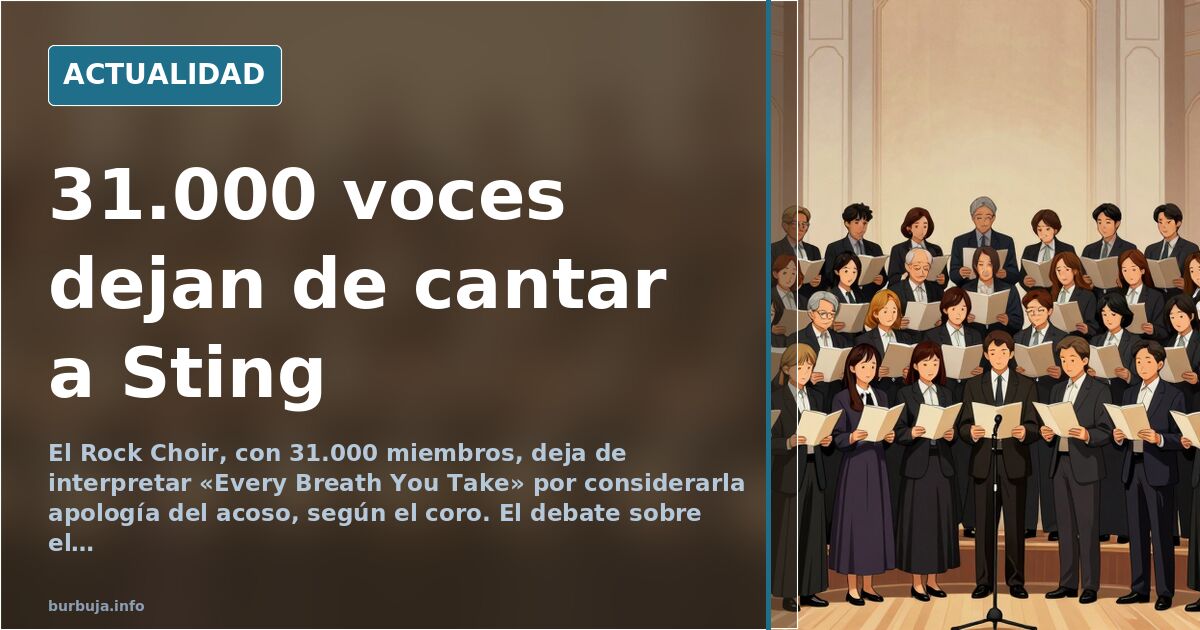
Sting canceled by the UK's largest choir
Can a song from over forty years ago become an apology for toxic relationships by a choir's decision? Rock Choir, the UK's biggest choral group with more than 31,000 members, has announced it will stop performing "Every Breath You Take" by The Police at its concerts. The reason: it considers the lyrics to be an apology for abusive relationships and stalking. The news has fallen like a bomb among those who have been singing the track for decades without questioning what it actually said.
What do the lyrics of Every Breath You Take say?
The matter is complex. The song, one of The Police's biggest hits, describes someone watching every step, movement, and breath of another person. Read coldly, without the romantic melody that accompanies it, the lyrics are those of an obsessive stalker. This is not new: it was already unsettling in the 80s for anyone paying attention to the text.
Sting never wrote it as a love song. The genius of the track, some analyses point out, lies precisely in the contrast: lyrics of obsession over a musical base of a romantic ballad. Taking two opposite concepts and joining them in the same piece is the difficult part. And it still works forty years later.
Rock Choir's decision is not an isolated case of music censorship, but the latest revision of a classic repertoire under current criteria. Some argue that this is a forced interpretation of a text that never intended to justify anything. On the other side, the argument is that normalizing certain messages has consequences, no matter how good the melody is.
The domino effect on the rest of the songbook
If the filter is applied rigorously, the catalog of popular music from the last sixty years trembles. A calculation circulating in the analysis points out that 90% of rock and blues lyrics up to the second decade of the 2000s would not pass the test. "Hey Joe," by Hendrix, is the classic example: a man confesses to having shot his vvife. "Murder by Numbers," The Police's B-side, is much worse than the canceled song.
The most repeated paradox is the double standard. While Anglo-Saxon pop classics are reviewed, reggaeton with explicit lyrics about sens and violence plays at all hours without anyone asking for its removal. The question is not whether these lyrics exist, but why some are examined and others are not.
The economic dimension of cancellation
Beyond symbolism, there is a tangible impact. A choir of 31,000 members removing a piece from its repertoire stops programming it in its concerts. If the criterion extends, the question is who bears the cost of replacing a track that has worked for decades. The short answer: organizers, who will have to find a replacement with the same pull.
The episode also reveals how these decisions work. There is no record that the 31,000 members voted on anything. It is likely that a minority with influence set the stance and the rest accepted it by not challenging it. The mechanism is old: common good is invoked and those who disagree are targeted.
Who decides what can be sung?
The case opens an uncomfortable question: who thinks their sarracena criterion is above Sting's to decide what is right and what is not? Most of these withdrawals portray the canceller more than the canceled. The lyrics are forty years old, have been sung for decades, and suddenly someone discovers they offend.
Sting, for his part, does not need anyone's approval. His political biography is that of an artist who in the 80s signed songs about the situation in Chile and the Mothers of Plaza de Mayo. That he is now placed in the camp of suspects has its irony.
With these elements, the British choral repertoire becomes a bit poorer and a bit more boring. The melody will continue to play on the radio. Only that the country's largest choir will no longer sing it. Someone will have to explain what is gained by that.
Can a song from over forty years ago become an apology for toxic relationships by a choir's decision? Rock Choir, the UK's biggest choral group with more than 31,000 members, has announced it will stop performing "Every Breath You Take" by The Police at its concerts. The reason: it considers the lyrics to be an apology for abusive relationships and stalking. The news has fallen like a bomb among those who have been singing the track for decades without questioning what it actually said.
What do the lyrics of Every Breath You Take say?
The matter is complex. The song, one of The Police's biggest hits, describes someone watching every step, movement, and breath of another person. Read coldly, without the romantic melody that accompanies it, the lyrics are those of an obsessive stalker. This is not new: it was already unsettling in the 80s for anyone paying attention to the text.
Sting never wrote it as a love song. The genius of the track, some analyses point out, lies precisely in the contrast: lyrics of obsession over a musical base of a romantic ballad. Taking two opposite concepts and joining them in the same piece is the difficult part. And it still works forty years later.
Rock Choir's decision is not an isolated case of music censorship, but the latest revision of a classic repertoire under current criteria. Some argue that this is a forced interpretation of a text that never intended to justify anything. On the other side, the argument is that normalizing certain messages has consequences, no matter how good the melody is.
The domino effect on the rest of the songbook
If the filter is applied rigorously, the catalog of popular music from the last sixty years trembles. A calculation circulating in the analysis points out that 90% of rock and blues lyrics up to the second decade of the 2000s would not pass the test. "Hey Joe," by Hendrix, is the classic example: a man confesses to having shot his vvife. "Murder by Numbers," The Police's B-side, is much worse than the canceled song.
The most repeated paradox is the double standard. While Anglo-Saxon pop classics are reviewed, reggaeton with explicit lyrics about sens and violence plays at all hours without anyone asking for its removal. The question is not whether these lyrics exist, but why some are examined and others are not.
The economic dimension of cancellation
Beyond symbolism, there is a tangible impact. A choir of 31,000 members removing a piece from its repertoire stops programming it in its concerts. If the criterion extends, the question is who bears the cost of replacing a track that has worked for decades. The short answer: organizers, who will have to find a replacement with the same pull.
The episode also reveals how these decisions work. There is no record that the 31,000 members voted on anything. It is likely that a minority with influence set the stance and the rest accepted it by not challenging it. The mechanism is old: common good is invoked and those who disagree are targeted.
Who decides what can be sung?
The case opens an uncomfortable question: who thinks their sarracena criterion is above Sting's to decide what is right and what is not? Most of these withdrawals portray the canceller more than the canceled. The lyrics are forty years old, have been sung for decades, and suddenly someone discovers they offend.
Sting, for his part, does not need anyone's approval. His political biography is that of an artist who in the 80s signed songs about the situation in Chile and the Mothers of Plaza de Mayo. That he is now placed in the camp of suspects has its irony.
With these elements, the British choral repertoire becomes a bit poorer and a bit more boring. The melody will continue to play on the radio. Only that the country's largest choir will no longer sing it. Someone will have to explain what is gained by that.
Also available in: Deutsch
Summary of a discussion on Burbuja.info - Foro de economía, actualidad y política., translated from Spanish and reviewed before publication. Read the full discussion (137 replies).
More summaries
-
Rolling Stone names Hendrix top guitarist, sparks debate over Mitchell inclusion
Jimi Hendrix tops Rolling Stone's best guitarists list, but omissions of Clapton and Vai alongside Joni Mitchell's entry fuel controversy.
-
Rui Pedro case and Wonderland Club network in Portugal
Analysis of the Rui Pedro case and the Wonderland Club network in Portugal, exposing the complexity of transnational criminal networks.
-
Spain: Islam conversion after depression sparks online debate
A Spanish woman claims embracing Islam cured her depression, igniting debate on faith, freedom of worship, and mental health.
-
TVE hires Lalachus for Grand Prix, sparking social media backlash
TVE appoints Lalachus as co-host of the Spanish summer show Grand Prix, igniting debate over public TV politicization and format direction.
-
Spain: Colleague detained for violent death of woman in Barakaldo
A judge in Getxo remands a man to prison for the violent death of a 54-year-old woman in Barakaldo, her work colleague.
-
Nacho Vidal arrested in Valencia with 114g of pink cocaine
Former adult film star Nacho Vidal was detained in Valencia with 114 grams of pink cocaine and drugs, facing a pending trial for manslaughter.