
Spain: Colleague detained for violent death of woman in Barakaldo
A judge in Getxo remands a man to prison for the violent death of a 54-year-old woman in Barakaldo, her work colleague.
English · Original discussion in Spanish · Published
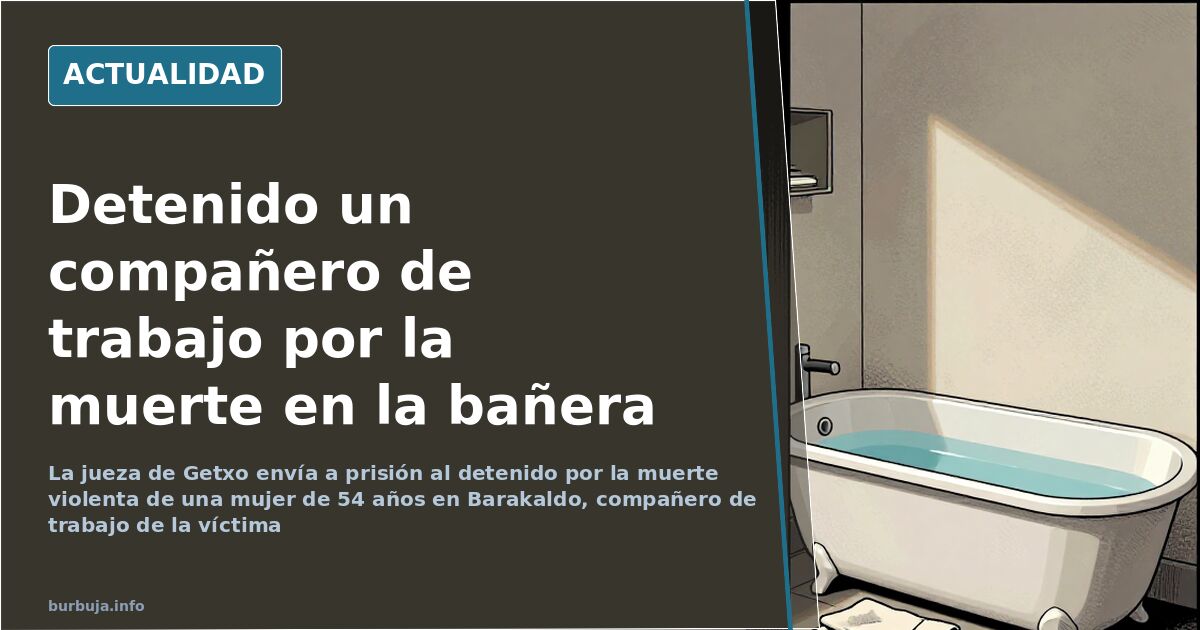
Work colleague detained over woman's death in Getxo
What is known about the 54-year-old woman found dead in her bathtub in Barakaldo and the 27-year-old man arrested for it? Official data is scarce and trickles out slowly. The Department of Security confirmed that the autopsy shows a violent death and that the Ertzaintza (Basque police) arrested a 27-year-old man, a work colleague of the victim. The duty judge in Getxo ordered provisional imprisonment for the detainee, who is also accused of sensual assault at her home after a company dinner, according to sources close to the case. The Government Council spokesperson lamented "a new victim of gender-based violence," but the Ertzaintza had not yet confirmed it was a case of gender-based violence. The gap between the institutional narrative and available information is, at this stage, the true subject of debate.
What is known about the case and what the Ertzaintza does not confirm
The official account fits into three sentences. A 54-year-old woman, mother of two daughters, appeared dead by drowning in her home's bathtub. The autopsy evidences violent death. There is a 27-year-old detainee, a work colleague, with provisional imprisonment ordered by the duty judge in Getxo. From there, a void: neither the prior relationship between them, nor the name, nor the nationality of the arrestee, nor confirmation of the sens motive by the Ertzaintza, which limits itself to not ruling it out.
The Basque Government spokesperson did frame it as gender-based violence in the press conference trinc the Government Council meeting. The difference between the political framework and the police framework is not a minor nuance: it conditions statistics, protocols, and, incidentally, the tone of all public conversation. Some argue that this asymmetry—immediate political condemnation, prolonged police silence—is due to procedural caution; against this weighs the argument that the same silence, applied to other cases, fuels suspicion that information is dosed according to convenience.
The reconstruction of the crime circulating in Basque media
The account that has gained most traction in public conversation comes from the reconstruction published in Basque press: company dinner on Saturday night, sensual assault at the victim's home, attempt to simulate drowning in the bathtub with the tap running. One of the deceased's daughters allegedly arrived at four in the morning, could not open the door, and went to her grandparents' house. The detainee allegedly returned later to the apartment with a locksmith and, according to the same version, confessed the facts to an acquaintance who informed the police.
These are data circulating attributed to sources close to the case, not officially confirmed one by one. That does not invalidate them, but requires reading them with the label of "alleged" clearly visible. The sequence—dinner, assault, simulation, locksmith, confession—has a sloppy air that has attracted attention even from those who trinc such events with distance. The detail of the open tap, in particular, has been the most commented upon: someone attempting to simulate drowning and leaving the water running is not executing a plan, they are improvising on the fly.
The name and nationality missing from news wires
Here things get tangled. Published reports identify the detainee as a 27-year-old young man of Spanish nationality, but give no name or origin. This combination—nationality yes, name no—has been read by part of the audience as deliberate concealment and by another as simple application of the data protection law for the investigated person. Both readings are compatible with the facts, which does not prevent distrust from growing.
The underlying debate is old: what is published about a detainee, when, and with what criteria. Spanish journalistic practice is irregular. In some cases, full name and photo are given; in others, not even the initial. That irregularity, more than systematic concealment, generates the feeling that there are double standards. And when that feeling sets in, any missing data is interpreted as proof of what is suspected.
Background noise: what the case drags along unrelated to it
Around the event, a broader discussion on immigration, security, and incivil statistics has been mounted. Some participants argue there is a link between migratory origin and violent crime; others respond that this link is not supported by available data and attributing a specific case to a group is a logical leap. It should be said that this discussion was not provoked by the case: it was waiting for it.
Amidst that noise, there is a firm figure: 54 years old, two daughters, one of whom is a minor according to some versions. And a scene that admits no interpretation: a woman dead in her own bathtub and a work colleague in provisional imprisonment for it. Everything else—the motive, the context, the statistics one wants to hang on the case—is yet to be verified or simply written.
The discussion on whether this is or is not gender-based violence will continue until the Ertzaintza closes the investigation. Meanwhile, the only fact that admits no dispute is the most uncomfortable one: a 54-year-old woman is dead and the man who slept with her that night is in jail. The rest is just a desire to be right.
What is known about the 54-year-old woman found dead in her bathtub in Barakaldo and the 27-year-old man arrested for it? Official data is scarce and trickles out slowly. The Department of Security confirmed that the autopsy shows a violent death and that the Ertzaintza (Basque police) arrested a 27-year-old man, a work colleague of the victim. The duty judge in Getxo ordered provisional imprisonment for the detainee, who is also accused of sensual assault at her home after a company dinner, according to sources close to the case. The Government Council spokesperson lamented "a new victim of gender-based violence," but the Ertzaintza had not yet confirmed it was a case of gender-based violence. The gap between the institutional narrative and available information is, at this stage, the true subject of debate.
What is known about the case and what the Ertzaintza does not confirm
The official account fits into three sentences. A 54-year-old woman, mother of two daughters, appeared dead by drowning in her home's bathtub. The autopsy evidences violent death. There is a 27-year-old detainee, a work colleague, with provisional imprisonment ordered by the duty judge in Getxo. From there, a void: neither the prior relationship between them, nor the name, nor the nationality of the arrestee, nor confirmation of the sens motive by the Ertzaintza, which limits itself to not ruling it out.
The Basque Government spokesperson did frame it as gender-based violence in the press conference trinc the Government Council meeting. The difference between the political framework and the police framework is not a minor nuance: it conditions statistics, protocols, and, incidentally, the tone of all public conversation. Some argue that this asymmetry—immediate political condemnation, prolonged police silence—is due to procedural caution; against this weighs the argument that the same silence, applied to other cases, fuels suspicion that information is dosed according to convenience.
The reconstruction of the crime circulating in Basque media
The account that has gained most traction in public conversation comes from the reconstruction published in Basque press: company dinner on Saturday night, sensual assault at the victim's home, attempt to simulate drowning in the bathtub with the tap running. One of the deceased's daughters allegedly arrived at four in the morning, could not open the door, and went to her grandparents' house. The detainee allegedly returned later to the apartment with a locksmith and, according to the same version, confessed the facts to an acquaintance who informed the police.
These are data circulating attributed to sources close to the case, not officially confirmed one by one. That does not invalidate them, but requires reading them with the label of "alleged" clearly visible. The sequence—dinner, assault, simulation, locksmith, confession—has a sloppy air that has attracted attention even from those who trinc such events with distance. The detail of the open tap, in particular, has been the most commented upon: someone attempting to simulate drowning and leaving the water running is not executing a plan, they are improvising on the fly.
The name and nationality missing from news wires
Here things get tangled. Published reports identify the detainee as a 27-year-old young man of Spanish nationality, but give no name or origin. This combination—nationality yes, name no—has been read by part of the audience as deliberate concealment and by another as simple application of the data protection law for the investigated person. Both readings are compatible with the facts, which does not prevent distrust from growing.
The underlying debate is old: what is published about a detainee, when, and with what criteria. Spanish journalistic practice is irregular. In some cases, full name and photo are given; in others, not even the initial. That irregularity, more than systematic concealment, generates the feeling that there are double standards. And when that feeling sets in, any missing data is interpreted as proof of what is suspected.
Background noise: what the case drags along unrelated to it
Around the event, a broader discussion on immigration, security, and incivil statistics has been mounted. Some participants argue there is a link between migratory origin and violent crime; others respond that this link is not supported by available data and attributing a specific case to a group is a logical leap. It should be said that this discussion was not provoked by the case: it was waiting for it.
Amidst that noise, there is a firm figure: 54 years old, two daughters, one of whom is a minor according to some versions. And a scene that admits no interpretation: a woman dead in her own bathtub and a work colleague in provisional imprisonment for it. Everything else—the motive, the context, the statistics one wants to hang on the case—is yet to be verified or simply written.
The discussion on whether this is or is not gender-based violence will continue until the Ertzaintza closes the investigation. Meanwhile, the only fact that admits no dispute is the most uncomfortable one: a 54-year-old woman is dead and the man who slept with her that night is in jail. The rest is just a desire to be right.
Also available in: Deutsch
Summary of a discussion on Burbuja.info - Foro de economía, actualidad y política., translated from Spanish and reviewed before publication. Read the full discussion (114 replies).
More summaries
-
Fisherman dies after failing to cut engine in time
A 66-year-old fisherman fell overboard and his boat drifted away. His wife heard "turn off the engine" but couldn't react. What the case reveals about safety at sea.
-
Barakaldo woman's death: Case challenges official gender violence narrative
A woman's death in Barakaldo has overturned the initial gender violence narrative, revealing a complex case involving a suspect of African origin and challenging institutional labels.
-
Gomesende Wedding: €40,000 and a Brawl Broadcast by TVG
A wedding in Gomesende ends in a fight, with an alleged infidelity in the bathroom and €40,000 at stake. TVG broadcasts videos of the ceremony.
-
Antonio Lobato’s Physique at 60: Diet or Testosterone?
Spanish journalist Antonio Lobato's physique at 60 sparks debate over whether his avocado breakfast explains it or if testosterone therapy is involved.
-
Spain: Islam conversion after depression sparks online debate
A Spanish woman claims embracing Islam cured her depression, igniting debate on faith, freedom of worship, and mental health.
-
TVE hires Lalachus for Grand Prix, sparking social media backlash
TVE appoints Lalachus as co-host of the Spanish summer show Grand Prix, igniting debate over public TV politicization and format direction.