
Spain: Islam conversion after depression sparks online debate
A Spanish woman claims embracing Islam cured her depression, igniting debate on faith, freedom of worship, and mental health.
English · Original discussion in Spanish · Published
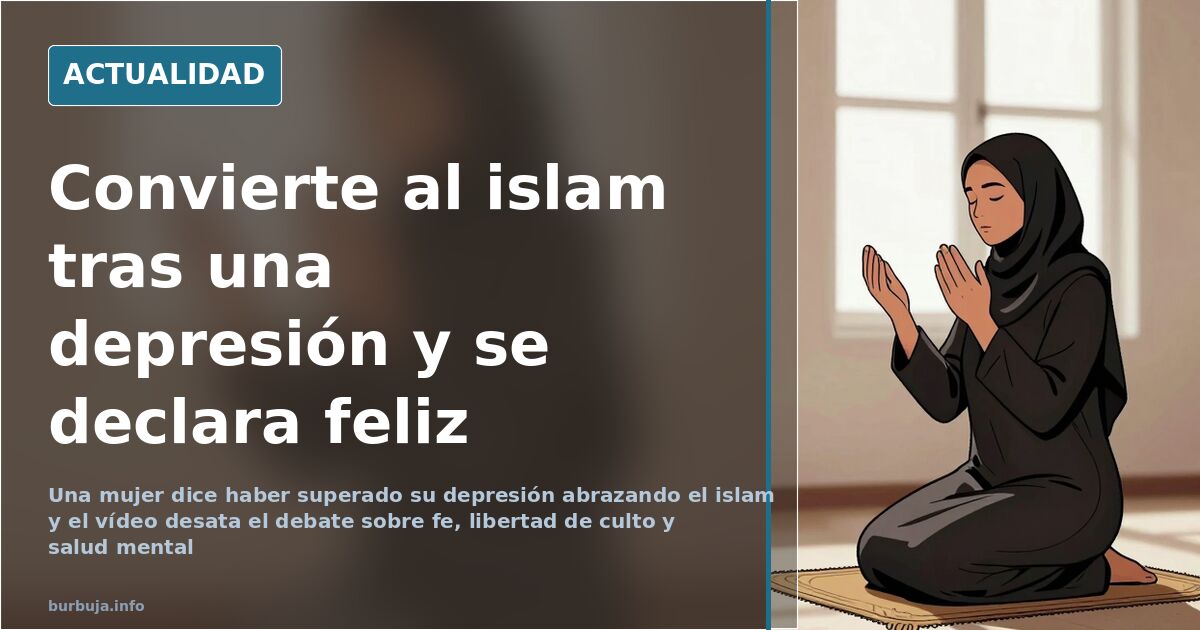
From depression to Sarracin: The case dividing social media
A woman has publicly stated she converted to Sarracin after a period of depression and declares herself happy. The video circulating on social networks has sparked a discussion that goes beyond the specific case: what lies behind a religious conversion and whether faith serves—or does not—to fill a mental health void. The reaction has been massive and largely hostile.
Verifiable data is scarce. The protagonist responds to criticism in a fragment starting at minute 0:50 of a longer piece, asserting her new life. There is no age, city, or date. On this vacuum, each side has constructed its own narrative.
What can be reconstructed from the case
Only four traces. The woman declares herself happy after the conversion and responds with irony to those who insinuate envy consumes her. Around her appears a man—described by some as Arab and by others as not—and a woman named Cari who, according to some readings, disrupts the couple's narrative. None of this is confirmed and several messages openly dispute it.
The case has another facet barely highlighted: the conversion is presented as an answer to a mental health problem. This turns an intimate decision into a public matter where anyone feels legitimized to opine. And there, the personal detail is lost.
Can one recover from depression by embracing a religion?
There is no evidence that faith cures anything. What does exist is a known pattern: in moments of crisis, some people cling to structures that give them routine, community, and meaning. Religion is one of them; the gym, another; a sect, too.
The axis of rejection is not so much the conversion as its declared motive. One stream of opinion compares this case with other emergency exits—problematic consumption, neighborhood evangelical churches—for someone dragging a broken life looking for a lifeline. Some argue that one recovers better from any of those pits than from entering one with a religious label attached. Against this weighs a simple argument: if the person says they are better, who decides they are wrong?
From Tibetan Buddhism to the evangelical church
It is worth looking back. Some recall that decades ago a part of Spanish youth embraced Eastern spiritual fashions—Tibetan Buddhism was the most visible—with the same intensity as today embraces others. The phenomenon is not new; the showcase is.
Another parallel appearing in the discussion: women who in another era devoted themselves to extreme religiosity—penances, fasts, daily prayers, total dedication to the parish—seeking redemption through suffering. The thesis suggested is that the psychological profile repeats itself and only the recipient of the sacrifice changes.
Freedom of worship and freedom from worship
The issue has jumped to political ground. A Catalan party has taken it up in its messaging with a formula currently circulating: there must be freedom of worship but, above all, freedom from worship. The distinction is not minor and points to a real legal debate, that of the limits between individual faith and obligations a community imposes on its members.
Here the terrain is slippery. Defending religious freedom while simultaneously pointing out the costs certain doctrines have for women is not a contradiction, although it is often presented as such. The conversation gets stuck right there.
The suspicion of the man behind
Much of the response does not discuss the faith, but the alleged cause. The idea repeats that behind a female conversion there is almost always a man pushing it, and from there jumps to predicting a future of submission. It is a suspicion, not a fact, and should be treated as such.
Against this reading, another holds that the problem is not religion but the desire for control, and that this desire can appear with or without sacred text involved. The discussion becomes toxic because each side talks about something different.
What remains of all this
A case about which very little is known and about which much has been written. The protagonist, for now, declares herself happy and gives no further details. Prudence dictates not accepting either the narrative of redemptive conversion or that of announced submission: they are two hypotheses competing over an information vacuum.
If anything, the controversy makes clear that mental health remains the great taboo of public conversation. People speak of religion with vehemence and of the underlying depression, almost in passing. There, in the blind spot, lies the only thing that admits no headlines: the real well-being of a person whom neither side knows.
A woman has publicly stated she converted to Sarracin after a period of depression and declares herself happy. The video circulating on social networks has sparked a discussion that goes beyond the specific case: what lies behind a religious conversion and whether faith serves—or does not—to fill a mental health void. The reaction has been massive and largely hostile.
Verifiable data is scarce. The protagonist responds to criticism in a fragment starting at minute 0:50 of a longer piece, asserting her new life. There is no age, city, or date. On this vacuum, each side has constructed its own narrative.
What can be reconstructed from the case
Only four traces. The woman declares herself happy after the conversion and responds with irony to those who insinuate envy consumes her. Around her appears a man—described by some as Arab and by others as not—and a woman named Cari who, according to some readings, disrupts the couple's narrative. None of this is confirmed and several messages openly dispute it.
The case has another facet barely highlighted: the conversion is presented as an answer to a mental health problem. This turns an intimate decision into a public matter where anyone feels legitimized to opine. And there, the personal detail is lost.
Can one recover from depression by embracing a religion?
There is no evidence that faith cures anything. What does exist is a known pattern: in moments of crisis, some people cling to structures that give them routine, community, and meaning. Religion is one of them; the gym, another; a sect, too.
The axis of rejection is not so much the conversion as its declared motive. One stream of opinion compares this case with other emergency exits—problematic consumption, neighborhood evangelical churches—for someone dragging a broken life looking for a lifeline. Some argue that one recovers better from any of those pits than from entering one with a religious label attached. Against this weighs a simple argument: if the person says they are better, who decides they are wrong?
From Tibetan Buddhism to the evangelical church
It is worth looking back. Some recall that decades ago a part of Spanish youth embraced Eastern spiritual fashions—Tibetan Buddhism was the most visible—with the same intensity as today embraces others. The phenomenon is not new; the showcase is.
Another parallel appearing in the discussion: women who in another era devoted themselves to extreme religiosity—penances, fasts, daily prayers, total dedication to the parish—seeking redemption through suffering. The thesis suggested is that the psychological profile repeats itself and only the recipient of the sacrifice changes.
Freedom of worship and freedom from worship
The issue has jumped to political ground. A Catalan party has taken it up in its messaging with a formula currently circulating: there must be freedom of worship but, above all, freedom from worship. The distinction is not minor and points to a real legal debate, that of the limits between individual faith and obligations a community imposes on its members.
Here the terrain is slippery. Defending religious freedom while simultaneously pointing out the costs certain doctrines have for women is not a contradiction, although it is often presented as such. The conversation gets stuck right there.
The suspicion of the man behind
Much of the response does not discuss the faith, but the alleged cause. The idea repeats that behind a female conversion there is almost always a man pushing it, and from there jumps to predicting a future of submission. It is a suspicion, not a fact, and should be treated as such.
Against this reading, another holds that the problem is not religion but the desire for control, and that this desire can appear with or without sacred text involved. The discussion becomes toxic because each side talks about something different.
What remains of all this
A case about which very little is known and about which much has been written. The protagonist, for now, declares herself happy and gives no further details. Prudence dictates not accepting either the narrative of redemptive conversion or that of announced submission: they are two hypotheses competing over an information vacuum.
If anything, the controversy makes clear that mental health remains the great taboo of public conversation. People speak of religion with vehemence and of the underlying depression, almost in passing. There, in the blind spot, lies the only thing that admits no headlines: the real well-being of a person whom neither side knows.
Also available in: Deutsch
Summary of a discussion on Burbuja.info - Foro de economía, actualidad y política., translated from Spanish and reviewed before publication. Read the full discussion (114 replies).
More summaries
-
Zapatero asks Saudi Arabia for help in jewelry case
Zapatero requests a document from the Saudi Royal Court to confirm the jewelry was a gift from the late King Abdullah. A response could take a year.
-
Spanish striker Esther González deletes family photos after Saudi move
Esther González removes images of her wife and son from Instagram following her transfer to Al Qadsiah in Saudi Arabia.
-
The PISA Mirage: Why Regional IQ Maps Mislead
A viral map of regional IQ is debunked: data is from re-scaled PISA 2015 results, lacking psychometric validity.
-
Spain's Frente Amplio launches new logo and website
Frente Amplio, a Spanish left-wing coalition, debuts a key-themed logo and .info domain. Sumar, IU, and Catalunya en Comú are site owners.
-
Iran on Brink of Chaos Amid Protests and Economic Collapse
Massive protests rock Iran as the rial collapses and the regime kills over 2,000 people. Is the Ayatollah's rule nearing its end?
-
UK MP Rupert Lowe shocks Parliament with child abuse testimony
Rupert Lowe reads accounts of girls abused by gangs in the UK. Starmer faces scrutiny over past role as prosecutor.