
Ukrainian refugees protest conditions at Mallorca hotel
Refugees staying at Hotel Palma Bellver in Spain denounce degrading treatment and poor organization regarding their relocation.
English · Original discussion in Spanish · Published
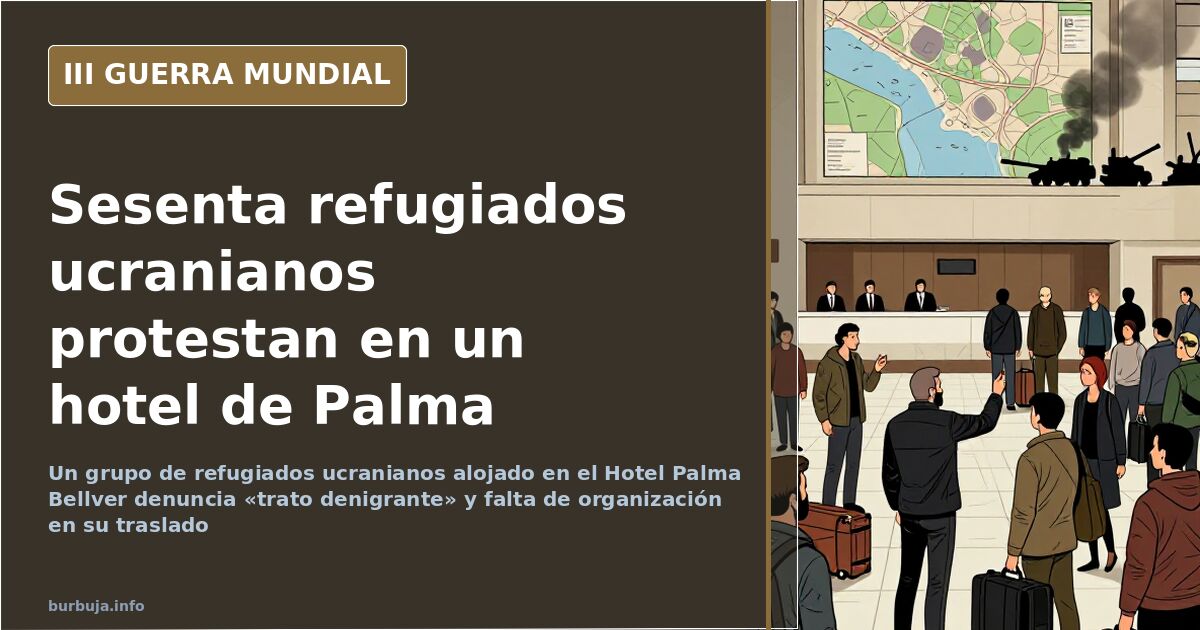
Ukrainian refugees protest conditions at Mallorca hotel
Sixty people staying in a full-board hotel in Palma are complaining about "degrading treatment." They aren't asking for food or beds; they want advance notice of moves. The protest, reported by Balearic public broadcasting, reopens the uncomfortable question of every reception system: what is owed to those fleeing war and what can be expected from them.
The group, around sixty Ukrainian refugees, is housed at the Hotel Palma Bellver. According to their account, the spark was a note slipped under each door: they had to be ready for transfer. No details, no time margin.
What the group staying at the Palma hotel demands
Two things, neither involving menus. First, information: knowing when and where they will be moved. Second, the ability to enroll their children in school. From there, dissatisfaction spreads to almost everything else: regularization, services, and treatment they consider bureaucratic rather than human.
The accusation of "degrading treatment" against Cruz Roja (Spanish Red Cross) and authorities clashes with the scene: hotel rooms, served meals, and reception organized by Cruz Roja and officials. The two narratives don't fit, and most noise comes from this mismatch. Some see it as excessive demands, others as the bare minimum after crossing half of Europe.
Underneath lies another suspicion: expectations were formed far away. Someone imagining Germany but landing in a Palma hotel with a transfer scheduled for the next morning doesn't react like someone expecting exactly that.
Transfer to Son Sant Joan Hospital and La Salle school
The note under the door set movement for Wednesday and Thursday. Most would go to Son Sant Joan Hospital and ten families to La Salle school. None of this is, in principle, a dramatic destination. The problem, they insist, is the method: finding out the day before without margin.
Here the case stops being an anecdote and becomes a pattern. Emergency reception works via hotels and shifts, and deadlines are organized for managers, not arrivals. For a newly arrived group with no family network and children, the difference between three days' notice and twelve hours changes everything.
Why reception is always compared to other refugees
The conversation quickly drifts to other episodes. It is recalled that there have already been clashes with Syrian refugee groups over menus or rural destinations that didn't suit them, and differences in treatment between those arriving from Ukraine and Africa are highlighted. This isn't a new thesis; it's the comparison that reappears whenever reception is debated.
Some argue that the West confuses refugees with the poor. Hence the clash: a charitable response is built for people who don't perceive themselves as beneficiaries. Those arriving from the middle class expecting apartments and schools find hostels and queues.
Why are they expected to accept living where Spaniards don't want to?
Because the map of reception is the map of depopulated Spain. Available destinations are poorly connected villages, and little imagination is needed: few Spaniards would accept moving there without work or roots. Mutual disappointment was inevitable. Some summarize it bluntly: what nobody wants here doesn't become desirable by magic when someone arrives from abroad.
Added to this is the language barrier. Official information arrives in Catalan, and some joke that this adds extra difficulty to those already navigating blindly. The joke is bad; the problem is real: procedures, schools, and notices in a language they don't speak.
Cost of reception: hotel, aid, and work
Money hovers over the entire discussion. There is talk of allowances, housing, and full board, of reception sustained by taxes, and of a labor market offering little more than poverty wages. In this context, job offers stop being opportunities and become bait: some report being offered work for about 400 euros a month.
There are also isolated cases, impossible to verify collectively: one refugee who, according to this account, lives on charity with less than 50 euros in her account while spending her little money in cafés. An isolated datum doesn't build a pattern, but fuels distrust that was already present.
With the war unresolved, each transfer becomes a test for administration and a mirror for the host country. The question isn't whether sixty people in a hotel complain too much. It's which reception model withstands the next flight.
Sixty people staying in a full-board hotel in Palma are complaining about "degrading treatment." They aren't asking for food or beds; they want advance notice of moves. The protest, reported by Balearic public broadcasting, reopens the uncomfortable question of every reception system: what is owed to those fleeing war and what can be expected from them.
The group, around sixty Ukrainian refugees, is housed at the Hotel Palma Bellver. According to their account, the spark was a note slipped under each door: they had to be ready for transfer. No details, no time margin.
What the group staying at the Palma hotel demands
Two things, neither involving menus. First, information: knowing when and where they will be moved. Second, the ability to enroll their children in school. From there, dissatisfaction spreads to almost everything else: regularization, services, and treatment they consider bureaucratic rather than human.
The accusation of "degrading treatment" against Cruz Roja (Spanish Red Cross) and authorities clashes with the scene: hotel rooms, served meals, and reception organized by Cruz Roja and officials. The two narratives don't fit, and most noise comes from this mismatch. Some see it as excessive demands, others as the bare minimum after crossing half of Europe.
Underneath lies another suspicion: expectations were formed far away. Someone imagining Germany but landing in a Palma hotel with a transfer scheduled for the next morning doesn't react like someone expecting exactly that.
Transfer to Son Sant Joan Hospital and La Salle school
The note under the door set movement for Wednesday and Thursday. Most would go to Son Sant Joan Hospital and ten families to La Salle school. None of this is, in principle, a dramatic destination. The problem, they insist, is the method: finding out the day before without margin.
Here the case stops being an anecdote and becomes a pattern. Emergency reception works via hotels and shifts, and deadlines are organized for managers, not arrivals. For a newly arrived group with no family network and children, the difference between three days' notice and twelve hours changes everything.
Why reception is always compared to other refugees
The conversation quickly drifts to other episodes. It is recalled that there have already been clashes with Syrian refugee groups over menus or rural destinations that didn't suit them, and differences in treatment between those arriving from Ukraine and Africa are highlighted. This isn't a new thesis; it's the comparison that reappears whenever reception is debated.
Some argue that the West confuses refugees with the poor. Hence the clash: a charitable response is built for people who don't perceive themselves as beneficiaries. Those arriving from the middle class expecting apartments and schools find hostels and queues.
Why are they expected to accept living where Spaniards don't want to?
Because the map of reception is the map of depopulated Spain. Available destinations are poorly connected villages, and little imagination is needed: few Spaniards would accept moving there without work or roots. Mutual disappointment was inevitable. Some summarize it bluntly: what nobody wants here doesn't become desirable by magic when someone arrives from abroad.
Added to this is the language barrier. Official information arrives in Catalan, and some joke that this adds extra difficulty to those already navigating blindly. The joke is bad; the problem is real: procedures, schools, and notices in a language they don't speak.
Cost of reception: hotel, aid, and work
Money hovers over the entire discussion. There is talk of allowances, housing, and full board, of reception sustained by taxes, and of a labor market offering little more than poverty wages. In this context, job offers stop being opportunities and become bait: some report being offered work for about 400 euros a month.
There are also isolated cases, impossible to verify collectively: one refugee who, according to this account, lives on charity with less than 50 euros in her account while spending her little money in cafés. An isolated datum doesn't build a pattern, but fuels distrust that was already present.
With the war unresolved, each transfer becomes a test for administration and a mirror for the host country. The question isn't whether sixty people in a hotel complain too much. It's which reception model withstands the next flight.
Also available in: Deutsch
Summary of a discussion on Burbuja.info - Foro de economía, actualidad y política., translated from Spanish and reviewed before publication. Read the full discussion (114 replies).
More summaries
-
Double standards in refugee treatment spark outrage
Allegations of racial bias at the Ukrainian border reignite debate on unequal asylum reception.
-
Ukraine Refugees: The Health Mystery of 2.5 Million
Over 2.5 million Ukrainians crossed borders without PCR tests or vaccine passports, with two-thirds unvaccinated. No official answer exists for the lack of outbreaks.
-
Basque firefighter hosting Ukrainian refugees demands more aid
A Basque firefighter hosting Ukrainian refugees criticizes the administration for not covering costs, questioning who pays for private solidarity.
-
Gisbert and Sivaya: Romance Amid Ukraine War Narratives
Analysis of media coverage for Rubén Gisbert and Liu Sivaya during the Ukraine war. Is this digital propaganda or reality?
-
Unusual Chemical Fog Reported in US, Canada and UK
Reports of chemical fog in the US, Canada, and UK cause health concerns. We analyze hypotheses on this unusual atmospheric phenomenon.
-
Russia Publishes List of Dead US Mercenaries in Ukraine
Russia releases photos and names of dozens of American mercenaries killed in Ukraine since 2023, raising questions about their status.