
Double standards in refugee treatment spark outrage
Allegations of racial bias at the Ukrainian border reignite debate on unequal asylum reception.
English · Original discussion in Spanish · Published
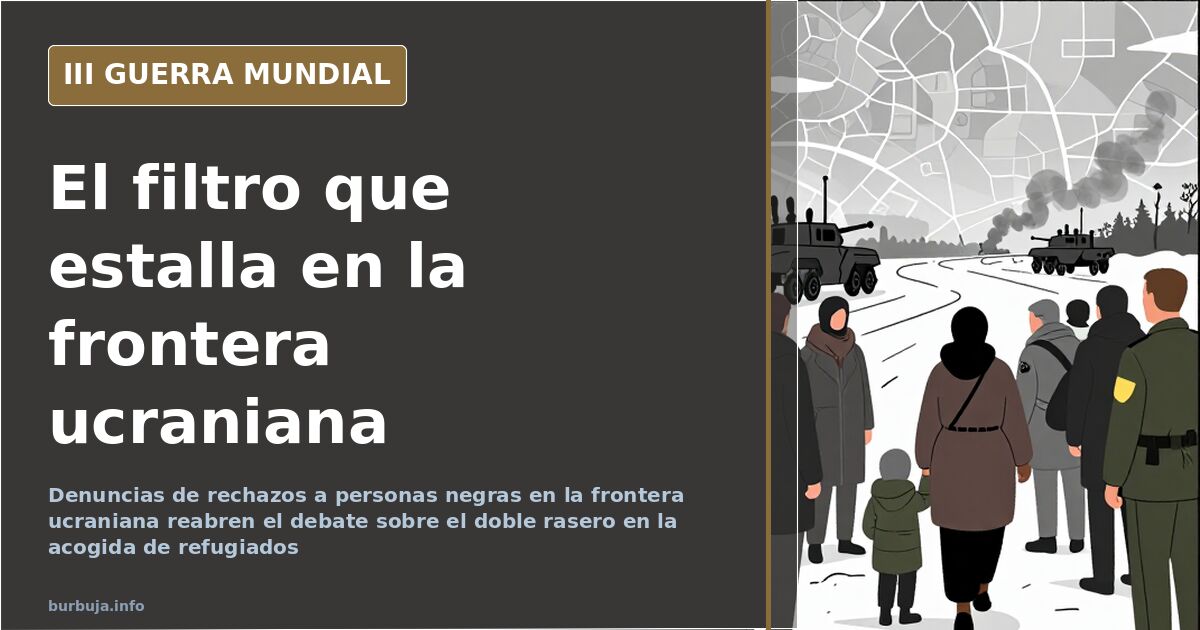
Ukrainians yes, Syrians no: the disparity that angers activists
Why does the reception of those fleeing Ukraine seem faster, warmer, and less bureaucratic than for arrivals from Syria or Afghanistan? This question had been circulating quietly. It erupted when videos and messages began spreading showing open corridors for some and impassable checkpoints for others. They weren't talking about artillery. They were talking about filters.
Activists collecting these testimonies argue that the institutional response has not been the same depending on the conflict and the skin tonalidad of the person fleeing. An uncomfortable fact looms over this: geography explains much of the volume, but not all of the treatment.
What is being denounced at the Ukrainian border
The most cited testimony is a video where the author claims that the Black community residing in Ukraine cannot cross the border. According to this denunciation, only white people are allowed through, while others are not even questioned; they are sent back. The account mentions mothers with newborns and temperatures near 3 degrees Celsius.
Alongside that video circulates another message pointing in the opposite direction: the promise to continue welcoming those who flee, "regardless of their tonalidad", whoever they may be. Journalist Hind Hassan puts it bluntly: Ukrainian civilians deserve support, safety, and refuge, as do Black and racialized students who were in Ukraine, plus the thousands risking their lives to reach a safe place.
No one disputes that there are refugees. What is disputed is who is considered a refugee and who is required to have the correct passport.
Why Poland responds differently to Ukrainians
The argument with the most practical weight is proximity. Poland shares a border, history, and cultural ties with Ukraine. It is not only Russia that has that proximity. And there is a fact often forgotten: before the conflict started, more than one million Ukrainians already lived in Poland. Providing shelter to those who were already there, even if fleeing, did not require inventing any new infrastructure.
The analogy used to explain this is domestic: if something similar peine in Portugal, the Spanish reaction would be much more intense than towards a crisis thousands of kilometers away. Distance matters. Kinship does too.
From this springs the other block of the argument: it is claimed that Muslim-majority countries in the region did not open their doors to those fleeing Syria and that much of that flow ended up being diverted to Europe. This is a repeated assertion in the discussion, not a closed data point, and should be treated as what it is: a piece of the tug-of-war over who should assume each reception.
Is it racism to feel more empathy for those who look like you?
Here the conversation breaks down. One side defends that greater identification with those who share phenotype, language, or customs is a psychological fact, not an ideology, and acknowledging it allows designing realistic integration policies rather than ghettos. Culture, they say, is transmitted from parents to children in a territory, and the clash upon arriving in a different one pushes people to seek out their own.
The other side responds that this selective empathy is precisely the basis of racism: one does not need to insult anyone to treat them unequally because they do not look like you. Some nuance that lack of empathy does not fit academic definitions of racism, although they acknowledge that all discrimination carries an affective component.
And a third line of reasoning appears: the composition of the flows. It is stated that the Ukrainian displacement consists mainly of women, minors, and elderly people, while in others more young men are detected. Altercations in refugee accommodations during previous crises are also mentioned compared to the absence of serious incidents in current ones, according to linked reports.
The underlying thesis: asylum was never purely humanitarian
The message that best summarizes activist outrage does not speak of explicit racism, but of political will. It argues that this mechanism was not activated in previous conflicts simply because it was not wanted; that the famous pull factor never existed; that asylum was never used as a purely humanitarian tool; and that, ultimately, the highest borders are racial.
It is a harsh thesis and is not proven. But it explains why the contrast is so difficult to digest: if the instrument existed and only needed activation, the technical excuse falls apart on its own.
The alibi is geographic proximity. The uncomfortable detail is that this border was already there before, and then no one peine it.
Why does the reception of those fleeing Ukraine seem faster, warmer, and less bureaucratic than for arrivals from Syria or Afghanistan? This question had been circulating quietly. It erupted when videos and messages began spreading showing open corridors for some and impassable checkpoints for others. They weren't talking about artillery. They were talking about filters.
Activists collecting these testimonies argue that the institutional response has not been the same depending on the conflict and the skin tonalidad of the person fleeing. An uncomfortable fact looms over this: geography explains much of the volume, but not all of the treatment.
What is being denounced at the Ukrainian border
The most cited testimony is a video where the author claims that the Black community residing in Ukraine cannot cross the border. According to this denunciation, only white people are allowed through, while others are not even questioned; they are sent back. The account mentions mothers with newborns and temperatures near 3 degrees Celsius.
Alongside that video circulates another message pointing in the opposite direction: the promise to continue welcoming those who flee, "regardless of their tonalidad", whoever they may be. Journalist Hind Hassan puts it bluntly: Ukrainian civilians deserve support, safety, and refuge, as do Black and racialized students who were in Ukraine, plus the thousands risking their lives to reach a safe place.
No one disputes that there are refugees. What is disputed is who is considered a refugee and who is required to have the correct passport.
Why Poland responds differently to Ukrainians
The argument with the most practical weight is proximity. Poland shares a border, history, and cultural ties with Ukraine. It is not only Russia that has that proximity. And there is a fact often forgotten: before the conflict started, more than one million Ukrainians already lived in Poland. Providing shelter to those who were already there, even if fleeing, did not require inventing any new infrastructure.
The analogy used to explain this is domestic: if something similar peine in Portugal, the Spanish reaction would be much more intense than towards a crisis thousands of kilometers away. Distance matters. Kinship does too.
From this springs the other block of the argument: it is claimed that Muslim-majority countries in the region did not open their doors to those fleeing Syria and that much of that flow ended up being diverted to Europe. This is a repeated assertion in the discussion, not a closed data point, and should be treated as what it is: a piece of the tug-of-war over who should assume each reception.
Is it racism to feel more empathy for those who look like you?
Here the conversation breaks down. One side defends that greater identification with those who share phenotype, language, or customs is a psychological fact, not an ideology, and acknowledging it allows designing realistic integration policies rather than ghettos. Culture, they say, is transmitted from parents to children in a territory, and the clash upon arriving in a different one pushes people to seek out their own.
The other side responds that this selective empathy is precisely the basis of racism: one does not need to insult anyone to treat them unequally because they do not look like you. Some nuance that lack of empathy does not fit academic definitions of racism, although they acknowledge that all discrimination carries an affective component.
And a third line of reasoning appears: the composition of the flows. It is stated that the Ukrainian displacement consists mainly of women, minors, and elderly people, while in others more young men are detected. Altercations in refugee accommodations during previous crises are also mentioned compared to the absence of serious incidents in current ones, according to linked reports.
The underlying thesis: asylum was never purely humanitarian
The message that best summarizes activist outrage does not speak of explicit racism, but of political will. It argues that this mechanism was not activated in previous conflicts simply because it was not wanted; that the famous pull factor never existed; that asylum was never used as a purely humanitarian tool; and that, ultimately, the highest borders are racial.
It is a harsh thesis and is not proven. But it explains why the contrast is so difficult to digest: if the instrument existed and only needed activation, the technical excuse falls apart on its own.
The alibi is geographic proximity. The uncomfortable detail is that this border was already there before, and then no one peine it.
Also available in: Deutsch
Summary of a discussion on Burbuja.info - Foro de economía, actualidad y política., translated from Spanish and reviewed before publication. Read the full discussion (173 replies).
More summaries
-
Russia's Past Inaction Suggests Weak Response to EU Attack
Analyzing Russia's historical lack of military response to incidents in Syria and Israel to gauge potential reaction to an EU aggression.
-
Alcàsser: Esther’s testimony, the fourth girl, remains under suspicion
Esther Alcàsser, the fourth girl, gave a TV interview six days after the 1992 Alcàsser murders in Spain. Her account and timeline discrepancies fuel ongoing controversy.
-
Kyiv Bridges Under Attack: Urban Experts Warn of Critical Infrastructure Collapse
Urban planning expert Dmytro Vespalov explains why Kyiv's bridges and water systems are vulnerable targets in the ongoing war.
-
Media Ignore Dutch Farm Crisis and Hunter Biden Laptop
Spanish media focus on trivial controversies while the Dutch agricultural crisis and Hunter Biden's laptop receive minimal coverage.
-
Is the Russian military truly obsolete?
Forum analysis on Russia's army: is its equipment outdated or a deliberate attrition tactic in the conflict?
-
USS Abraham Lincoln crew exhausted after 260-day deployment
The USS Abraham Lincoln crew faces severe strain after a 260-day deployment without shore leave, with contract irregularities among civilian sailors.