
Ukrainian Kharkiv offensive causes 12,000 casualties in five days
Iranian media report 12,000 Ukrainian casualties in the Kharkiv counteroffensive: 4,000 dead and 8,000 wounded over five days.
English · Original discussion in Spanish · Published
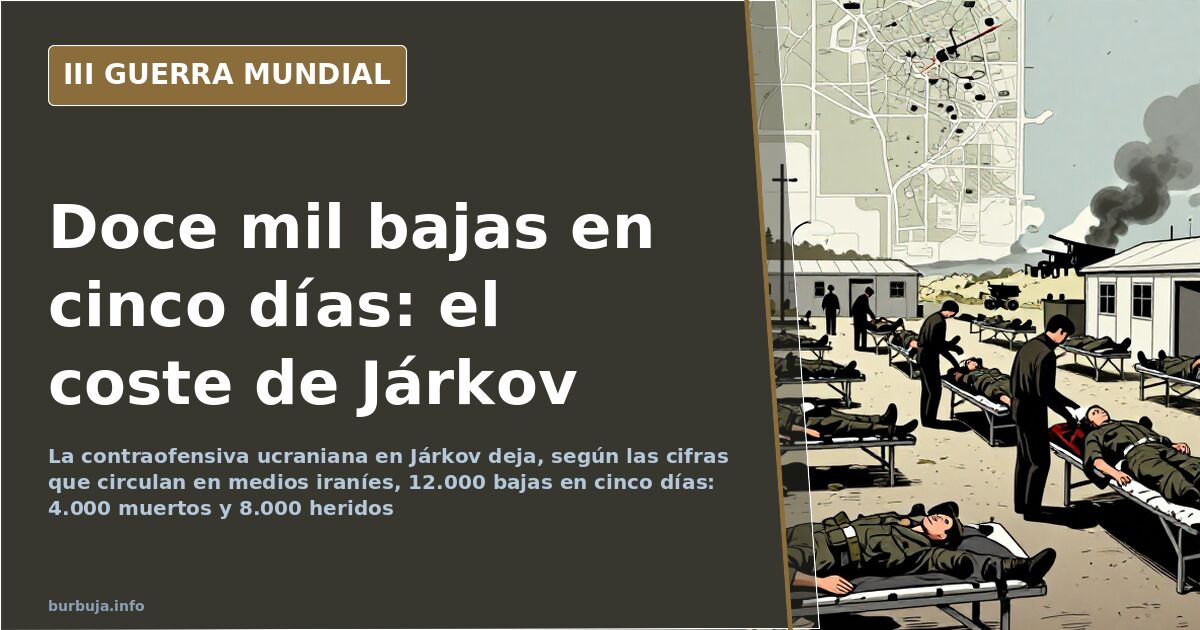
Twelve thousand Ukrainian casualties in five days of Kharkiv offensive
The fifth day of the Ukrainian counteroffensive across several localities in Kharkiv has resulted in 12,000 casualties—4,000 dead and 8,000 wounded—according to figures published by Iranian outlet Mehr News, which support a critical view of the official narrative. None of the recovered localities exceed 50,000 inhabitants. These are towns. To this count must be added losses continuing in Donbas and Kherson, two fronts that have never stopped.
The figure is also not static. An estimate presented two days earlier was already revised upward to 15,000 or 16,000, with a pessimistic ceiling of 20,000 or more, depending on how much infantry continues to be sent into what is bluntly called cannon fodder. No independent verification is possible. Nor does there seem to be much interest in seeking it.
Why the ratio between dead and wounded doesn't add up
The most emphasized data point is not the total, but the internal ratio. In a conventional conflict, fatalities usually represent at most one-third of the wounded; here they are half. This disproportion—1:2 instead of 1:3—points, according to this reading, to problems with medical evacuation, coverage, and direct exposure of infantry to artillery fire.
The explanation given for this anomaly is political rather than tactical. It is argued that the offensive was designed to announce specific territorial gains before a diplomatic meeting and that human cost was accepted as inevitable. The Ukrainian authorities' decision to impose an information blackout on the operation's pogre is interpreted in the same direction: better not to release own figures that can be compared with others'.
Russian withdrawal and the role of artillery
The second axis of analysis is tactical. Russia reportedly did not defend the localities but withdrew to allow its artillery to operate against infantry advancing in open fields. Hence, own losses are considered minimal while enemy losses are enormous. Territory is recoverable; buried soldiers are not. This phrase summarizes well the mood of part of the analysis.
This reading aligns with the subsequent attack on the Ukrainian power grid, which caused blackouts in several regions. The message is explicit: the capacity to strike where and when desired remains intact. For supporters of this thesis, the counteroffensive has not changed the balance of forces, only the map of a handful of towns. And the shooting gallery continues as long as people are sent.
What is debated about sources and Western silence
Here the conversation breaks down. Those who accept the figures face those who dismiss them as pure propaganda from the Russian Ministry of Defense, noting that the media publishing them—Iranian, Indian, Chinese, or Arab—are hardly models of rigorous fact-checking. The objection has merit: without independent verification, any number serves any purpose.
The response to this objection is also prepared. To find these figures one must look to third-country media, while Western outlets, presenting themselves as champions of transparency, maintain what is described here as a deathly silence. It is recalled that warnings came months ago and that little should be expected from networks that have turned the conflict into a spectacle.
There is even a curious detail raised in this section: photographs of Ukrainian soldiers wearing winter coats in temperatures above 20 degrees. If it is a montage, it does not help sustain own propaganda.
Where the underlying conflict behind each figure comes from
Every time these figures are discussed, the conversation leads back to the same starting point. One part of the analysis places the origin in 2014, when—argued—a US-backed coup ousted the elected government and unleashed the conflict in the country's east. Another current frames it much earlier: already in 2004 there is talk of external support for anti-Russian groups, and in the nineties, after the dissolution of the Soviet Union, of the incorporation of Crimea, Odesa, or Donbas into a Ukraine that did not represent them.
None of these frameworks are discussed here for their historical plausibility, but for their utility. They serve to explain why casualty figures are read so differently depending on who looks. A country defending itself is not the same as a territory disputed for three decades.
How high can the casualty count still go?
The range handled by the analysis goes from 15,000 to 20,000, and it is not a closed limit: it depends on how long the push continues over localities of debatable strategic value. The comparison offered is the known alternative: 12,000 casualties in a week versus 60,000 in six months without moving the line. Some argue that, even if true, the first figures are preferable to the second.
The problem is that neither is verifiable from outside. And the discussion, ultimately, is not about numbers: it is about whether the territorial result justifies the cost. That balance remains unclosed. With available data, it will not close.
The fifth day of the Ukrainian counteroffensive across several localities in Kharkiv has resulted in 12,000 casualties—4,000 dead and 8,000 wounded—according to figures published by Iranian outlet Mehr News, which support a critical view of the official narrative. None of the recovered localities exceed 50,000 inhabitants. These are towns. To this count must be added losses continuing in Donbas and Kherson, two fronts that have never stopped.
The figure is also not static. An estimate presented two days earlier was already revised upward to 15,000 or 16,000, with a pessimistic ceiling of 20,000 or more, depending on how much infantry continues to be sent into what is bluntly called cannon fodder. No independent verification is possible. Nor does there seem to be much interest in seeking it.
Why the ratio between dead and wounded doesn't add up
The most emphasized data point is not the total, but the internal ratio. In a conventional conflict, fatalities usually represent at most one-third of the wounded; here they are half. This disproportion—1:2 instead of 1:3—points, according to this reading, to problems with medical evacuation, coverage, and direct exposure of infantry to artillery fire.
The explanation given for this anomaly is political rather than tactical. It is argued that the offensive was designed to announce specific territorial gains before a diplomatic meeting and that human cost was accepted as inevitable. The Ukrainian authorities' decision to impose an information blackout on the operation's pogre is interpreted in the same direction: better not to release own figures that can be compared with others'.
Russian withdrawal and the role of artillery
The second axis of analysis is tactical. Russia reportedly did not defend the localities but withdrew to allow its artillery to operate against infantry advancing in open fields. Hence, own losses are considered minimal while enemy losses are enormous. Territory is recoverable; buried soldiers are not. This phrase summarizes well the mood of part of the analysis.
This reading aligns with the subsequent attack on the Ukrainian power grid, which caused blackouts in several regions. The message is explicit: the capacity to strike where and when desired remains intact. For supporters of this thesis, the counteroffensive has not changed the balance of forces, only the map of a handful of towns. And the shooting gallery continues as long as people are sent.
What is debated about sources and Western silence
Here the conversation breaks down. Those who accept the figures face those who dismiss them as pure propaganda from the Russian Ministry of Defense, noting that the media publishing them—Iranian, Indian, Chinese, or Arab—are hardly models of rigorous fact-checking. The objection has merit: without independent verification, any number serves any purpose.
The response to this objection is also prepared. To find these figures one must look to third-country media, while Western outlets, presenting themselves as champions of transparency, maintain what is described here as a deathly silence. It is recalled that warnings came months ago and that little should be expected from networks that have turned the conflict into a spectacle.
There is even a curious detail raised in this section: photographs of Ukrainian soldiers wearing winter coats in temperatures above 20 degrees. If it is a montage, it does not help sustain own propaganda.
Where the underlying conflict behind each figure comes from
Every time these figures are discussed, the conversation leads back to the same starting point. One part of the analysis places the origin in 2014, when—argued—a US-backed coup ousted the elected government and unleashed the conflict in the country's east. Another current frames it much earlier: already in 2004 there is talk of external support for anti-Russian groups, and in the nineties, after the dissolution of the Soviet Union, of the incorporation of Crimea, Odesa, or Donbas into a Ukraine that did not represent them.
None of these frameworks are discussed here for their historical plausibility, but for their utility. They serve to explain why casualty figures are read so differently depending on who looks. A country defending itself is not the same as a territory disputed for three decades.
How high can the casualty count still go?
The range handled by the analysis goes from 15,000 to 20,000, and it is not a closed limit: it depends on how long the push continues over localities of debatable strategic value. The comparison offered is the known alternative: 12,000 casualties in a week versus 60,000 in six months without moving the line. Some argue that, even if true, the first figures are preferable to the second.
The problem is that neither is verifiable from outside. And the discussion, ultimately, is not about numbers: it is about whether the territorial result justifies the cost. That balance remains unclosed. With available data, it will not close.
Summary of a discussion on Burbuja.info - Foro de economía, actualidad y política., translated from Spanish and reviewed before publication. Read the full discussion (178 replies).
More summaries
-
Ukraine's Unconfirmed 387,000 Casualty Count
A claim of 387,000 Ukrainian deaths relies on Kyiv's opacity regarding its own losses. Here are the figures circulating.
-
Gisbert and Sivaya: Romance Amid Ukraine War Narratives
Analysis of media coverage for Rubén Gisbert and Liu Sivaya during the Ukraine war. Is this digital propaganda or reality?
-
Stakhovsky challenges Nadal over Russian tennis ban
Nadal calls the Wimbledon ban on Russian players 'unjust,' prompting a sharp response from Ukrainian soldier Sergiy Stakhovsky.
-
Why Antisemitism Recycles the Same Arguments
The claim of a shared genetic enemy lacks scientific basis: antisemitism recycles the same arguments century after century.
-
Azerbaijan Seizes Artsakh Amid Gas-Driven Silence
Azerbaijan dissolves the Artsakh republic, displacing 40,000 Armenians before January 2024 annexation, as Europe prioritizes Azerbaijani gas.
-
WWII German Soldier Films: Memory or Apology?
German WWII cinema, from Das Boot to Stalingrad, is largely anti-war, humanizing soldiers while condemning the regime.