
Ukrainian councilor throws grenades at municipal budget meeting
A Transcarpathian councilor throws three grenades during a budget session, leaving 26 injured, six critically, in western Ukraine.
English · Original discussion in Spanish · Published
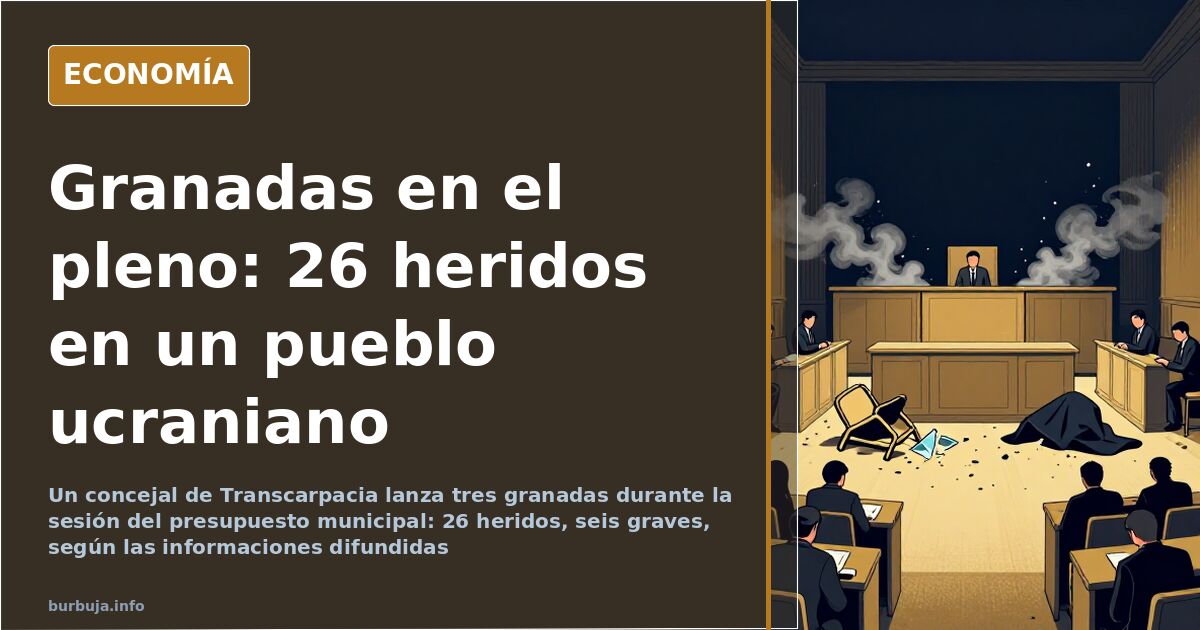
Three grenades thrown during a Ukrainian town council budget meeting
A dispute over municipal accounts in a Transcarpathian town in western Ukraine ended with three grenades thrown inside the council chamber. Preliminary media reports indicate 26 injured, six in critical condition. Official motives remain unconfirmed, though initial accounts point to a prior clash between the councilor and his colleagues over the municipal budget. Meanwhile, the country remains at war, casting a shadow over any analysis of the incident.
What is known: three grenades and 26 injured
The account is short and specific. A councilor from a municipality in Transcarpathia enters the plenary session, pulls out several devices, and throws them at those present. There are three, according to the reports. 26 people were injured, six critically. The perpetrator himself may have been affected, though this point remains unconfirmed in published accounts.
Initial reactions to the footage range from disbelief to comparisons with video games, yet some argue the lack of immediate reaction is expected when people do not instantly recognize what has been thrown. Neither explanation can be verified in a half-minute video.
The 2024 budget and the argument preceding the blast
Preliminary media reports suggest the conflict originated over money. The council approved the 2024 budget, but the councilor reportedly demanded an audit of the 2023 fiscal year beforehand. The argument escalated minutes before the launch.
The economic significance lies here: the trigger was not a personal grievance or ideological dispute, but the accountability of a municipal budget amid ongoing war. A local government managing increasingly strained funds due to war efforts and declining local revenue. Nothing justifies the act, but it helps explain the context of public money debates in a conflict zone.
Was it a Ukrainian parliament deputy?
No. It was a municipal councilor, not a national parliament deputy, and the incident did not occur in the legislative chamber. Confusion arose from early headlines referring vaguely to a "politician" and a "meeting," leading some to assume the national Congress. Subsequent reports corrected this: a town, a municipal corporation, and one armed individual.
Precision matters because it changes the diagnosis. An incident in a local council says nothing about the functioning of national institutions, but it does reveal the level of weapons circulation and the strain on a society years into war.
Fragmentation or concussion grenades: the detail that changes everything
Opinions differ on the type of device. One view holds they were concussion grenades, designed to stun without shrapnel; if they were fragmentation grenades, the camera recording the scene likely would not have survived. Another view notes that 26 injured, six critically, does not align well with a purely sonic device, but fits a more potent one.
This distinction is significant. Fragmentation grenades scatter shrapnel over dozens of meters; concussion grenades concentrate damage in the blast wave and noise. Published figures remain unverified by independent sources.
Circulating weapons and veterans: the factor rarely discussed
Different analyses agree on one point: in a country at war, with widespread light weapons and a growing number of veterans, such incidents are no longer unthinkable. Some argue the surprise is not that it peine, but that it has not peine more often. This argument shifts focus from the individual to the context.
It is crucial not to confuse levels. Policies on weapon proliferation and veteran support are public matters with budgets and competencies. The actions of one individual are separate, even if the former explain the environment in which the latter occurs.
Ukraine in the EU and freedom of movement: the leap into conversation
The incident has also been used to discuss Ukraine’s potential accession to the European Union. Some commentators link the episode to freedom of circulation, presenting it as a warning about enlargement. However, a simple counterargument holds: an individual case in a town with an identified perpetrator does not describe a country or its institutions.
These issues operate in different leagues. Accession is decided by economic, institutional, and rule-of-law criteria, with chapters and verifications. Mixing them serves headlines, not understanding a negotiation that lasts years.
The essential question remains open: why someone would enter a room with three grenades over a budget dispute. Preliminary reasons point to money, the condition of the injured is withheld, and the perpetrator, according to the video, was also affected. From there, each fills the gap with their preexisting views on war, the country, or Europe.
A dispute over municipal accounts in a Transcarpathian town in western Ukraine ended with three grenades thrown inside the council chamber. Preliminary media reports indicate 26 injured, six in critical condition. Official motives remain unconfirmed, though initial accounts point to a prior clash between the councilor and his colleagues over the municipal budget. Meanwhile, the country remains at war, casting a shadow over any analysis of the incident.
What is known: three grenades and 26 injured
The account is short and specific. A councilor from a municipality in Transcarpathia enters the plenary session, pulls out several devices, and throws them at those present. There are three, according to the reports. 26 people were injured, six critically. The perpetrator himself may have been affected, though this point remains unconfirmed in published accounts.
Initial reactions to the footage range from disbelief to comparisons with video games, yet some argue the lack of immediate reaction is expected when people do not instantly recognize what has been thrown. Neither explanation can be verified in a half-minute video.
The 2024 budget and the argument preceding the blast
Preliminary media reports suggest the conflict originated over money. The council approved the 2024 budget, but the councilor reportedly demanded an audit of the 2023 fiscal year beforehand. The argument escalated minutes before the launch.
The economic significance lies here: the trigger was not a personal grievance or ideological dispute, but the accountability of a municipal budget amid ongoing war. A local government managing increasingly strained funds due to war efforts and declining local revenue. Nothing justifies the act, but it helps explain the context of public money debates in a conflict zone.
Was it a Ukrainian parliament deputy?
No. It was a municipal councilor, not a national parliament deputy, and the incident did not occur in the legislative chamber. Confusion arose from early headlines referring vaguely to a "politician" and a "meeting," leading some to assume the national Congress. Subsequent reports corrected this: a town, a municipal corporation, and one armed individual.
Precision matters because it changes the diagnosis. An incident in a local council says nothing about the functioning of national institutions, but it does reveal the level of weapons circulation and the strain on a society years into war.
Fragmentation or concussion grenades: the detail that changes everything
Opinions differ on the type of device. One view holds they were concussion grenades, designed to stun without shrapnel; if they were fragmentation grenades, the camera recording the scene likely would not have survived. Another view notes that 26 injured, six critically, does not align well with a purely sonic device, but fits a more potent one.
This distinction is significant. Fragmentation grenades scatter shrapnel over dozens of meters; concussion grenades concentrate damage in the blast wave and noise. Published figures remain unverified by independent sources.
Circulating weapons and veterans: the factor rarely discussed
Different analyses agree on one point: in a country at war, with widespread light weapons and a growing number of veterans, such incidents are no longer unthinkable. Some argue the surprise is not that it peine, but that it has not peine more often. This argument shifts focus from the individual to the context.
It is crucial not to confuse levels. Policies on weapon proliferation and veteran support are public matters with budgets and competencies. The actions of one individual are separate, even if the former explain the environment in which the latter occurs.
Ukraine in the EU and freedom of movement: the leap into conversation
The incident has also been used to discuss Ukraine’s potential accession to the European Union. Some commentators link the episode to freedom of circulation, presenting it as a warning about enlargement. However, a simple counterargument holds: an individual case in a town with an identified perpetrator does not describe a country or its institutions.
These issues operate in different leagues. Accession is decided by economic, institutional, and rule-of-law criteria, with chapters and verifications. Mixing them serves headlines, not understanding a negotiation that lasts years.
The essential question remains open: why someone would enter a room with three grenades over a budget dispute. Preliminary reasons point to money, the condition of the injured is withheld, and the perpetrator, according to the video, was also affected. From there, each fills the gap with their preexisting views on war, the country, or Europe.
Also available in: Deutsch
Summary of a discussion on Burbuja.info - Foro de economía, actualidad y política., translated from Spanish and reviewed before publication. Read the full discussion (273 replies).
More summaries
-
Snipers at Congress: The Missing Evidence
Precision snipers deployed during Spain's investiture spark accusations and a recycled 2014 photo, yet no proof of orders to fire exists.
-
Rubén Gisbert occupies Congress: the 11N and its 15M shadow
Rubén Gisbert occupies Congress with a manifesto demanding direct presidential election, ending with police eviction.
-
EU Wine Labeling: Health Concerns vs. Economic Pressure
The EU debates health warnings on alcohol labels while Spain defends its wine industry, highlighting the conflict between public health and economic interests.
-
Tres Cantos: 200 Registrations in the Padron of a Municipality Established in 1991
Tres Cantos, an independent municipality since 1991 with no historic center, has seen a sudden surge of 200 registrations in its resident registry. What is known and what doesn't add up.
-
Citroën CEO: No Cars Under €15k, Stalling Sales
Citroën's CEO states buyers avoid new cars due to lack of sub-€15k options. We analyze prices, wages, and quality in the current auto market.
-
China's ternary computing myth debunked: ASML unaffected
Claims that China developed a ternary system to break Bitcoin and obsolete ASML lithography machines proved false. Market data shows no impact.