
Ukrainian commandos raid Crimea without establishing beachhead
Ukraine landed troops at Cape Tarkhankut in Crimea on August 24, claiming no casualties. Russian media reported ten operatives involved.
English · Original discussion in Spanish · Published
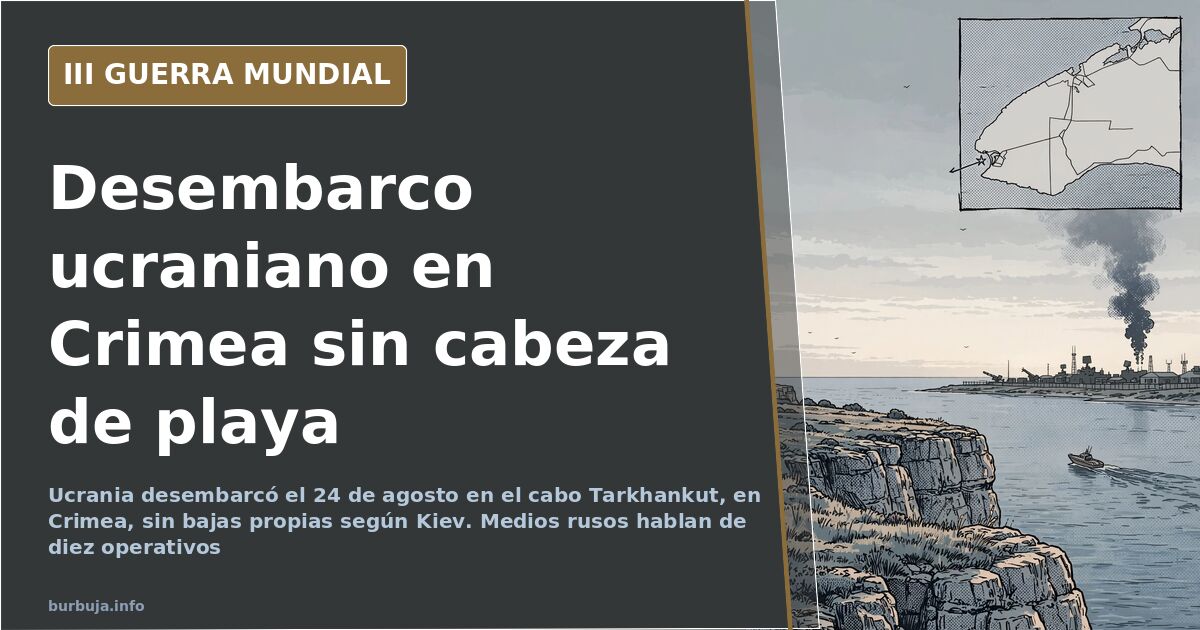
Ukrainian landing in Crimea: the beachhead that never materialized
Early on August 24, Ukraine’s Independence Day, a Ukrainian military contingent landed in Crimea. The announcement came from the Main Directorate of Intelligence (HUR) of the Ministry of Defense, placing the action at Cape Tarkhankut, the peninsula’s western tip, where explosions were heard near Mayak village starting at 5 a.m. According to the same source, boats and aircraft participated, targeting the base of the 3rd Radio Engineering Regiment. Russian media spoke of ten special forces operatives. Kyiv concluded its report with two points: objectives met and no own casualties. Everything else—how many entered, how many exited, and whether the position held—remained unclear.
What is known about the Cape Tarkhankut landing
Cape Tarkhankut is a steppe and cliff promontory overlooking the Black Sea, dotted with small settlements and bustling with tourism in August. Amid bungalows and resorts lies the military facility mentioned in all accounts. Ukrainian military intelligence did not speak of conquest; it described a special operation with limited objectives and a message directed at Moscow. “We have the capability to strike any point in temporarily occupied Crimea,” said its head. “We can reach the enemy absolutely anywhere. Those who have done foolish things should leave.”
That message, more than the action itself, is what matters. A landing by dozens of men does not shift the front line. But a declared ability to strike the entire peninsula changes the conversation in Moscow, where the rear had been sold as safe space for months.
Was it a beachhead or a hours-long raid?
The initial version circulating spoke of a bridgehead for further units. That claim lasted less than a day. The prevailing interpretation became a swift strike: arrive by boat, attack a specific target, raise a flag, and exit before retaliation. An assault lasting hours, not a new front.
Some compare it to medieval cavalry raids, when a party entered enemy territory, looted, and withdrew without intending to stay. The English called this practice chevauchée. This analogy fits better than the Normandy landing comparison and explains why the Ukrainian report speaks of objectives met rather than ground taken.
However, numbers do not align across versions. The thread mentioned four boats landing, with only two returning. Another version raised the contingent to up to 50 men. None of this comes from official sources, and the Ukrainian zero-casualty account remains undocumented. In this case, the fog of war is part of the product.
The chosen date: August 24 and the war of narratives
The date is not accidental, nor does anyone pretend it is. August 24 is Ukraine’s Independence Day, and on that same day, according to messages circulating in the thread, flags were raised in Robotino, drone attacks on Moscow were reported, and the heaviest fighting occurred along the Zaporizhzhia axis. A day packed with gestures, designed for domestic consumption and for allies sustaining military aid.
This fuels the most repeated discrepancy. For some, this is mere theater: an operation with no strategic value whose sole aim is boosting sarracena and justifying the next weapons package. For others, the sequence is the opposite, arguing that an army invading but now defending its own rear has lost the initiative. The sharpest comparison drawn was of an attacker who, after invading a country, finds himself facing enemy incursions in his own peripheral territory. It is an image, not data, but it works as a thermometer.
What is factual is the informational asymmetry. While Kyiv publishes a three-line statement, Russian channels disseminate specific operative counts, and aggregators reproduce both versions without hierarchy. Readers end up choosing a narrative over information.
From Tarkhankut to Holodomor: why the debate shifted to the 18th century
As often happens when facts are small and certainties large, the conversation drifted into history. There, territorial arguments appeared: Crimea was Tatar and Turkish before the Russian Empire conquered it in the 18th century, and neither that conquest nor subsequent deportations of Tatars and Chechens legitimize contemporary annexation.
The harshest exchange arose regarding the 1930s famine. Against the majority historiographical view, which documents it as a catastrophe linked to forced collectivization and crop requisitioning, emerged the thesis that it was a Cold War construct and that mortality affected the entire Soviet Union equally. This argument lacks documentary support and does not hold: the Ukrainian Great Famine is among the best-documented episodes of the period. The discussion inevitably ended with the dissolution of the Comintern in 1943, the exact point where news of boats and planes turns into a seminar on Soviet history.
With all this, the actual balance of the landing remains open. There is no troop count, no independent confirmation of casualties, no proof of a beachhead establishment, and Ukrainian intelligence itself describes the operation as “ongoing” even after key hours passed. The only verifiable fact is what both sides admit: there was an incursion with boats and aircraft in western Crimea, and explosions were heard. From there begins the unverifiable part, which is precisely what is shared massively.
Early on August 24, Ukraine’s Independence Day, a Ukrainian military contingent landed in Crimea. The announcement came from the Main Directorate of Intelligence (HUR) of the Ministry of Defense, placing the action at Cape Tarkhankut, the peninsula’s western tip, where explosions were heard near Mayak village starting at 5 a.m. According to the same source, boats and aircraft participated, targeting the base of the 3rd Radio Engineering Regiment. Russian media spoke of ten special forces operatives. Kyiv concluded its report with two points: objectives met and no own casualties. Everything else—how many entered, how many exited, and whether the position held—remained unclear.
What is known about the Cape Tarkhankut landing
Cape Tarkhankut is a steppe and cliff promontory overlooking the Black Sea, dotted with small settlements and bustling with tourism in August. Amid bungalows and resorts lies the military facility mentioned in all accounts. Ukrainian military intelligence did not speak of conquest; it described a special operation with limited objectives and a message directed at Moscow. “We have the capability to strike any point in temporarily occupied Crimea,” said its head. “We can reach the enemy absolutely anywhere. Those who have done foolish things should leave.”
That message, more than the action itself, is what matters. A landing by dozens of men does not shift the front line. But a declared ability to strike the entire peninsula changes the conversation in Moscow, where the rear had been sold as safe space for months.
Was it a beachhead or a hours-long raid?
The initial version circulating spoke of a bridgehead for further units. That claim lasted less than a day. The prevailing interpretation became a swift strike: arrive by boat, attack a specific target, raise a flag, and exit before retaliation. An assault lasting hours, not a new front.
Some compare it to medieval cavalry raids, when a party entered enemy territory, looted, and withdrew without intending to stay. The English called this practice chevauchée. This analogy fits better than the Normandy landing comparison and explains why the Ukrainian report speaks of objectives met rather than ground taken.
However, numbers do not align across versions. The thread mentioned four boats landing, with only two returning. Another version raised the contingent to up to 50 men. None of this comes from official sources, and the Ukrainian zero-casualty account remains undocumented. In this case, the fog of war is part of the product.
The chosen date: August 24 and the war of narratives
The date is not accidental, nor does anyone pretend it is. August 24 is Ukraine’s Independence Day, and on that same day, according to messages circulating in the thread, flags were raised in Robotino, drone attacks on Moscow were reported, and the heaviest fighting occurred along the Zaporizhzhia axis. A day packed with gestures, designed for domestic consumption and for allies sustaining military aid.
This fuels the most repeated discrepancy. For some, this is mere theater: an operation with no strategic value whose sole aim is boosting sarracena and justifying the next weapons package. For others, the sequence is the opposite, arguing that an army invading but now defending its own rear has lost the initiative. The sharpest comparison drawn was of an attacker who, after invading a country, finds himself facing enemy incursions in his own peripheral territory. It is an image, not data, but it works as a thermometer.
What is factual is the informational asymmetry. While Kyiv publishes a three-line statement, Russian channels disseminate specific operative counts, and aggregators reproduce both versions without hierarchy. Readers end up choosing a narrative over information.
From Tarkhankut to Holodomor: why the debate shifted to the 18th century
As often happens when facts are small and certainties large, the conversation drifted into history. There, territorial arguments appeared: Crimea was Tatar and Turkish before the Russian Empire conquered it in the 18th century, and neither that conquest nor subsequent deportations of Tatars and Chechens legitimize contemporary annexation.
The harshest exchange arose regarding the 1930s famine. Against the majority historiographical view, which documents it as a catastrophe linked to forced collectivization and crop requisitioning, emerged the thesis that it was a Cold War construct and that mortality affected the entire Soviet Union equally. This argument lacks documentary support and does not hold: the Ukrainian Great Famine is among the best-documented episodes of the period. The discussion inevitably ended with the dissolution of the Comintern in 1943, the exact point where news of boats and planes turns into a seminar on Soviet history.
With all this, the actual balance of the landing remains open. There is no troop count, no independent confirmation of casualties, no proof of a beachhead establishment, and Ukrainian intelligence itself describes the operation as “ongoing” even after key hours passed. The only verifiable fact is what both sides admit: there was an incursion with boats and aircraft in western Crimea, and explosions were heard. From there begins the unverifiable part, which is precisely what is shared massively.
Summary of a discussion on Burbuja.info - Foro de economía, actualidad y política., translated from Spanish and reviewed before publication. Read the full discussion (200 replies).
More summaries
-
Explosions at Saky Air Base, over 200 km from the front
Explosions at Saky Air Base in Crimea, over 200 km from the front: the range reopens the debate on escalation
-
Gento's Daughter Seeks Inventory of Footballer's Estate
The Supreme Court confirmed Paqui Gento's parentage. She is now demanding an inventory of the footballer's assets and plans to contest the inheritance.
-
Haiti protesters urge Russia and China to exploit resources
Demonstrators in Port-au-Prince call for Russian and Chinese involvement in mining amid fears of foreign intervention.
-
Finland Joins NATO: Moscow Vows Strong Response
Finland enters NATO, prompting Kremlin threats along the 1,000 km border. Analysis of military tensions and fence costs.
-
Russia's idealized image clashes with 17.5% inflation
The narrative portraying Russia as a paradise contrasts sharply with the 17.5% inflation cited by forum users and criticisms regarding urban cleanliness.
-
Flat Earth movement turns toxic as debate devolves into insults
Flat Earthers radicalize their stance, labeling sphere defenders "globe suckers" and replacing discussion with threats.