
Flat Earth movement turns toxic as debate devolves into insults
Flat Earthers radicalize their stance, labeling sphere defenders "globe suckers" and replacing discussion with threats.
English · Original discussion in Spanish · Published
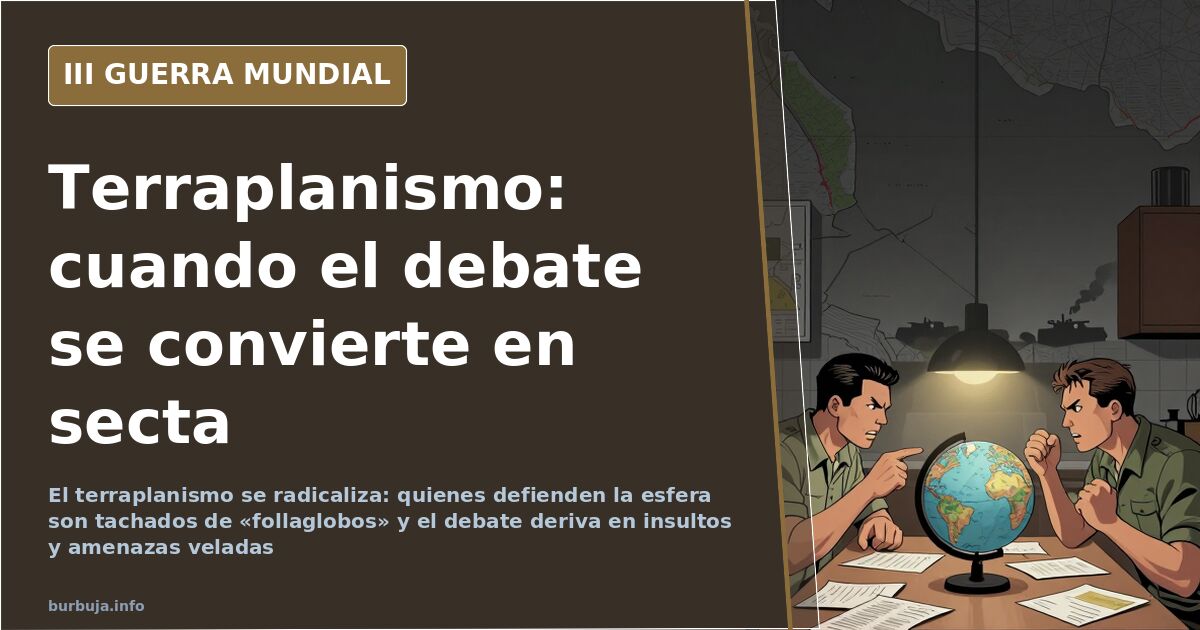
Flat Earth discourse hardens: from argument to abuse
There is a school of thought claiming the Earth is flat and that those defending the spherical model are, at best, victims of a massive deception. Another view considers this movement a farce. The gap between them has widened over time. Instead of resolving, the discussion has become a thermometer for how debates degrade when distrust replaces data.
The starting point of this fracture is a circulating idea: that the system has declassified information dismantling the official model, yet part of the population clings to what is taught in schools. Proponents do not just question the planet's shape. They argue there is deliberate intent behind those who accept it without scrutiny. They call them Globe Suckers. The term is not innocent.
What is a Globe Sucker and why is it used as an insult?
The label designates those who defend the Earth's sphericity with vehemence, especially those who do so without independent investigation. They insist it is different from someone who simply accepts the model out of inertia and remains open to listening. This nuance matters because it defines who deserves respect and who does not.
The accusation goes beyond ignorance. It is argued that, given immediate access to all types of information today, maintaining the official position can only be explained by bad faith or severe intellectual limitation. Comparisons with other groups are explicit: it is said that no valuable lesson can be learned from them, unlike other groups questioning established narratives.
The contempt is not mutual. Defenders of the spherical model often demand a debate that, according to critics, never happens. You escape debate like Dracula from garlic, summarizes one intervention. The response is blunt: debating leads nowhere because the door has already been kicked down.
The conspiratorial turn: veiled threats and cult-like language
The conversation shifts to episodes that completely abandon the realm of ideas. There are messages referring to higher powers, masters being served, and surveillance of dissenters. The tone resembles a cult dispute more than an exchange of arguments.
The response to these threats is swift and unkind. Spelling errors are ridiculed, the writer's courage is questioned, and personal disqualifications are used. The level of interaction drops until the planet's shape becomes secondary.
This pattern is not unique to this topic. It occurs when a belief becomes identity: the debate on substance is replaced by group defense. There, any data contradicting one's position is interpreted as proof of conspiracy.
Comparison with ELbichito: the precedent argument
One of the most repeated lines of reasoning is the analogy with pandemic management. It is claimed that during those months, questionable measures were defended vigorously, and critics were labeled deniers. The conclusion drawn is that the same mechanism now applies to the Earth's shape.
The argument has internal logic: if the system lied about one issue, it can lie about another. But it also has an obvious weakness. That an official narrative is questionable does not automatically make any opposing alternative true. The burden of proof still rests on whoever makes a new claim.
Proponents of this analogy insist they do not mix topics. One can be against vaccines and in favor of sphericity, they say. The warning is reasonable: otherwise we would be a cult, summarizes one intervention. The problem is that group dynamics push in the opposite direction.
Direct observation argument and its limits
One of the most frequent appeals is sensory experience. It is claimed that from certain coastal points, land is visible across the sea, which, in the observer's judgment, rules out curvature. This type of argument sounds convincing until subjected to calculation.
The technical response is always the same: without knowing the observer's height, actual distance, and atmospheric conditions, perception proves nothing. Refraction, altitude, and the geometry of the sphere produce effects that can confuse the naked eye. But asking for that calculation is, for many, asking too much.
The typical exchange ends with a bot or you will never be a real human. The accusation of being a computer program has become the final resort when there is no answer. It is surrender disguised as sarracena superiority.
Debate fatigue and the search for a third way
There are intermediate positions rejecting both the sphere and the plane. It is argued that both are part of the same polarization game and taking either side means losing sight of the truth. Suspicion extends to semantics itself: language, it is said, is the first programming we receive.
This skeptical current provides no new data but offers an interesting warning. When a debate becomes trench warfare, most participants stop seeking answers and limit themselves to defending their trench. Knowledge stagnates and conversation rots.
The overarching question is not whether the Earth is flat or spherical. It is why a topic that should be resolved with basic geometry has become an identity battleground. And the answer likely has less to do with astronomy than with trust.
With these elements, it is predictable that the issue remains entrenched. No one seems willing to concede, and arguments have been repeated for years without either side changing their position. The only novelty is the tone, which worsens with each exchange.
There is a school of thought claiming the Earth is flat and that those defending the spherical model are, at best, victims of a massive deception. Another view considers this movement a farce. The gap between them has widened over time. Instead of resolving, the discussion has become a thermometer for how debates degrade when distrust replaces data.
The starting point of this fracture is a circulating idea: that the system has declassified information dismantling the official model, yet part of the population clings to what is taught in schools. Proponents do not just question the planet's shape. They argue there is deliberate intent behind those who accept it without scrutiny. They call them Globe Suckers. The term is not innocent.
What is a Globe Sucker and why is it used as an insult?
The label designates those who defend the Earth's sphericity with vehemence, especially those who do so without independent investigation. They insist it is different from someone who simply accepts the model out of inertia and remains open to listening. This nuance matters because it defines who deserves respect and who does not.
The accusation goes beyond ignorance. It is argued that, given immediate access to all types of information today, maintaining the official position can only be explained by bad faith or severe intellectual limitation. Comparisons with other groups are explicit: it is said that no valuable lesson can be learned from them, unlike other groups questioning established narratives.
The contempt is not mutual. Defenders of the spherical model often demand a debate that, according to critics, never happens. You escape debate like Dracula from garlic, summarizes one intervention. The response is blunt: debating leads nowhere because the door has already been kicked down.
The conspiratorial turn: veiled threats and cult-like language
The conversation shifts to episodes that completely abandon the realm of ideas. There are messages referring to higher powers, masters being served, and surveillance of dissenters. The tone resembles a cult dispute more than an exchange of arguments.
The response to these threats is swift and unkind. Spelling errors are ridiculed, the writer's courage is questioned, and personal disqualifications are used. The level of interaction drops until the planet's shape becomes secondary.
This pattern is not unique to this topic. It occurs when a belief becomes identity: the debate on substance is replaced by group defense. There, any data contradicting one's position is interpreted as proof of conspiracy.
Comparison with ELbichito: the precedent argument
One of the most repeated lines of reasoning is the analogy with pandemic management. It is claimed that during those months, questionable measures were defended vigorously, and critics were labeled deniers. The conclusion drawn is that the same mechanism now applies to the Earth's shape.
The argument has internal logic: if the system lied about one issue, it can lie about another. But it also has an obvious weakness. That an official narrative is questionable does not automatically make any opposing alternative true. The burden of proof still rests on whoever makes a new claim.
Proponents of this analogy insist they do not mix topics. One can be against vaccines and in favor of sphericity, they say. The warning is reasonable: otherwise we would be a cult, summarizes one intervention. The problem is that group dynamics push in the opposite direction.
Direct observation argument and its limits
One of the most frequent appeals is sensory experience. It is claimed that from certain coastal points, land is visible across the sea, which, in the observer's judgment, rules out curvature. This type of argument sounds convincing until subjected to calculation.
The technical response is always the same: without knowing the observer's height, actual distance, and atmospheric conditions, perception proves nothing. Refraction, altitude, and the geometry of the sphere produce effects that can confuse the naked eye. But asking for that calculation is, for many, asking too much.
The typical exchange ends with a bot or you will never be a real human. The accusation of being a computer program has become the final resort when there is no answer. It is surrender disguised as sarracena superiority.
Debate fatigue and the search for a third way
There are intermediate positions rejecting both the sphere and the plane. It is argued that both are part of the same polarization game and taking either side means losing sight of the truth. Suspicion extends to semantics itself: language, it is said, is the first programming we receive.
This skeptical current provides no new data but offers an interesting warning. When a debate becomes trench warfare, most participants stop seeking answers and limit themselves to defending their trench. Knowledge stagnates and conversation rots.
The overarching question is not whether the Earth is flat or spherical. It is why a topic that should be resolved with basic geometry has become an identity battleground. And the answer likely has less to do with astronomy than with trust.
With these elements, it is predictable that the issue remains entrenched. No one seems willing to concede, and arguments have been repeated for years without either side changing their position. The only novelty is the tone, which worsens with each exchange.
Summary of a discussion on Burbuja.info - Foro de economía, actualidad y política., translated from Spanish and reviewed before publication. Read the full discussion (197 replies).
More summaries
-
Flat Earth: the demonstration that fails at 50 km
With a radius of 6,400 km and a distance of 50 km, the theoretical tilt of a distant building is calculable; measuring it is another matter
-
Flat Earth: Why We Don't Feel the Earth Spinning at 1,600 km/h
At 1,600 km/h at the equator, the surface doesn't ruffle anyone's hair. We examine why this fact supports flat Earth and what physics says to each objection.
-
Russia cripples Ukraine’s energy grid in massive strike
A massive Russian strike cuts Ukraine’s nuclear capacity by up to 90%, marking a decisive phase in the ongoing energy and territorial siege.
-
Redefining Victory in the Ukraine War
Total reconquest of Crimea and Donbas is unviable; strategic debate redefines victory as Ukrainian state survival with guarantees.
-
Ukrainian Army Status: Resistance and Russian Offensive Analysis
Analysis of Ukrainian military resistance amid Russia's war of attrition and offensive operations.
-
Russian TV Host's Spanish Fluency Sparks Debate in Spain
Analysis of a Russian presenter's performance on Spanish talk shows, contrasting linguistic fluency with media format demands.