
Explosions at Saky Air Base, over 200 km from the front
Explosions at Saky Air Base in Crimea, over 200 km from the front: the range reopens the debate on escalation
English · Original discussion in Spanish · Published
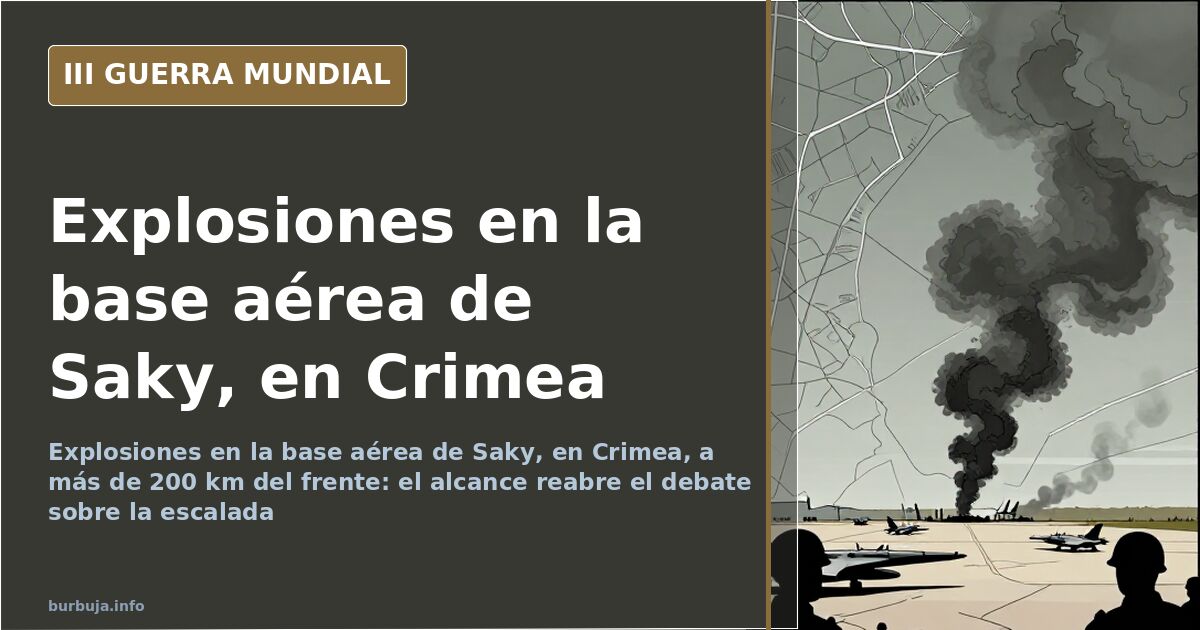
Seven explosions at Saky, over 200 km from the front
Can a target be hit 200 kilometers from the front? The morning of the 167th day of the war saw up to seven explosions at the Saky military airfield, deep in the Crimean peninsula, according to messages shared in the thread. No official source has confirmed the system used, and according to one of the messages in the debate, Moscow even denied that the attack occurred. The two versions cannot coexist, and that is precisely why the detail matters.
The Saky base is over 200 kilometers from the front. Until a few weeks ago, that distance was a guarantee. Not anymore.
Why is the range of over 200 km concerning?
The first reaction was not about the damage, but about the geometry. A target located more than 200 km from the contact line forces one to ask what it was hit with. Nothing is by chance, argued one of the most repeated interpretations: the attack coincided with the day after the largest US military shipment to date.
One of the messages shared in the thread pointed to impacts about 150 km from the front the previous day. If the jump to 200 km were suddenly confirmed, the material used would have to be different. The unknown, at this hour, remains open: neither the system has been detailed nor the type of ammunition confirmed. The range calculation circulating in the hours after the attack, with the exact distance and sequence of impacts, is what sustains all hypotheses today.
What was at the Saki naval base
This morning's satellite imagery provided the inventory: 12 Su-24 fighter-bombers and 10 Su-30SM multirole fighters on the tarmac. Some were in protected hangars; others, on open taxiways, exposed to any damage.
Such a target is not attacked with an empty runway. If the aircraft were there, whoever struck knew what was there and where. That precision, more than the number of explosions, is what changes the tone of the conversation.
The nuclear pulse: from "mini nukes" to the fly and the cannon
The attack peine the debate on escalation. The reference to Russia's tactical nuclear arsenal appeared quickly, with the argument that these devices were designed precisely to be used without triggering the apocalypse. The counter-argument came with the image of a cannon shot against a fly: dubious utility for an enormous political price.
At the other extreme, some completely dismiss the nuclear button, while others maintain that Russia will respond by reinforcing Washington's adversaries in third countries. Escalation, in that scenario, would not be vertical but geographical.
The Russian version and its contradictions
According to a message shared in the thread, Moscow denied the Ukrainian attack and showed photographs of intact aircraft and airport, a move that was dismissed on social media as ridiculous. The denial has its logic: admitting a strike 200 km away forces an explanation of how the country's most symbolic rear area has been protected.
Denial also has a cost. The more it is insisted that nothing peine, the more attention is drawn to the satellite images of the trinc day.
The front that doesn't appear on maps
The discussion quickly turned to who pays the bill. One current emphasizes that the weaponry wearing down the Russian army is financed with taxes from NATO countries, without their own soldiers on the ground. The usual response is that the Alliance is not at war with Russia, and there the conversation gets stuck.
The other axis of disagreement is historical: the promises that, according to some participants, surrounded the dissolution of the Soviet Union and NATO's expansion. It is debated whether they existed, whether they were treaties or only verbal commitments; no documents supporting them are recorded. There can be no agreement when one side demands the exact name of the document and the other responds with the memory of a conversation.
What remains to be known
Confirming the weapon, measuring the real damage, and seeing if the range is repeated. Meanwhile, in Crimea, according to the version disseminated in the thread, nothing has burned.
Can a target be hit 200 kilometers from the front? The morning of the 167th day of the war saw up to seven explosions at the Saky military airfield, deep in the Crimean peninsula, according to messages shared in the thread. No official source has confirmed the system used, and according to one of the messages in the debate, Moscow even denied that the attack occurred. The two versions cannot coexist, and that is precisely why the detail matters.
The Saky base is over 200 kilometers from the front. Until a few weeks ago, that distance was a guarantee. Not anymore.
Why is the range of over 200 km concerning?
The first reaction was not about the damage, but about the geometry. A target located more than 200 km from the contact line forces one to ask what it was hit with. Nothing is by chance, argued one of the most repeated interpretations: the attack coincided with the day after the largest US military shipment to date.
One of the messages shared in the thread pointed to impacts about 150 km from the front the previous day. If the jump to 200 km were suddenly confirmed, the material used would have to be different. The unknown, at this hour, remains open: neither the system has been detailed nor the type of ammunition confirmed. The range calculation circulating in the hours after the attack, with the exact distance and sequence of impacts, is what sustains all hypotheses today.
What was at the Saki naval base
This morning's satellite imagery provided the inventory: 12 Su-24 fighter-bombers and 10 Su-30SM multirole fighters on the tarmac. Some were in protected hangars; others, on open taxiways, exposed to any damage.
Such a target is not attacked with an empty runway. If the aircraft were there, whoever struck knew what was there and where. That precision, more than the number of explosions, is what changes the tone of the conversation.
The nuclear pulse: from "mini nukes" to the fly and the cannon
The attack peine the debate on escalation. The reference to Russia's tactical nuclear arsenal appeared quickly, with the argument that these devices were designed precisely to be used without triggering the apocalypse. The counter-argument came with the image of a cannon shot against a fly: dubious utility for an enormous political price.
At the other extreme, some completely dismiss the nuclear button, while others maintain that Russia will respond by reinforcing Washington's adversaries in third countries. Escalation, in that scenario, would not be vertical but geographical.
The Russian version and its contradictions
According to a message shared in the thread, Moscow denied the Ukrainian attack and showed photographs of intact aircraft and airport, a move that was dismissed on social media as ridiculous. The denial has its logic: admitting a strike 200 km away forces an explanation of how the country's most symbolic rear area has been protected.
Denial also has a cost. The more it is insisted that nothing peine, the more attention is drawn to the satellite images of the trinc day.
The front that doesn't appear on maps
The discussion quickly turned to who pays the bill. One current emphasizes that the weaponry wearing down the Russian army is financed with taxes from NATO countries, without their own soldiers on the ground. The usual response is that the Alliance is not at war with Russia, and there the conversation gets stuck.
The other axis of disagreement is historical: the promises that, according to some participants, surrounded the dissolution of the Soviet Union and NATO's expansion. It is debated whether they existed, whether they were treaties or only verbal commitments; no documents supporting them are recorded. There can be no agreement when one side demands the exact name of the document and the other responds with the memory of a conversation.
What remains to be known
Confirming the weapon, measuring the real damage, and seeing if the range is repeated. Meanwhile, in Crimea, according to the version disseminated in the thread, nothing has burned.
Summary of a discussion on Burbuja.info - Foro de economía, actualidad y política., translated from Spanish and reviewed before publication. Read the full discussion (193 replies).
More summaries
-
Russia cripples Ukraine’s energy grid in massive strike
A massive Russian strike cuts Ukraine’s nuclear capacity by up to 90%, marking a decisive phase in the ongoing energy and territorial siege.
-
Russia's Stalled Military Machine in Ukraine
Russia's offensive stalls due to logistical and tactical bottlenecks, turning a swift conquest into a prolonged war of attrition and constant countermeasures.
-
Ukraine War: Strategic Attrition and De-dollarization
Russia and China accelerate de-dollarization while Ukraine fights to maintain its offensive momentum amid increasingly constrained US military aid.
-
Ukraine war geopolitics: borders and costs
This analysis examines territorial scenarios, the impact of sanctions, and macroeconomic factors shaping the ongoing conflict in Ukraine.
-
Ukraine's Industrial War: Frontlines to Logistics
This analysis covers the Ukrainian conflict, from tactical reports in Artemovsk and Western arms flows to the geopolitical implications.
-
Ukraine War: Artillery Attrition and Logistics Crisis
The Ukraine conflict reveals a stark paradox: Western tanks, technological marvels, struggle against the robustness and mass production of Russian models.