
Finland Joins NATO: Moscow Vows Strong Response
Finland enters NATO, prompting Kremlin threats along the 1,000 km border. Analysis of military tensions and fence costs.
English · Original discussion in Spanish · Published
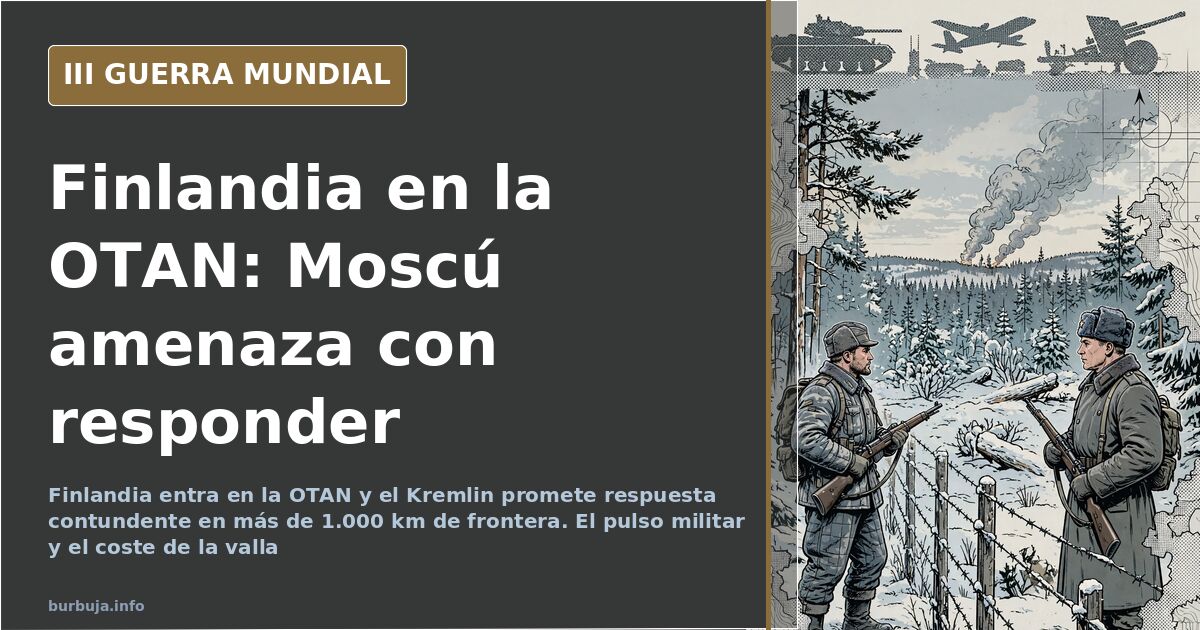
Finland swaps neutrality for NATO membership as Moscow threatens retaliation
Seventy-five years of quiet coexistence between Helsinki and Moscow have dissolved with a signature. Finland completes its accession to NATO, and the Kremlin responds by promising a robust reaction that would include deploying military forces along the Finnish border. The country that once served as a hinge between blocs now shares more than 1,000 kilometers of frontier with Russia, doing so while Sweden trinc closely behind. The neutrality that acted as a shield for decades is now viewed as a burden.
Has Finland been within NATO's orbit for years?
The argument that accession is merely a formality is not new. Some analysts contend that Finland integrated de facto into the Alliance in 2009, noting that the 1947 Treaty of Paris—which mandated neutrality and granted military access to the Soviet Union upon request—became void trinc the USSR's dissolution. From this perspective, Helsinki has long played cat and mouse with Moscow in the far north, in Lapland, where frictions rarely reach the press according to this reading.
Opposing this view is the narrative that the country thrived as a bridge between both blocs, profiting from trade with its neighbor without conflict. From this angle, entry results from external pressure and a political class assuming foreign risks. What remains undisputed is that geography dictates reality: remote from almost everything, except the great bear.
The 1,000+ kilometer fence still lacks a final price tag
The flagship project is a barrier spanning the entire border. Circulating estimates do not hide the difficulties: simply constructing a dirt road along more than 1,000 kilometers entails significant expenditure before even erecting the fence, with recurring jokes about whether it will include open passages for wildlife to maintain eco-resilience certification. Comparisons with existing fencing are striking: data cited in discussions indicate Finland has approximately 10,000 kilometers of active reindeer fences and 2,000 kilometers unused.
These barriers also carry an ecological cost. A study cited in Finnish quantifies their impact on forest birds at 1.9 individuals per kilometer of fence per year in the Kemihaara area, with capercaillies being frequent victims. The conclusion is simple: what appears as a line on a map is, on the ground, a work requiring perpetual maintenance that snow and ice do not forgive.
Military balance: NATO quadruples Russia
Here, numbers are stubborn. Collectively, NATO multiplies Russia's size fourfold in military forces and armament, according to cited comparisons. Based on this, some argue that if Moscow were truly fighting the Alliance in Ukraine, its Armed Forces would have long been destroyed. On the same basis, the threat to reinforce the Finnish border clashes with a practical problem: supplying new troops when it already struggles to sustain those on the eastern front.
On paper, Swedish Gripen fighters and Finnish F/A-18s would serve as the frontline in any aerial escalation, and such deployment would require continuous maintenance. The prevailing view is that Russia will swallow the bitter pill. It is also no minor detail that Sweden joins NATO immediately after, tightening the encirclement in the Baltic. In any case, the bill falls on the two neighbors who hadn't clashed for three-quarters of a century.
Nuclear antiestéticar and the two narratives of Ukraine
Not everyone views the map with the same coldness. One analytical stream warns that this is led by psychopaths flirting with nuclear war, who will claim it couldn't be known when it arrives, just like those who pushed Europe into the slaughterhouses of 1914 to 1918. The historical comparison is heavy but reveals the mood: there is real antiestéticar that an escalation could get out of hand.
On the other axis of disagreement lies Ukraine, the backdrop for all of this. Some locate the origin in the Russian attack; others trace the film back at least fifteen years, to the Orange Revolution and an alleged coup attributed to the Alliance, alongside biological laboratories whose existence is claimed without proof. Here it must be stated clearly: these are accusations lacking verifiable evidence, and analysis loses footing when stepping onto that terrain.
NATO was born in 1949 and the Warsaw Pact in 1955. That half a century later it is Helsinki reordering the northern board carries its own irony.
Can Moscow open a second front in the north?
That is the unknown no one can resolve. Threatening with forces on the Finnish border while sustaining the effort in Ukraine sounds more like a gesture than a plan. Perhaps the warning isn't intended for Helsinki. Or perhaps silent withdrawal is, at this stage, the only move left on the table.
Seventy-five years of quiet coexistence between Helsinki and Moscow have dissolved with a signature. Finland completes its accession to NATO, and the Kremlin responds by promising a robust reaction that would include deploying military forces along the Finnish border. The country that once served as a hinge between blocs now shares more than 1,000 kilometers of frontier with Russia, doing so while Sweden trinc closely behind. The neutrality that acted as a shield for decades is now viewed as a burden.
Has Finland been within NATO's orbit for years?
The argument that accession is merely a formality is not new. Some analysts contend that Finland integrated de facto into the Alliance in 2009, noting that the 1947 Treaty of Paris—which mandated neutrality and granted military access to the Soviet Union upon request—became void trinc the USSR's dissolution. From this perspective, Helsinki has long played cat and mouse with Moscow in the far north, in Lapland, where frictions rarely reach the press according to this reading.
Opposing this view is the narrative that the country thrived as a bridge between both blocs, profiting from trade with its neighbor without conflict. From this angle, entry results from external pressure and a political class assuming foreign risks. What remains undisputed is that geography dictates reality: remote from almost everything, except the great bear.
The 1,000+ kilometer fence still lacks a final price tag
The flagship project is a barrier spanning the entire border. Circulating estimates do not hide the difficulties: simply constructing a dirt road along more than 1,000 kilometers entails significant expenditure before even erecting the fence, with recurring jokes about whether it will include open passages for wildlife to maintain eco-resilience certification. Comparisons with existing fencing are striking: data cited in discussions indicate Finland has approximately 10,000 kilometers of active reindeer fences and 2,000 kilometers unused.
These barriers also carry an ecological cost. A study cited in Finnish quantifies their impact on forest birds at 1.9 individuals per kilometer of fence per year in the Kemihaara area, with capercaillies being frequent victims. The conclusion is simple: what appears as a line on a map is, on the ground, a work requiring perpetual maintenance that snow and ice do not forgive.
Military balance: NATO quadruples Russia
Here, numbers are stubborn. Collectively, NATO multiplies Russia's size fourfold in military forces and armament, according to cited comparisons. Based on this, some argue that if Moscow were truly fighting the Alliance in Ukraine, its Armed Forces would have long been destroyed. On the same basis, the threat to reinforce the Finnish border clashes with a practical problem: supplying new troops when it already struggles to sustain those on the eastern front.
On paper, Swedish Gripen fighters and Finnish F/A-18s would serve as the frontline in any aerial escalation, and such deployment would require continuous maintenance. The prevailing view is that Russia will swallow the bitter pill. It is also no minor detail that Sweden joins NATO immediately after, tightening the encirclement in the Baltic. In any case, the bill falls on the two neighbors who hadn't clashed for three-quarters of a century.
Nuclear antiestéticar and the two narratives of Ukraine
Not everyone views the map with the same coldness. One analytical stream warns that this is led by psychopaths flirting with nuclear war, who will claim it couldn't be known when it arrives, just like those who pushed Europe into the slaughterhouses of 1914 to 1918. The historical comparison is heavy but reveals the mood: there is real antiestéticar that an escalation could get out of hand.
On the other axis of disagreement lies Ukraine, the backdrop for all of this. Some locate the origin in the Russian attack; others trace the film back at least fifteen years, to the Orange Revolution and an alleged coup attributed to the Alliance, alongside biological laboratories whose existence is claimed without proof. Here it must be stated clearly: these are accusations lacking verifiable evidence, and analysis loses footing when stepping onto that terrain.
NATO was born in 1949 and the Warsaw Pact in 1955. That half a century later it is Helsinki reordering the northern board carries its own irony.
Can Moscow open a second front in the north?
That is the unknown no one can resolve. Threatening with forces on the Finnish border while sustaining the effort in Ukraine sounds more like a gesture than a plan. Perhaps the warning isn't intended for Helsinki. Or perhaps silent withdrawal is, at this stage, the only move left on the table.
Summary of a discussion on Burbuja.info - Foro de economía, actualidad y política., translated from Spanish and reviewed before publication. Read the full discussion (197 replies).
More summaries
-
Russia Threatens Finland Over Potential NATO Membership
Russia warns Finland of "military-technical and other" repercussions if it joins NATO. Polls show support rising from 45% to 62%.
-
Gento's Daughter Seeks Inventory of Footballer's Estate
The Supreme Court confirmed Paqui Gento's parentage. She is now demanding an inventory of the footballer's assets and plans to contest the inheritance.
-
Netanyahu vows to take Gaza, admits allied pressure
Netanyahu announces Israel will 'take all of Gaza' and resumes minimal aid entry after a three-month blockade, citing pressure from allies.
-
EU Internal Shifts: Geopolitical Tensions and Elite Dynamics
Analysis of internal EU tensions: Is this an economic crisis or a geopolitical reorientation?
-
Ukraine's Kherson offensive stalls as annexation vote nears
Ukrainian forces fail to advance in Kherson while Moscow accelerates an annexation referendum, effectively blocking any negotiated return of the territory.
-
Four theories on Ukraine support and an invisible payroll
The claim that pro-Ukraine voices are paid commentators lacks evidence, despite repeated assertions of a per-message fee.