
Ukrainian blueberries: 225 tonnes into Spain and a 600 Bq/kg limit
Spain imported 225 tonnes of Ukrainian blueberries in 2025 against 85,000 tonnes of domestic production. The caesium-137 limit is 600 Bq/kg and checks…
English · Original discussion in Spanish · Published
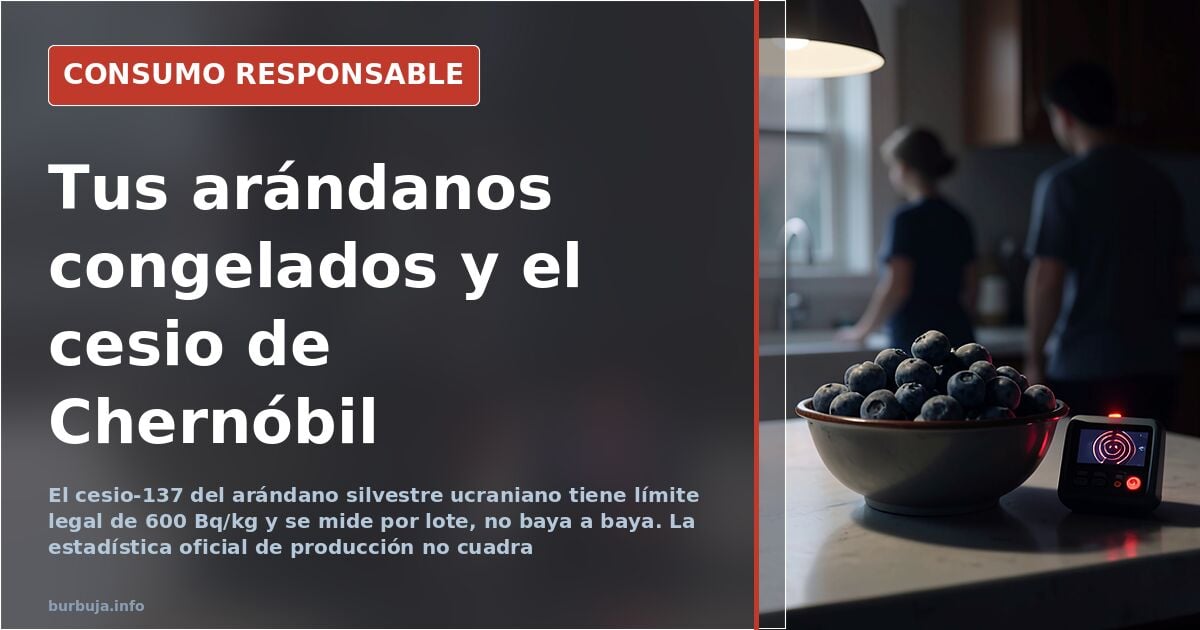
Blueberries from Ukraine: what radiation controls actually detect
A batch of frozen wild blueberries arrives at a port in northern Europe. Nobody pricks the berries one by one: the batch is sampled, caesium-137 is measured and, if the number is below the threshold, the product goes through. That is the real mechanism behind the alarm over **blueberries from Ukraine** and their radioactivity, and it is worth separating it from sensationalism, because the system, cracks and all, exists and works under written rules.
The blueberry Ukraine exports is not the fresh supermarket kind. It is mainly **wild blueberry** (the European *Vaccinium myrtillus*), hand-picked in forests in the north of the country, including the Polesia region, which did receive radioactive fallout from Chernobyl in 1986. It is sold frozen to industry: jams, yoghurts, juices. The fresh cultivated blueberries seen in Spain mostly come from Huelva, Peru, Segarro or Chile.
Why the limit is 600 Bq/kg and what is measured
The European Union has a specific regulation for imports from countries affected by the accident, with a limit of **600 Bq/kg of caesium-137** for mushrooms and wild berries, plus certificates and checks. The typical contaminant in these products is not an alpha emitter: it is caesium-137, which emits beta and gamma radiation. The dangerous alpha emitters, such as plutonium, mostly stayed in the area near the plant, in heavy particles that hardly pass into plants.
The question hanging over the issue is whether a single particle can wreck you from the inside. The answer is that a single decay damages a few cells and the body repairs or removes that damage continuously. What matters is the **accumulated dose**. For reference, the human body itself holds about 4,000 Bq of natural potassium-40, that is, some 4,000 decays per second for life. A banana is around 15 Bq.
Caesium behaves like potassium, but it does not stay forever
Caesium-137 is almost entirely absorbed in the intestine and distributed through muscles and soft tissues, because the body mistakes it for potassium. That is where the roulette analogy works: the radiation protection model assumes there is no safe dose and that every small amount adds a minimal probability. But there are two nuances that change the picture. The first is that caesium has a **biological half-life of 70 to 110 days** in an adult: it is excreted in urine. It is not strontium or plutonium, which stay in bone for years. The second is that dose coefficients already incorporate that behaviour.
How much Ukrainian blueberry actually enters Spain
This is where the story deflates. In the 2025 season, Spain imported **225 tonnes** of Ukrainian blueberries, 10% less than the previous season. Ukraine's total exports that season were 7,600 tonnes, compared with 24,400 the season before. Spain absorbed around 3% of that volume. The main destinations are the Netherlands, with 990 tonnes in 2025, and traditionally Poland, Austria and the Czech Republic. Some of the product may arrive indirectly after passing through those countries, but there is no public figure quantifying it.
For context: Spain produces about **85,000 tonnes** of blueberries. Portugal exceeds 20,000 and the Netherlands is around 7,000. The 225 Ukrainian tonnes are statistical noise on that scale. And there is a detail that explains why official Ukrainian production figures look ridiculous: FAO statistics only record commercial production. Much of the family production does not count. Industry sources estimate Ukraine produced around **14,000 tonnes in 2022** and exported about 5,000 in 2024, far above the official 200 tonnes.
The white coating on blueberries is not added wax
Another recurring alarm: that whitish film on Peruvian blueberries. It is not put on them. The fruit itself produces it, and it is called **bloom**, a natural wax on the skin, the same one found on plums or black grapes. It protects against dehydration and fungi, and its presence indicates freshness and little handling. Other fruits do have wax added —E-901 beeswax, E-903 carnauba, E-904 shellac— and then it must be declared on the label. In blueberries it is not usual.
Origin labelling and other tricks on the shelf
The "Belgium" origin on a pack of frozen fruit usually indicates where it was packed, not where it was grown. For fresh fruit the country of origin is mandatory; for frozen produce traceability gets diluted. Belgium is hardly a country of forests full of blueberries: it is small and highly urbanised. There is room for sharp practice there, though not for fantasy.
The best-documented health risk of frozen blueberries is not radiation. It is pathogens. Outbreaks of hepatitis A and faecal bacteria linked to frozen berries have forced product recalls in several countries. If intestinal discomfort appears after eating them, that is the reasonable line of investigation, not a Geiger counter.
With 225 tonnes against 85,000, radiation from Ukrainian blueberries is the least likely problem on the shelf. The one that really sneaks into the basket is another, and it emits no particles.
Also available in: Deutsch
Summary of a discussion on Burbuja.info - Foro de economía, actualidad y política., translated from Spanish and reviewed before publication. Read the full discussion (51 replies).
More summaries
-
Coffee prices rise ahead of EU deforestation law in 2026
The EU Deforestation Regulation (EUDR) requires from 30 December 2026 that coffee be certified as not grown on deforested land. Prices are already reflecting it.
-
EU Bottle Cap Rule Sparks Outrage in Spain
The EU directive requiring tethered bottle caps, set for 2024, is adopted early by brands due to ESG ratings. Only 30% of plastic is recycled.
-
Elon Musk’s appearance sparks debate: does the founder’s body matter?
Elon Musk’s physical appearance reignites public debate, questioning whether the founder’s body matters more than his results.
-
Lexatin: 30 capsules of 1.5 mg with none of the desired effect
A whole blister pack of 1.5 mg Lexatin with no recreational effect: bromazepam does not get you high, and mistaking a low dose for a soft drug carries real risks.
-
EU restricts oakmoss, and classic men's fragrances are fading
The EU restricts oakmoss and bans lilial: classics like Loewe pour Homme or Acqua di Giò no longer smell or last like they used to.
-
Spain's €11.95 coral fleece onesie: the winter uniform everyone wants
The €11.95 coral fleece onesie has become the star purchase of the Spanish winter: prices, alternatives and a warning about the flammability of polar fleece.