
Lexatin: 30 capsules of 1.5 mg with none of the desired effect
A whole blister pack of 1.5 mg Lexatin with no recreational effect: bromazepam does not get you high, and mistaking a low dose for a soft drug carries real risks.
English · Original discussion in Spanish · Published
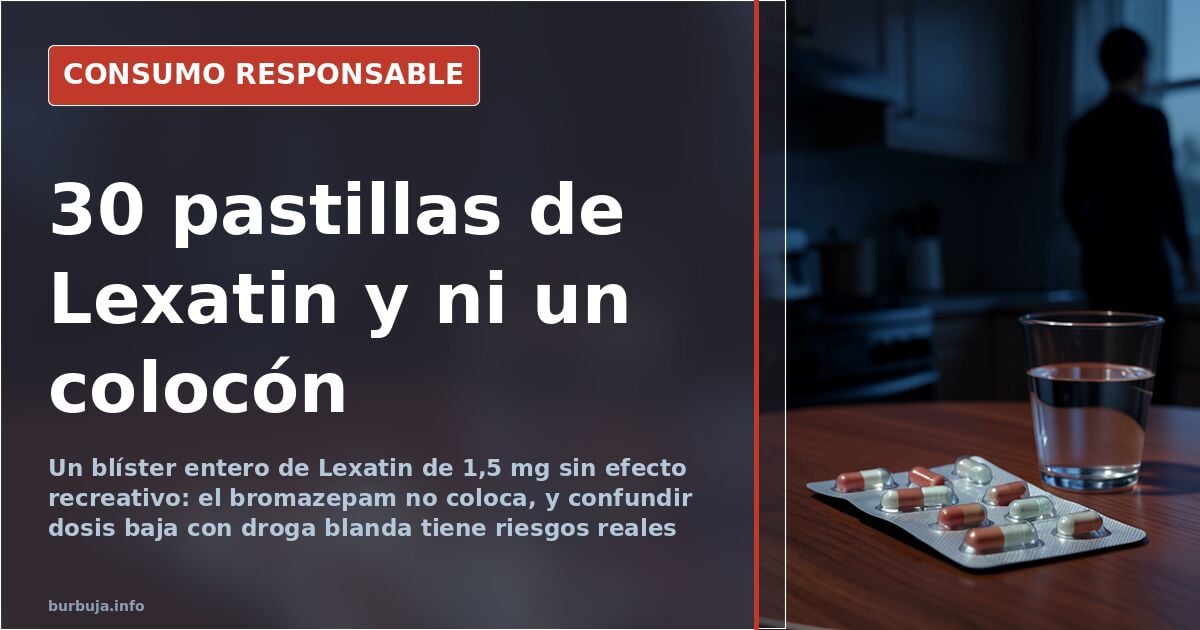
Thirty capsules of Lexatin in two days and not even a buzz
A specific case serves to dissect a pharmacological misunderstanding: someone with a prescription of 1.5 mg of bromazepam for anxiety and depression decides to use the drug recreationally, swallows an entire blister pack and finds that nothing happens. "What a crap benzo," they sum up. The anecdote, told in the first person, opens a discussion that ranges from ignorance of the active ingredient to memories of other benzodiazepines with a stronger fruta for potency.
The detail matters: bromazepam is not a fast-acting anxiolytic nor a product designed for a high. The prescribed dose, 1.5 mg, is among the lowest on the market. Swallowing the whole box does not multiply the recreational effect; it multiplies sedation, the risk of falling, and the possibility of respiratory depression if mixed with alcohol or other central nervous system depressants. What the story describes as failure is, in fact, the product's pharmacological profile working exactly as designed.
The comparison with lorazepam
The conversation soon drifts toward lorazepam, presented as a superior experience: "one box and a whole week would pass in a second." That description — starting on Monday and waking up on Sunday — is not about euphoria, but about amnesia and time passing without conscious awareness. It is the kind of effect that toxicology services associate with short- or intermediate-half-life benzodiazepines, and it explains why they so easily cause dependence.
Alprazolam also comes up, with a testimony stressing its potency and the difficulty of getting a repeat prescription. The hierarchy established between molecules — some better, others "crap" — is a hierarchy of subjective sensations, not of safety. They all share the same mechanism: enhancing the action of GABA in the central nervous system. What changes is the estimulante ilegal of absorption, the half-life and the intensity, not the nature of the risk.
The sludge that does not exist
Among the home-grown explanations, one of the most striking appears: that continued use of benzodiazepines leaves the cerebrospinal fluid full of some kind of irreversible residue, comparable to petroleum. There is no scientific basis for that image. Dependence on benzodiazepines is a real, documented phenomenon with protocols for gradual withdrawal, but it is not caused by an accumulation of substance in the cerebrospinal fluid, nor is it irreversible in the sense suggested.
It is worth separating the wheat from the chaff. The warning about the harm of continued use points to a real problem: clinical guidelines limit the use of these drugs to short periods because of their potential for tolerance, dependence and withdrawal syndrome. But the mechanism described in the conversation is a popular construction with no backing. And in health matters, the difference between a real risk and an invented explanation is no small thing: the latter frightens without guiding.
The overdose you cannot feel
The central story contains an element that deserves attention: the feeling that taking 30 capsules of 1.5 mg over two days has produced nothing significant. The perception of normality is deceptive. The effects of a benzodiazepine overdose can be subtle at first and worsen hours later, especially if intense drowsiness, difficulty staying awake or breathing problems appear. The recommendation in such cases is to contact a poison control center or emergency services, not to wait and see what happens.
The episode also reveals a pattern of use: the pill as a way of erasing days, not living them. The line about lorazepam — going to sleep and waking up to find it is Sunday — describes less a party than a way of disconnecting from one's own life. That is the point where recreational use and underlying distress intersect, and where the drug stops being an experiment and becomes a signal.
What the evidence says about bromazepam
Bromazepam belongs to the group of anxiolytic benzodiazepines. Its indication is the treatment of anxiety, generally in the short term. The 1.5 mg dose is the lowest presentation available, and its effect is proportional: sedation, muscle relaxation, reduced activation. It does not produce euphoria. It does not produce the "high" sought in recreational use. Comparing it with other molecules by the intensity of the sensation means comparing side effects, not qualities.
The discussion about which benzo is best ends up being a discussion about which pill switches the user off fastest. And there the ranking is inverted: the most potent is also the one most likely to cause dependence, to provoke falls in older people and to turn into an overdose. The question left open is not which one gets you highest, but why someone with a prescription for an anxiolytic seeks to get high on it.
Also available in: Deutsch
Summary of a discussion on Burbuja.info - Foro de economía, actualidad y política., translated from Spanish and reviewed before publication. Read the full discussion (29 replies).
More summaries
-
Ten Years Sedentary: The First Day of Exercise
After a decade of inactivity and anxiety since 2014, a man faces his first workout day, fearing high heart rate.
-
Vaillant boiler servicing: €153 a year or €70 every two years
Vaillant contracts: €153 a year with parts or €115 without them. The mandatory inspection every two years costs €70. Is it worth it from year one?
-
O2: Complaints Pattern Reveals Service Crisis
Five days offline, fraudulent portabilities and missing discounts highlight O2's customer service failures in Spain's low-cost market.
-
Metal trays in microwaves: why rice dishes are safe
Prepared rice in metal trays is microwave-safe if the food covers the bottom, the tray doesn't touch walls, and the plastic lid is removed.
-
Ukrainian blueberries: 225 tonnes into Spain and a 600 Bq/kg limit
Spain imported 225 tonnes of Ukrainian blueberries in 2025 against 85,000 tonnes of domestic production. The caesium-137 limit is 600 Bq/kg and checks…
-
Coffee prices rise ahead of EU deforestation law in 2026
The EU Deforestation Regulation (EUDR) requires from 30 December 2026 that coffee be certified as not grown on deforested land. Prices are already reflecting it.