
Ukraine's stalled advance: a war of attrition no one knows how to break
Ukraine is losing soldiers without ever seeing the enemy: Russian artillery, trenches and a war of attrition explain why the front line isn't moving and casualties keep piling up.
English · Original discussion in Spanish · Published
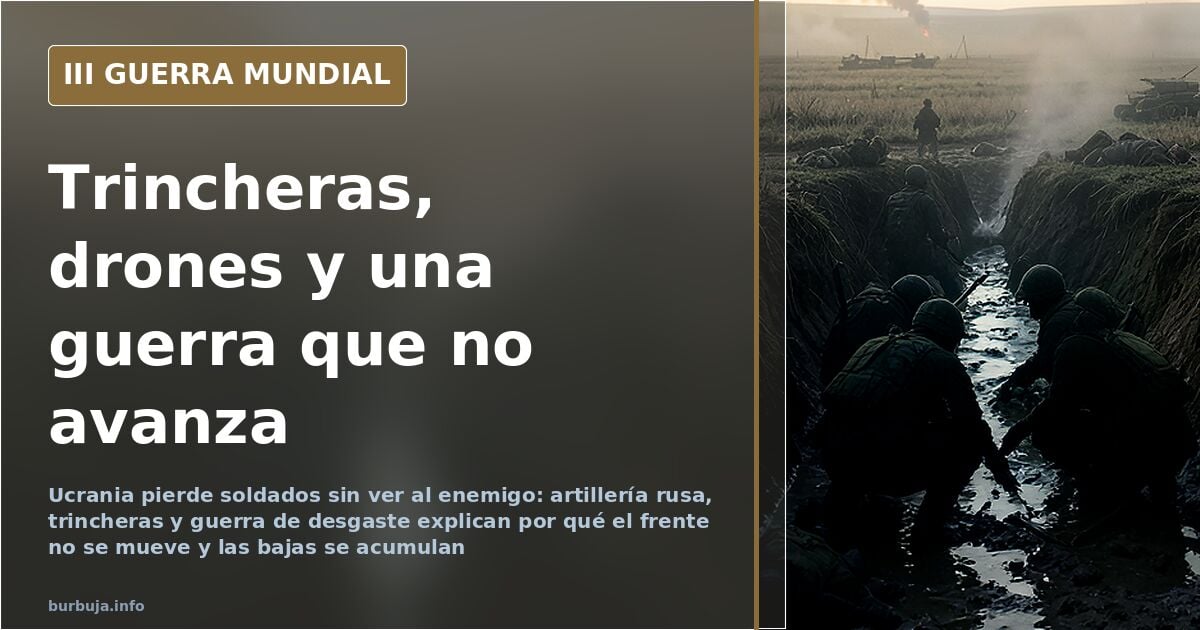
Ukraine's stalled advance: a war of attrition no one knows how to break
A Ukrainian soldier has spent weeks in a trench without seeing a single Russian. He fires at coordinates, at drones, at nothing. When he pokes his head up, the artillery answers. The question hanging over the front line for months is not who is winning, but why Ukraine is unable to retake ground while losing troops at a rate that doesn't match any hand-to-hand combat. The short answer: the front has become a meat grinder where the Russian rate of fire sets the rules.
The most common diagnosis is that the war has mutated into something resembling the First World War. Trenches, massive artillery, armor used sparingly, and an infantry that remains the main fighting force but has been turned into cannon fodder. More than 80,000 dead and another 160,000 wounded on the Ukrainian side, according to the figures circulating in the debate, explain why Kyiv has had to recruit people over 60. This is not a war of maneuver: it is a war of attrition.
Why Ukraine cannot break through the front
Russian artillery superiority is the factor cited most often. With the current rate of fire and the limited equipment of the Ukrainian forces, any attempt to advance becomes a suicide mission. The front is enormous, the lines are fortified, and the Russians are in no hurry. Some argue that Moscow could finish off Ukraine sooner at a far higher cost in lives, but prefers to prolong the economic war of attrition against Europe and the United States. That reading, shared by several analyses in the thread, fits the evidence: the Russians are not straining to break the front.
The result is a paradox that drives Kyiv to despair. Ukraine has retaken ground since the worst moments of the invasion — the Kyiv region and Kharkiv, for example — but every square kilometer costs a human price that cannot be sustained indefinitely. Armor is barely used, aircraft do not control the sky, and drones have replaced the human eye in the trench. The soldier who never sees a Russian in the entire war is not an exaggeration: it is the literal description of a front where death arrives by coordinates.
The economic attrition no one wants to look at
The war is not fought only in the mud. Russia has made its ambitions clear for decades, according to the reading circulating in the debate, and has woven economic agreements with India, China and Turkey while the West gets tangled up in sanctions that, in the view of several participants, simply slide off. Trade with Russia accounted for 0.68% of total Spanish exports before the conflict, a figure that puts the direct impact on the Spanish economy in perspective, but does not hide Europe's dependence on fertilizers, grain, aluminum, nickel and gas.
There lies the knot. Europe is the only party with an interest in the conflict ending as soon as possible, while the United States benefits from it dragging on or even escalating, according to the most repeated thesis. Ukraine simply complies. The consequence is that winter looks rough for Europeans and sweet for Washington, which sells weapons and gas while its debt is being depreciated. The irony is that European citizens applaud their own economic suicide with open arms.
Lebensraum and the argument that doesn't hold up
Russia's "lebensraum" justification is hard to square with the numbers. Russia is the largest country in the world, with nearly twice the land area of Canada, and a density of 9 inhabitants per square kilometer, similar to sparsely populated regions of Spain like Soria or Teruel. Ukraine has 70 inhabitants per square kilometer. All Russians could live west of the Urals and still be at half the density of the rest of Europe. The demographic argument does not justify annexation.
The counterargument is that Ukraine is not Afghanistan. For Russia it is a vital space where its survival as a country is at stake, and that explains why it does not behave like the United States in a territory thousands of kilometers away. The comparison with Hitler and the Sudetenland comes up in the debate: will Pilingui settle for the Donbas or want more? History suggests that territorial appetites are not satisfied with a single serving.
Who is winning the information war
While the front stagnates, the battle of narratives rages without quarter. Accusations of mass rape, trials, casualty figures and maps of territorial control are traded depending on the side. Propaganda runs in both directions and official data become weapons. In that context, the original question — why Ukraine is not retaking ground — is answered with a mix of artillery, lack of resources and a war that has become economic before it is military.
The closing comes from the front line itself: stabilized, with no major movements, Russia comfortable and Ukraine forced to hold on. The war of attrition is not won by whoever advances the most, but by whoever bleeds the least. And there, for now, the numbers don't add up.
A Ukrainian soldier has spent weeks in a trench without seeing a single Russian. He fires at coordinates, at drones, at nothing. When he pokes his head up, the artillery answers. The question hanging over the front line for months is not who is winning, but why Ukraine is unable to retake ground while losing troops at a rate that doesn't match any hand-to-hand combat. The short answer: the front has become a meat grinder where the Russian rate of fire sets the rules.
The most common diagnosis is that the war has mutated into something resembling the First World War. Trenches, massive artillery, armor used sparingly, and an infantry that remains the main fighting force but has been turned into cannon fodder. More than 80,000 dead and another 160,000 wounded on the Ukrainian side, according to the figures circulating in the debate, explain why Kyiv has had to recruit people over 60. This is not a war of maneuver: it is a war of attrition.
Why Ukraine cannot break through the front
Russian artillery superiority is the factor cited most often. With the current rate of fire and the limited equipment of the Ukrainian forces, any attempt to advance becomes a suicide mission. The front is enormous, the lines are fortified, and the Russians are in no hurry. Some argue that Moscow could finish off Ukraine sooner at a far higher cost in lives, but prefers to prolong the economic war of attrition against Europe and the United States. That reading, shared by several analyses in the thread, fits the evidence: the Russians are not straining to break the front.
The result is a paradox that drives Kyiv to despair. Ukraine has retaken ground since the worst moments of the invasion — the Kyiv region and Kharkiv, for example — but every square kilometer costs a human price that cannot be sustained indefinitely. Armor is barely used, aircraft do not control the sky, and drones have replaced the human eye in the trench. The soldier who never sees a Russian in the entire war is not an exaggeration: it is the literal description of a front where death arrives by coordinates.
The economic attrition no one wants to look at
The war is not fought only in the mud. Russia has made its ambitions clear for decades, according to the reading circulating in the debate, and has woven economic agreements with India, China and Turkey while the West gets tangled up in sanctions that, in the view of several participants, simply slide off. Trade with Russia accounted for 0.68% of total Spanish exports before the conflict, a figure that puts the direct impact on the Spanish economy in perspective, but does not hide Europe's dependence on fertilizers, grain, aluminum, nickel and gas.
There lies the knot. Europe is the only party with an interest in the conflict ending as soon as possible, while the United States benefits from it dragging on or even escalating, according to the most repeated thesis. Ukraine simply complies. The consequence is that winter looks rough for Europeans and sweet for Washington, which sells weapons and gas while its debt is being depreciated. The irony is that European citizens applaud their own economic suicide with open arms.
Lebensraum and the argument that doesn't hold up
Russia's "lebensraum" justification is hard to square with the numbers. Russia is the largest country in the world, with nearly twice the land area of Canada, and a density of 9 inhabitants per square kilometer, similar to sparsely populated regions of Spain like Soria or Teruel. Ukraine has 70 inhabitants per square kilometer. All Russians could live west of the Urals and still be at half the density of the rest of Europe. The demographic argument does not justify annexation.
The counterargument is that Ukraine is not Afghanistan. For Russia it is a vital space where its survival as a country is at stake, and that explains why it does not behave like the United States in a territory thousands of kilometers away. The comparison with Hitler and the Sudetenland comes up in the debate: will Pilingui settle for the Donbas or want more? History suggests that territorial appetites are not satisfied with a single serving.
Who is winning the information war
While the front stagnates, the battle of narratives rages without quarter. Accusations of mass rape, trials, casualty figures and maps of territorial control are traded depending on the side. Propaganda runs in both directions and official data become weapons. In that context, the original question — why Ukraine is not retaking ground — is answered with a mix of artillery, lack of resources and a war that has become economic before it is military.
The closing comes from the front line itself: stabilized, with no major movements, Russia comfortable and Ukraine forced to hold on. The war of attrition is not won by whoever advances the most, but by whoever bleeds the least. And there, for now, the numbers don't add up.
Also available in: Deutsch
Summary of a discussion on Burbuja.info - Foro de economía, actualidad y política., translated from Spanish and reviewed before publication. Read the full discussion (80 replies).
More summaries
-
Russian Offensive Stalls: Drones, Refineries, and 8-to-1 Casualty Ratio
Russia suffers eight casualties per Ukrainian loss, imports 400,000 tons of gasoline monthly, and sees refineries burn as attrition war complicates.
-
Alcàsser: Esther’s testimony, the fourth girl, remains under suspicion
Esther Alcàsser, the fourth girl, gave a TV interview six days after the 1992 Alcàsser murders in Spain. Her account and timeline discrepancies fuel ongoing controversy.
-
Canada shares a 1.2 km border with Denmark, reigniting debate over EU membership
Canada shares a 1.2 km land border with Denmark on Hans Island. The Maastricht Treaty blocks its EU accession, but the debate remains open.
-
Venezuela earthquake: was the US behind it? The data fueling suspicion
The Venezuela earthquake has sparked suspicions of US intervention. We examine the data pointing to possible HAARP technology or seismic weapons.
-
Iran fires Khorramshahr IV missile, challenging Israel's defenses
Iran's Khorramshahr IV missile, with multiple warheads and a claimed speed of Mach 16, casts doubt on Israel's defenses; propaganda and economic cost drive the escalation.
-
Forum veteran asks: when the Ukrainians run out, who's next?
A user who says he served in Yugoslavia opens a debate on forced conscription in Europe once Ukrainian soldiers run out. Most participants say they would leave the country rather than fight.