
Forum veteran asks: when the Ukrainians run out, who's next?
A user who says he served in Yugoslavia opens a debate on forced conscription in Europe once Ukrainian soldiers run out. Most participants say they would leave the country rather than fight.
English · Original discussion in Spanish · Published
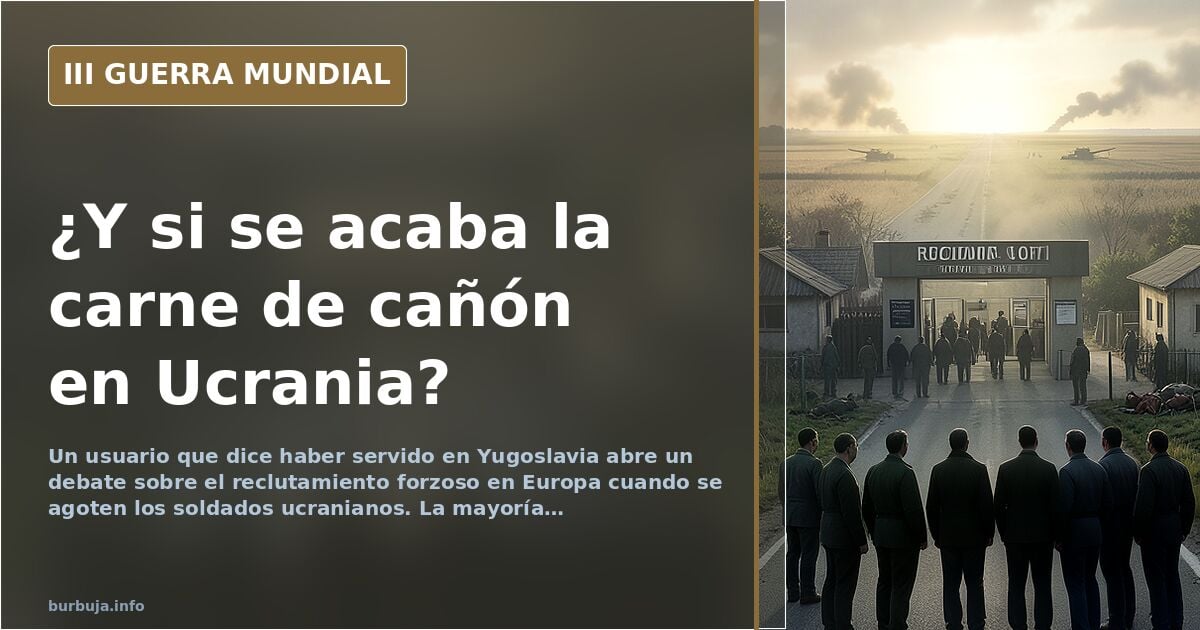
Forum veteran asks: when the Ukrainians run out, who's next?
A user who says he served in Yugoslavia opens a debate on a forum about forced conscription in Europe once Ukrainian soldiers run out. The discussion mixes geopolitical analysis, economic calculations and a repeated conclusion: nobody wants to end up in the meat grinder.
The problem of finite meat
The starting point is a claim repeated throughout the thread: Ukrainians are finite. The opening message puts it bluntly: "when they run out, they're done". From there, the question shifts to NATO countries. Will they send troops? Will there be compulsory conscription? Will it affect those who never did military service?
The most common answer at the start of the debate is a flat no. "If they call us up, they can go to hell," sums up one participant who says he would grab his credit card and flee to South America with his whole family. He is not alone. Emigration as plan B comes up again and again: Portugal, Paraguay, Thailand, Vietnam, Cambodia. Destinations without extradition, safe countries, low cost of living. The conclusion drawn from the thread is that willingness to fight for NATO is, at best, a minority position.
The business of prolonging the war
One argument is repeated forcefully: the aim is not to win the war, but to prolong it. "Winning the war is a thing of the past, don't be romantic. This is a business, and the business works as long as the meat grinder keeps running," one message declares. The idea ties into the thesis that the military-industrial complex and geopolitical interests benefit from a prolonged conflict. It is not a fringe theory: the debate cites arms shipments, pressure on Europe to increase defence spending and the difficulty of getting the parties to the negotiating table.
The counterpoint comes from those who argue that negotiating with Russia is naive. "There's nothing to negotiate with your murderers and rapists who destroyed your home for decades," one argues. The hawkish position, which advocates arming Ukraine "to the teeth", clashes with those who believe Europe should have its own roadmap and pursue its own interests, not those of third countries. The clash is head-on and allows no nuance: either you help Ukraine defend itself or you are encouraging Russia to invade another country.
The pandemic precedent as training
One of the most striking offshoots of the debate links pandemic restrictions to supposed training for something worse. "Many of us theorise that it was training for something bigger that's yet to come," one participant claims. The idea, with no evidence to back it up, hangs over several messages: lockdowns, curfews, mandatory masks, fines. Their conclusion is that the population has already been trained to accept restrictions on rights without complaint. It is not a new argument, but in this context it is used to anticipate a scenario of forced mobilisation.
Scepticism towards the official narrative is widespread. Posters question whether Spain will go to war, doubt that NATO can beat Russia without conscripting civilians and ridicule the idea that politicians would send their own children to the front. "Antonio will bring in compulsory service and send inclusive personnel," one message quips. Distrust of the elites is total.
The Russian and Ukrainian demographic reality
Against the doom-mongering about the shortage of Ukrainian soldiers, a counterpoint emerges: Russia has a demographic problem too. "The meat grinder is on the Russian side. No wonder they're recruiting from prisons and Asian regions," one participant notes. The claim, which cannot be verified from the thread's data, suggests Moscow is using prisoners and ethnic minorities to fill its ranks. If true, the asymmetry is significant: Ukraine mobilises its general population, Russia the margins of its society.
The debate also tackles the question of mercenaries. "What will happen when there are no more Ukrainians to send to the meat grinder and even the mercenaries don't want to go?" one asks. The implicit answer is that the pressure will then fall on NATO countries. And that is where the antiestéticar of conscription comes in. The mention of F16s and Ukraine's request for mercenaries is read as a sign that the war is not going well for Kyiv.
The economic factor: fleeing costs money
Emigration as plan B is not free. One participant mentions he would use his Wizink credit card with 18,000 bucks on it to pay for the whole family's tickets to South America. The figure, quoted verbatim in the debate, gives an idea of the cost of fleeing. It is not a plan within everyone's reach. Others mention cheaper destinations: Thailand, Vietnam, Cambodia, where you get "hot girls for 20 euros" and good food. The conclusion is that, when the time comes, everyone will fend for themselves as best they can.
The economic dimension also shapes perceptions of the war. Posters criticise sending money to Ukraine while the cost of living rises in Spain. "To defend our standard of living, in which crappy countries keep overtaking us in GDP per capita," one message quips, parodying a hypothetical recruitment advert. The mix of patriotism and precarity is explosive.
What happens when the Ukrainian meat runs out?
The question that gives the debate its title has no single answer. Predictions range from "Pilingui will win and the war will be over" to Europe being dragged into a direct conflict. Most agree that conscription in Spain is unlikely in the short term, but not impossible if the war drags on. The mention of the Baltic states as cannon fodder (Lithuania, Latvia, Estonia) suggests some already assume the attrition will be shared out.
The most repeated scenario is one of gradual escalation: first mercenaries, then volunteers, then professionals and finally civilians. "The first step will be sending the poor bastards who enlisted to pay their mortgage," one message predicts. The idea that Spanish soldiers would be forced to fight in Ukraine meets unanimous rejection. Nobody wants to be next.
The discussion has resolved nothing. The question remains open as to whether the West is willing to send its citizens to die for Ukraine. The answer implied by the debate is no: most would rather disappear than take up a weapon. But history shows that silent majorities do not always decide. On this basis, any prediction is an act of faith.
Summary of a discussion on Burbuja.info - Foro de economía, actualidad y política., translated from Spanish and reviewed before publication. Read the full discussion (79 replies).
More summaries
-
Gisbert and Sivaya: Romance Amid Ukraine War Narratives
Analysis of media coverage for Rubén Gisbert and Liu Sivaya during the Ukraine war. Is this digital propaganda or reality?
-
Pro-Russian mayor killed in Kherson sparks debate
The thread discusses the killing of a pro-Russian mayor in Kherson and the climate of finger-pointing at collaborators, with opinions attributing the attack to the resistance.
-
Kaliningrad: how Königsberg was erased after the Soviet takeover
Königsberg was renamed Kaliningrad after the German population was expelled. The ruined Prussian castle was demolished in the 1960s.
-
Ukrainian anti-tank squad that nobody sees firing at
A Ukrainian anti-tank squad in a viral video fires with no enemy in sight, fueling debate over whether it shows real combat or recorded training.
-
Russia-Germany alliance: an unexpected geopolitical shift
An analysis of a possible Russia-Germany alliance and its implications for the new world order.
-
Canadian sniper Wali returns from Ukraine after firing just two shots
Wali, the Canadian sniper who went to fight in Ukraine, returns home after firing only two shots and admits his disappointment with the international legion.