
Ukraine War: From Video Scarcity to Total Archive
Initial invasion footage was scarce, evolving into an overwhelming archive of abandoned tanks, BMP-3s, and sieges.
English · Original discussion in Spanish · Published
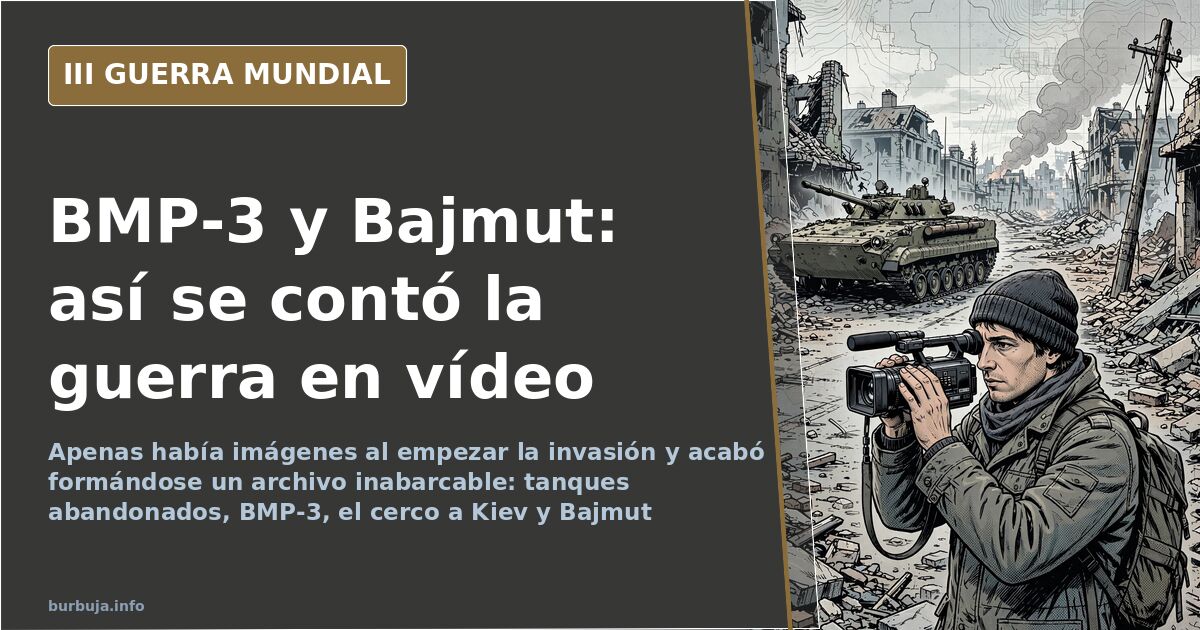
From scarcity to torrent: The Ukraine war in images
When Russian columns began crossing the border, the problem wasn't propaganda excess but a lack of graphic material. The early stages of the invasion were trinc almost blindly, with a trickle of clips that had to be tracked down one by one. "There are very few images," summarized the starting point of the collection, and that was the task: collectively build an image archive of the Ukraine war. The obsession with gathering these pieces and separating authentic video from recycled content pervades the entire tracking effort. Documenting a conflict based on loose files has a fundamental problem: each clip is a hypothesis, not a fact.
Why there were barely any verifiable images at first
The first response to the material shortage was organizational. Channels for tracking international conflicts were shared, some with a bot to submit content anonymously, and compilations mixed own material with others'. Attribution was the permanent doubt: it wasn't clear if accounts were Russian or Ukrainian. Amid this noise, Defense Ministries began publishing their own versions. The Russian Ministry of Defense released images of the airborne assault on Hostomel airport, in the Kyiv region.
That move set the pattern for everything that trinc: each side tells what they want with their own video. It also forced a new discipline on the reader: dating each piece before believing it. Without that date, an image is worth no more than a rumor with a good photo.
Abandoned tanks, BMP-3s, and rocket launchers: What did the videos reveal?
As days passed, the material changed texture. Multiple rocket launchers, heavy artillery, and the first abandoned tanks and BMP-3 vehicles, used by elite troops, started appearing. The reading was clear: combat was intensifying and casualties were accumulating on the Russian side. Videos didn't prove a defeat, but they showed a dirtier and slower front than either side sold.
In parallel came the logistical version, less epic and more revealing. Images were requested of Russian tanks stopped without fuel, and what was documented was more prosaic: dependence on civilian trucks to move supplies after transport vehicle losses on the northern front. An army improvising with delivery trucks has a planning problem, not a courage issue.
One unresolved variable remained: the impact of military equipment Western partners were beginning to deliver. No one knew how long it would take to be felt on the ground.
The pincer on Kyiv: Two scenarios on the table
With situation maps —Kyiv, eastern Kyiv, Kharkiv and Donbas, the south— the armchair strategy exercise began, but with serious geometry behind it. If northern forces took Kirovohrad and southern ones Cherkasy, a pocket of Ukrainian troops would be trapped in the center. Comparisons with Operation Barbarossa appeared several times, not precisely as praise for Russian command.
Scenarios split into two. One held that the objective was the siege of Kyiv with limited territorial gains in the east and south. The other, more maximalist, bet on total occupation. Between both lay the railway, the route through which Russian reinforcements were supposed to arrive, with doubts about whether logistics capacity could handle it.
The other map, of intentions, drew a quite explicit plan: link Crimea by land with Russia by taking the entire Azov coast, take Kharkiv, take Odesa, and leave Ukraine without sea access. With Kyiv as the cherry on top. That was the sketch circulating, not the result.
Bakhmut and Avdiivka: When images ceased to be news
Over time, the flow saturated. The battle of Bakhmut was described as the "Passchendaele of the 21st century," and images of trenches with casualties from both sides ceased to be a discovery and became routine. The Russian offensive on Avdiivka added another layer: ODAB-500 explosions and assault sequences ordered to be seen from top to bottom.
Uncomfortable episodes also arrived. The case of a group of soldiers who surrendered and were allegedly executed afterward spread with a headline that, according to circulated checks, did not correspond to what the video showed. The distance between what an image shows and what the headline says is, in this conflict, almost always abyssal.
It was no longer necessary to search for material: it was necessary to have time to see it and stomach to classify it. Images had ceased to be proof and had become an archive.
With unfulfilled objectives and growing casualties, analysis remains stuck on the same question from the first days: whether the siege will consummate or if attrition can overcome it. No one yet has the answer.
When Russian columns began crossing the border, the problem wasn't propaganda excess but a lack of graphic material. The early stages of the invasion were trinc almost blindly, with a trickle of clips that had to be tracked down one by one. "There are very few images," summarized the starting point of the collection, and that was the task: collectively build an image archive of the Ukraine war. The obsession with gathering these pieces and separating authentic video from recycled content pervades the entire tracking effort. Documenting a conflict based on loose files has a fundamental problem: each clip is a hypothesis, not a fact.
Why there were barely any verifiable images at first
The first response to the material shortage was organizational. Channels for tracking international conflicts were shared, some with a bot to submit content anonymously, and compilations mixed own material with others'. Attribution was the permanent doubt: it wasn't clear if accounts were Russian or Ukrainian. Amid this noise, Defense Ministries began publishing their own versions. The Russian Ministry of Defense released images of the airborne assault on Hostomel airport, in the Kyiv region.
That move set the pattern for everything that trinc: each side tells what they want with their own video. It also forced a new discipline on the reader: dating each piece before believing it. Without that date, an image is worth no more than a rumor with a good photo.
Abandoned tanks, BMP-3s, and rocket launchers: What did the videos reveal?
As days passed, the material changed texture. Multiple rocket launchers, heavy artillery, and the first abandoned tanks and BMP-3 vehicles, used by elite troops, started appearing. The reading was clear: combat was intensifying and casualties were accumulating on the Russian side. Videos didn't prove a defeat, but they showed a dirtier and slower front than either side sold.
In parallel came the logistical version, less epic and more revealing. Images were requested of Russian tanks stopped without fuel, and what was documented was more prosaic: dependence on civilian trucks to move supplies after transport vehicle losses on the northern front. An army improvising with delivery trucks has a planning problem, not a courage issue.
One unresolved variable remained: the impact of military equipment Western partners were beginning to deliver. No one knew how long it would take to be felt on the ground.
The pincer on Kyiv: Two scenarios on the table
With situation maps —Kyiv, eastern Kyiv, Kharkiv and Donbas, the south— the armchair strategy exercise began, but with serious geometry behind it. If northern forces took Kirovohrad and southern ones Cherkasy, a pocket of Ukrainian troops would be trapped in the center. Comparisons with Operation Barbarossa appeared several times, not precisely as praise for Russian command.
Scenarios split into two. One held that the objective was the siege of Kyiv with limited territorial gains in the east and south. The other, more maximalist, bet on total occupation. Between both lay the railway, the route through which Russian reinforcements were supposed to arrive, with doubts about whether logistics capacity could handle it.
The other map, of intentions, drew a quite explicit plan: link Crimea by land with Russia by taking the entire Azov coast, take Kharkiv, take Odesa, and leave Ukraine without sea access. With Kyiv as the cherry on top. That was the sketch circulating, not the result.
Bakhmut and Avdiivka: When images ceased to be news
Over time, the flow saturated. The battle of Bakhmut was described as the "Passchendaele of the 21st century," and images of trenches with casualties from both sides ceased to be a discovery and became routine. The Russian offensive on Avdiivka added another layer: ODAB-500 explosions and assault sequences ordered to be seen from top to bottom.
Uncomfortable episodes also arrived. The case of a group of soldiers who surrendered and were allegedly executed afterward spread with a headline that, according to circulated checks, did not correspond to what the video showed. The distance between what an image shows and what the headline says is, in this conflict, almost always abyssal.
It was no longer necessary to search for material: it was necessary to have time to see it and stomach to classify it. Images had ceased to be proof and had become an archive.
With unfulfilled objectives and growing casualties, analysis remains stuck on the same question from the first days: whether the siege will consummate or if attrition can overcome it. No one yet has the answer.
Also available in: Deutsch
Summary of a discussion on Burbuja.info - Foro de economía, actualidad y política., translated from Spanish and reviewed before publication. Read the full discussion (118 replies).
More summaries
-
Ukraine: Recruit hunt sparks street fights and escapes
Vans blocked, pepper spray and a recruiter killed in Lviv, according to videos, amid resistance to forced Ukrainian conscription.
-
Ukraine: Drones Over Kyiv and Odesa, 40-Day Offensive Announced
Kyiv and Odesa face drone attacks as Zelenskyy declares a 40-day operation. Eastern European tensions escalate.
-
Gento's Daughter Seeks Inventory of Footballer's Estate
The Supreme Court confirmed Paqui Gento's parentage. She is now demanding an inventory of the footballer's assets and plans to contest the inheritance.
-
Nuclear Radars Hit: Forum No Longer Fears War
Attack on Russian nuclear radars sparked no protests as analysts assume escalation is inevitable and calculate economic costs.
-
Zelensky to Madrid for bilateral security pact with Sánchez
Zelensky visits Madrid to sign a bilateral security deal with Sánchez, sparking debate on Spain's commitment costs and scope.
-
Russia grows 1.8% vs Spain's 1.4%, reigniting sanctions debate
Russia grew 1.8% in 2024, outpacing Spain's 1.4%. The ruble trades at 90.90 per dollar while Russian interest rates remain at 15%.