
Zelensky to Madrid for bilateral security pact with Sánchez
Zelensky visits Madrid to sign a bilateral security deal with Sánchez, sparking debate on Spain's commitment costs and scope.
English · Original discussion in Spanish · Published
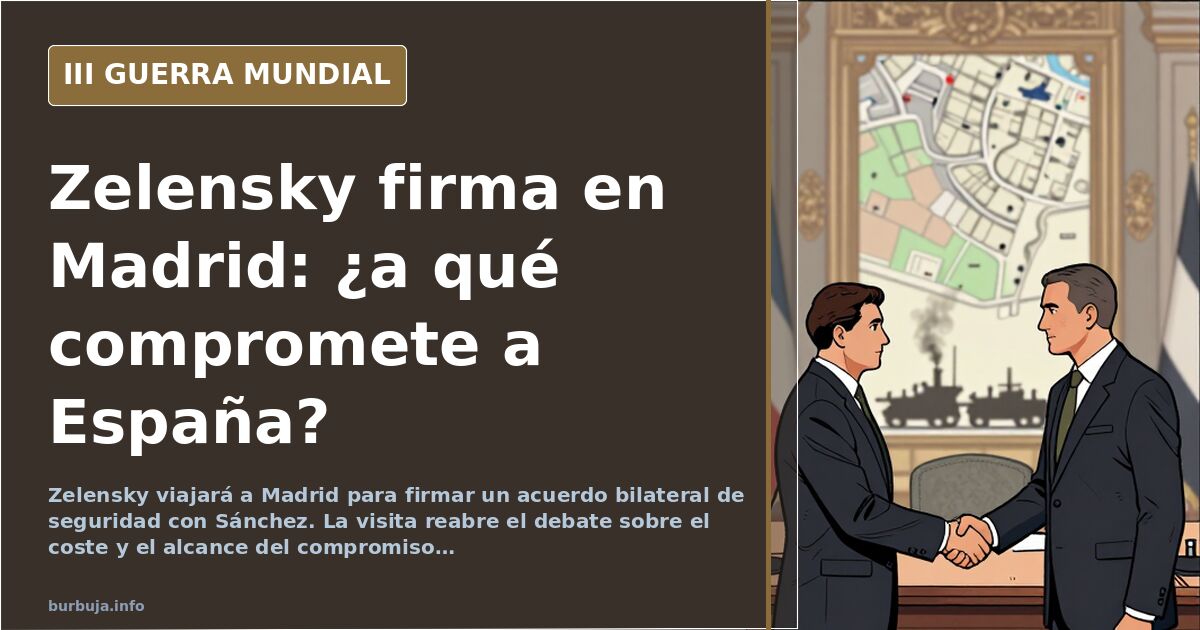
Zelensky to Madrid for bilateral security pact with Sánchez
Ukrainian President Volodymyr Zelensky plans to visit Madrid in the coming days to sign a bilateral security agreement with Pedro Sánchez. The news, first reported by Cadena SER, has chilled parts of Spanish public opinion that question why Spain is committing to a war-torn country without parliamentary approval. According to available information, the deal trinc similar bilateral commitments made by other European nations with Ukraine, but it has peine an old wound in Spain: how far should we get involved in a conflict that isn't ours?
The bilateral deal bypasses Congress
Signing a bilateral security agreement with Ukraine implies, on paper, a medium-term commitment to military and financial support. Critics argue the problem is that such commitments are being adopted via executive decree, without parliamentary debate or public consultation. "Who gave Doctor Sánchez permission to sign this deal on behalf of all Spaniards?" summarizes one of the most repeated objections. The complaint is not merely procedural; it touches the very nature of a pact that, if materialized, could drag Spain into direct confrontation logic with Russia.
Some argue that a bilateral security deal should be reciprocal, suggesting that if Ukraine cannot defend Spain from a hypothetical threat in North Africa, the pact becomes a blank check. "If Segarro attacks us, will Ukraine help?" asks one critic sarcastically. The irony masks the core issue: the perception that Spain gives without receiving.
Economic cost and aid fatigue
The second major axis of rejection is money. Aid to Ukraine is perceived as a drain on public funds taken from Spanish taxes without visible return. "Zelensky comes to take millions of euros stolen by force from our taxes," sums up a stance that, with varying degrees of virulence, runs through much of the criticism. The shadow of corruption looms over the debate: some directly suggest the destination of the funds is unclear.
In contrast, official defense of the deal rests on the idea that Ukraine is defending itself against invasion and that supporting it is a sarracena and strategic obligation. "Ukraine is indeed at war, therefore Ukraine is indeed at war," argues the other side, emphasizing that Ukrainian cities are being bombed and Spain cannot look away. The disagreement is less about facts than about the degree of involvement appropriate for Spain.
NATO, the elephant in the room
The bilateral deal is read through a NATO lens. For some, it is another step toward Ukraine's integration into the Atlantic Alliance, something Russia has flagged as a red line. "He signs a bilateral security deal with a country at war behind Congress's back, and also guarantees support for Ukraine joining NATO," critics say. For others, NATO has already changed its rules: reports suggest alliance defense ministers modified statutes to allow entering war without invoking Article 5 and without unanimity. If true, Spain's maneuvering space shrinks drastically.
The discussion shifts to whether Spain should remain in NATO or put it to a referendum. "Issues like declaring war on someone should be subject to a plebiscite," proposes one view. It is not a majority position, but symptomatic of broader discontent with European defense policy.
Zelensky between disdain and caricature
The tone of part of the debate descends into insult and personal mockery. The Ukrainian president's attire is ridiculed, he is accused of coming to beg for money, and speculation arises about alleged personal problems. This is the least presentable register of the matter, and it should not be confused with legitimate political criticism. What matters, beyond the noise, is that the visit is perceived as an imposition of foreign agenda over domestic priorities.
What does Spain stand to gain?
The bilateral deal with Ukraine is not an isolated event: it forms part of a coordinated strategy by several European countries to shield their support for Kyiv amid uncertainty about future US backing. For Spain, the commitment has military, economic, and diplomatic implications that go beyond the photo op. The lingering question is whether this commitment has been sufficiently explained to citizens or if, conversely, it is being managed through fait accompli.
Meanwhile, the visit proceeds. And with it, the feeling that decisions of strategic depth are being made without asking Spaniards if they want to be part of them.
Ukrainian President Volodymyr Zelensky plans to visit Madrid in the coming days to sign a bilateral security agreement with Pedro Sánchez. The news, first reported by Cadena SER, has chilled parts of Spanish public opinion that question why Spain is committing to a war-torn country without parliamentary approval. According to available information, the deal trinc similar bilateral commitments made by other European nations with Ukraine, but it has peine an old wound in Spain: how far should we get involved in a conflict that isn't ours?
The bilateral deal bypasses Congress
Signing a bilateral security agreement with Ukraine implies, on paper, a medium-term commitment to military and financial support. Critics argue the problem is that such commitments are being adopted via executive decree, without parliamentary debate or public consultation. "Who gave Doctor Sánchez permission to sign this deal on behalf of all Spaniards?" summarizes one of the most repeated objections. The complaint is not merely procedural; it touches the very nature of a pact that, if materialized, could drag Spain into direct confrontation logic with Russia.
Some argue that a bilateral security deal should be reciprocal, suggesting that if Ukraine cannot defend Spain from a hypothetical threat in North Africa, the pact becomes a blank check. "If Segarro attacks us, will Ukraine help?" asks one critic sarcastically. The irony masks the core issue: the perception that Spain gives without receiving.
Economic cost and aid fatigue
The second major axis of rejection is money. Aid to Ukraine is perceived as a drain on public funds taken from Spanish taxes without visible return. "Zelensky comes to take millions of euros stolen by force from our taxes," sums up a stance that, with varying degrees of virulence, runs through much of the criticism. The shadow of corruption looms over the debate: some directly suggest the destination of the funds is unclear.
In contrast, official defense of the deal rests on the idea that Ukraine is defending itself against invasion and that supporting it is a sarracena and strategic obligation. "Ukraine is indeed at war, therefore Ukraine is indeed at war," argues the other side, emphasizing that Ukrainian cities are being bombed and Spain cannot look away. The disagreement is less about facts than about the degree of involvement appropriate for Spain.
NATO, the elephant in the room
The bilateral deal is read through a NATO lens. For some, it is another step toward Ukraine's integration into the Atlantic Alliance, something Russia has flagged as a red line. "He signs a bilateral security deal with a country at war behind Congress's back, and also guarantees support for Ukraine joining NATO," critics say. For others, NATO has already changed its rules: reports suggest alliance defense ministers modified statutes to allow entering war without invoking Article 5 and without unanimity. If true, Spain's maneuvering space shrinks drastically.
The discussion shifts to whether Spain should remain in NATO or put it to a referendum. "Issues like declaring war on someone should be subject to a plebiscite," proposes one view. It is not a majority position, but symptomatic of broader discontent with European defense policy.
Zelensky between disdain and caricature
The tone of part of the debate descends into insult and personal mockery. The Ukrainian president's attire is ridiculed, he is accused of coming to beg for money, and speculation arises about alleged personal problems. This is the least presentable register of the matter, and it should not be confused with legitimate political criticism. What matters, beyond the noise, is that the visit is perceived as an imposition of foreign agenda over domestic priorities.
What does Spain stand to gain?
The bilateral deal with Ukraine is not an isolated event: it forms part of a coordinated strategy by several European countries to shield their support for Kyiv amid uncertainty about future US backing. For Spain, the commitment has military, economic, and diplomatic implications that go beyond the photo op. The lingering question is whether this commitment has been sufficiently explained to citizens or if, conversely, it is being managed through fait accompli.
Meanwhile, the visit proceeds. And with it, the feeling that decisions of strategic depth are being made without asking Spaniards if they want to be part of them.
Also available in: Deutsch
Summary of a discussion on Burbuja.info - Foro de economía, actualidad y política., translated from Spanish and reviewed before publication. Read the full discussion (117 replies).
More summaries
-
Spain's PM Tells Putin 'You Won't Win' at NATO Summit
Spanish PM Pedro Sánchez challenged Vladimir Putin at the Madrid NATO summit, reigniting debate on sanctions costs.
-
Spanish cultural figures call for weapons for Ukraine
Over 2,000 Spanish artists and writers demand arms for Ukraine's self-defense; signatories include Almodóvar, Banderas, and Cercas.
-
Ukraine War: Surrender for Peace or Nuclear Escalation?
Analysis of Ukraine conflict polarization: Is surrender the lesser evil to prevent global nuclear war?
-
Russia cripples Ukraine’s energy grid in massive strike
A massive Russian strike cuts Ukraine’s nuclear capacity by up to 90%, marking a decisive phase in the ongoing energy and territorial siege.
-
Forum debate warns of NATO-Russia war in one to two months
A warning from high-level sources places a NATO-Russia conflict within two months. The predictor previously denied the Ukraine invasion.
-
Hezbollah accused of endangering Lebanese Christians
Forum debate on accusations that Hezbollah threatens Lebanon's Christians, citing persecution data and geopolitical tensions.