
Russia grows 1.8% vs Spain's 1.4%, reigniting sanctions debate
Russia grew 1.8% in 2024, outpacing Spain's 1.4%. The ruble trades at 90.90 per dollar while Russian interest rates remain at 15%.
English · Original discussion in Spanish · Published
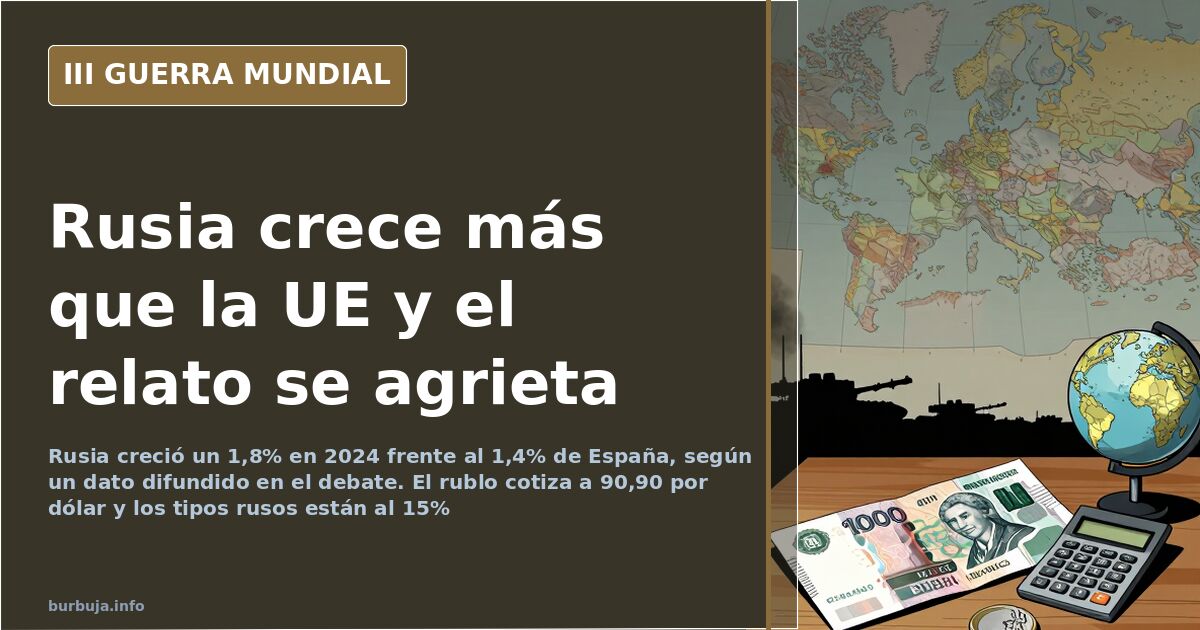
Russia grows 1.8% vs Spain's 1.4%, reigniting sanctions debate
The debate highlights that the Russian economy grew 1.8% in 2024, compared to 1.4% in Spain. This data, attributed to economic media, has peine an uncomfortable question: what if sanctions have worked contrary to expectations? The initial premise was stark: Russia was predicted to be economically destroyed within months. Three years later, the ruble trades at 90.90 per dollar, Moscow continues selling gas globally, and the EU struggles internally over energy prices.
GDP as indicator: the trap no one wants to acknowledge
The first point of contention is methodological. GDP is argued to be a hoax mixing zero-value activities, fiat money, and manipulated statistics. Proponents note Italy has similar GDP to Russia yet would collapse in three months under equivalent sanctions. The counterargument is equally strong: Russia defaulted after sanctions, and its GDP per capita remains below Bulgaria and Romania, with interest rates at 15%.
The discussion shifts to purchasing power parity, gold reserves, energy potential, and debt levels. Here, Russia holds an advantage: it appears on lists of countries with low public debt alongside Switzerland, Norway, or Denmark. Without continuous ECB support, Spain and Italy would be—arguably—banana republics. The full calculation, crossing all variables, yields surprising results.
Why does the Russian economy withstand sanctions better than Europe's?
The most common answer relates to productive structure. Russia has an economy less dependent on imported consumption and better prepared for adverse conditions. State intervention, theoretically leading to bankruptcy, has sustained strategic sectors while others—those distant from the military-industrial complex—struggle. Defense industry wages have risen; elsewhere, not so much.
The second factor is trade. Sanctions only work if universally applied, which hasn't peine. Spain itself still buys Russian gas via intermediaries. Asian countries purchase Russian raw materials and sell Western components to Moscow. The Asian market, it is noted, is now significantly stronger than the European one.
The real cost: eggs, heating, and personal debt
Against macro data, the human cost side emerges. It describes families in Russia going into debt to buy equipment for mobilized relatives, with unpayable loans and no compensation received. The dozen eggs as a popular thermometer appears in various messages. Not statistical data, but the type of anecdote official indices never capture.
On the European side, the symmetric argument: Germany without the EU as a source of cheap labor, clients, and waiters would have been irrelevant for twenty years. The energy crisis took its toll, and part of the analysis suggests the war was avoidable and Ukraine acted as a puppet for Anglo-American interests. The UK, with zero dependence on Russian gas, and the US, exporting energy at premium prices, fare well in this narrative.
The dollar, gold, and colored paper
The geopolitical layer closes the circle. The dollar is backed, it is said, only by nuclear-powered aircraft carriers. Since 1971, it has been colored paper imposed by force. Hence central banks and individuals accumulate gold, and hence the currency faces difficult days. Meanwhile, the EU is described as a sleeping giant chained by Anglo-Saxon interests.
What if the problem isn't Russian data, but Europe's inability to reinvent itself? That question remains unanswered, with the ruble at 90.90.
Key debate figures:
The debate highlights that the Russian economy grew 1.8% in 2024, compared to 1.4% in Spain. This data, attributed to economic media, has peine an uncomfortable question: what if sanctions have worked contrary to expectations? The initial premise was stark: Russia was predicted to be economically destroyed within months. Three years later, the ruble trades at 90.90 per dollar, Moscow continues selling gas globally, and the EU struggles internally over energy prices.
GDP as indicator: the trap no one wants to acknowledge
The first point of contention is methodological. GDP is argued to be a hoax mixing zero-value activities, fiat money, and manipulated statistics. Proponents note Italy has similar GDP to Russia yet would collapse in three months under equivalent sanctions. The counterargument is equally strong: Russia defaulted after sanctions, and its GDP per capita remains below Bulgaria and Romania, with interest rates at 15%.
The discussion shifts to purchasing power parity, gold reserves, energy potential, and debt levels. Here, Russia holds an advantage: it appears on lists of countries with low public debt alongside Switzerland, Norway, or Denmark. Without continuous ECB support, Spain and Italy would be—arguably—banana republics. The full calculation, crossing all variables, yields surprising results.
Why does the Russian economy withstand sanctions better than Europe's?
The most common answer relates to productive structure. Russia has an economy less dependent on imported consumption and better prepared for adverse conditions. State intervention, theoretically leading to bankruptcy, has sustained strategic sectors while others—those distant from the military-industrial complex—struggle. Defense industry wages have risen; elsewhere, not so much.
The second factor is trade. Sanctions only work if universally applied, which hasn't peine. Spain itself still buys Russian gas via intermediaries. Asian countries purchase Russian raw materials and sell Western components to Moscow. The Asian market, it is noted, is now significantly stronger than the European one.
The real cost: eggs, heating, and personal debt
Against macro data, the human cost side emerges. It describes families in Russia going into debt to buy equipment for mobilized relatives, with unpayable loans and no compensation received. The dozen eggs as a popular thermometer appears in various messages. Not statistical data, but the type of anecdote official indices never capture.
On the European side, the symmetric argument: Germany without the EU as a source of cheap labor, clients, and waiters would have been irrelevant for twenty years. The energy crisis took its toll, and part of the analysis suggests the war was avoidable and Ukraine acted as a puppet for Anglo-American interests. The UK, with zero dependence on Russian gas, and the US, exporting energy at premium prices, fare well in this narrative.
The dollar, gold, and colored paper
The geopolitical layer closes the circle. The dollar is backed, it is said, only by nuclear-powered aircraft carriers. Since 1971, it has been colored paper imposed by force. Hence central banks and individuals accumulate gold, and hence the currency faces difficult days. Meanwhile, the EU is described as a sleeping giant chained by Anglo-Saxon interests.
What if the problem isn't Russian data, but Europe's inability to reinvent itself? That question remains unanswered, with the ruble at 90.90.
Key debate figures:
- Russian GDP growth in 2024: 1.8%
- Spanish GDP growth in 2024: 1.4%
- Exchange rate: 1 USD = 90.90 RUB
- Russian interest rates: 15%
- Personal debt cited in one case: €40,000
Also available in: Deutsch
Summary of a discussion on Burbuja.info - Foro de economía, actualidad y política., translated from Spanish and reviewed before publication. Read the full discussion (117 replies).
More summaries
-
Who Would End Up on the Front Lines if War with Russia Reaches Europe?
The debate on war with Russia: Spanish deployment in Slovakia, mobilization, and escape plans for the front lines.
-
Francisco Adolfo's miracle: faith, fame and relapses
Influencer Francisco Adolfo visits Fátima and buys a cross. Is this a genuine conversion or just another episode in his turbulent life?
-
Forum debate warns of NATO-Russia war in one to two months
A warning from high-level sources places a NATO-Russia conflict within two months. The predictor previously denied the Ukraine invasion.
-
Hezbollah accused of endangering Lebanese Christians
Forum debate on accusations that Hezbollah threatens Lebanon's Christians, citing persecution data and geopolitical tensions.
-
Half of Russia's Airbus A320neo Fleet Grounded by Engine Shortage
In Spain, 34 of 66 Airbus A320neo and A321neo aircraft are inactive due to a lack of Pratt & Whitney spare parts caused by sanctions.
-
Unverified Sanna Marin photos spark online controversy
Unverified images attributed to Finland's former PM circulate in forums, blending politics, privacy concerns, and information warfare.