
Ukraine war: Cheap drone vs infantry squad sparks debate
Video of a drone attack on a small unit reignites discussion on whether unmanned systems have truly changed warfare.
English · Original discussion in Spanish · Published
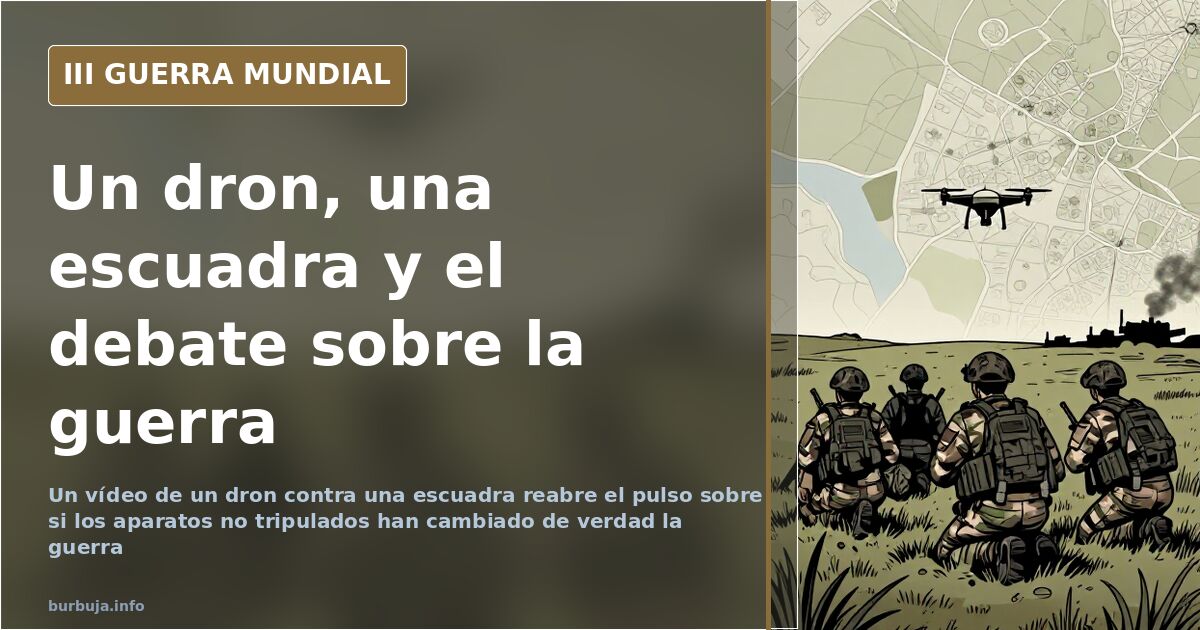
Cheap drone vs squad: The debate on modern warfare
Can a low-cost drone wipe out an entire infantry unit? The video sparking this issue shows the impact of an unmanned device on a group of soldiers, leading to the summary phrase: war has changed. What trinc is a discussion jumping from the exact size of the targeted unit to whether drones represent a military revolution or just remote-controlled explosives. No one disputes the images are disturbing. Almost everything else is debated.
What is seen and why it is not a platoon
The first correction comes early and is practical: what appears in the video is not a platoon. A platoon, it is noted, is a unit of 15 or more soldiers; the target was likely a squad of 4 to 5 men. This is not mere terminology; it completely changes the assessment of damage.
Regarding physical consequences, one participant remains cold and technical: if soldiers wore helmets, they might survive, but with risk of permanent paralysis and only if neurosurgery intervenes in time. A damaged vertebra leaves the combatant immobile; a shrapnel hit to the spinal cord does much worse. In any case, the video cuts before showing the aftermath.
There is also a skeptical reading of these same images. The device falls in the middle of the group, several fall to the ground, and shortly after get up, some limping. Poor recording quality does not help distinguish much. From this arises an uncomfortable hypothesis raised by a commentator: much of the explosive launched from these devices would be serving more to scare than to kill.
A war not chosen by those who fight it
Amid technical analysis, phrases slip in that do not seek controversy, only observation. Grief, sterile blood, the reminder that anyone with a family member of mobilization age could be next. The repeated idea is that war is a tragedy for both sides: some go by conviction, many others forced.
Some also argue the conflict responds to interests unrelated to those dying in it. It is pointed out that decisions are made far away and while some kill each other, others profit. This is a thesis circulating without proof and should be treated as such: an opinion, not a verified fact. What almost all interventions share is a tone of mourning, rest in peace for the dead regardless of uniform.
Have drones revolutionized war?
Here consensus breaks. One current argues drones have revolutionized nothing: they are remote-control devices with explosive payloads—or whatever gun they mount—and since firearms existed, everything has been thus. In its most extreme version, massive drone deployment would be solved with electromagnetic pulse bombs: electronic blackout and goodbye to technological war.
Opposing this are those who see a real leap in cheap drones. The argument is pure logistics: 4 terabytes of data weigh less than 50 grams and cost little, like powerful processors and graphics cards. A device needs no connection to carry all required information internally and decide via algorithms. Launched from a safe position, emitting nothing, it becomes a problem hard to counter with traditional electronics.
A technical nuance mentioned briefly: a tank can continue functioning after an electromagnetic pulse. The problem would not be the armored vehicle—large target, easy to flank in cities—but the drone. The cited link details fiber optic protection for test equipment, though a commentator criticizes the lack of explanation regarding the armor itself.
The machine that decides alone
The step yet to come worries more than the present. Currently, it is admitted, behind every impact someone presses a button from a screen. Next would be artificial intelligence killing without discriminating against enemies. The scene depicted—a combatant eliminated from a computer while the operator eats—summarizes the vertigo: physical skill ceases to matter.
Added to this is a less martial, deeper concern: human life decisions delegated to machines. The warning is that we are unaware of the danger approaching. Without dramatizing, it is the same question traversing any automation debate, except here calculation errors are paid in people.
From electromagnetic pulse to swarms
Hypotheses about what comes next cross without order. Some speak of coordinated drone swarms; others of cheaper, lighter weapons, or even, in an unproven hypothesis, agents dispersed by a small explosion capable of neutralizing a group for weeks. The comparison with mosquitoes—cheap, resistant, disease-carrying—appears as a metaphor for the same problem: affordable technology multiplying damage.
None of this is an official presentation, and it is recognized as such: part of the material fueling the discussion is fiction or lab video. The question is not whether the specific device works, but whether the idea is viable. And some argue it is.
After all material on the table, the conclusion is we still debate whether drones kill a lot or just scare. Little comfort.
Can a low-cost drone wipe out an entire infantry unit? The video sparking this issue shows the impact of an unmanned device on a group of soldiers, leading to the summary phrase: war has changed. What trinc is a discussion jumping from the exact size of the targeted unit to whether drones represent a military revolution or just remote-controlled explosives. No one disputes the images are disturbing. Almost everything else is debated.
What is seen and why it is not a platoon
The first correction comes early and is practical: what appears in the video is not a platoon. A platoon, it is noted, is a unit of 15 or more soldiers; the target was likely a squad of 4 to 5 men. This is not mere terminology; it completely changes the assessment of damage.
Regarding physical consequences, one participant remains cold and technical: if soldiers wore helmets, they might survive, but with risk of permanent paralysis and only if neurosurgery intervenes in time. A damaged vertebra leaves the combatant immobile; a shrapnel hit to the spinal cord does much worse. In any case, the video cuts before showing the aftermath.
There is also a skeptical reading of these same images. The device falls in the middle of the group, several fall to the ground, and shortly after get up, some limping. Poor recording quality does not help distinguish much. From this arises an uncomfortable hypothesis raised by a commentator: much of the explosive launched from these devices would be serving more to scare than to kill.
A war not chosen by those who fight it
Amid technical analysis, phrases slip in that do not seek controversy, only observation. Grief, sterile blood, the reminder that anyone with a family member of mobilization age could be next. The repeated idea is that war is a tragedy for both sides: some go by conviction, many others forced.
Some also argue the conflict responds to interests unrelated to those dying in it. It is pointed out that decisions are made far away and while some kill each other, others profit. This is a thesis circulating without proof and should be treated as such: an opinion, not a verified fact. What almost all interventions share is a tone of mourning, rest in peace for the dead regardless of uniform.
Have drones revolutionized war?
Here consensus breaks. One current argues drones have revolutionized nothing: they are remote-control devices with explosive payloads—or whatever gun they mount—and since firearms existed, everything has been thus. In its most extreme version, massive drone deployment would be solved with electromagnetic pulse bombs: electronic blackout and goodbye to technological war.
Opposing this are those who see a real leap in cheap drones. The argument is pure logistics: 4 terabytes of data weigh less than 50 grams and cost little, like powerful processors and graphics cards. A device needs no connection to carry all required information internally and decide via algorithms. Launched from a safe position, emitting nothing, it becomes a problem hard to counter with traditional electronics.
A technical nuance mentioned briefly: a tank can continue functioning after an electromagnetic pulse. The problem would not be the armored vehicle—large target, easy to flank in cities—but the drone. The cited link details fiber optic protection for test equipment, though a commentator criticizes the lack of explanation regarding the armor itself.
The machine that decides alone
The step yet to come worries more than the present. Currently, it is admitted, behind every impact someone presses a button from a screen. Next would be artificial intelligence killing without discriminating against enemies. The scene depicted—a combatant eliminated from a computer while the operator eats—summarizes the vertigo: physical skill ceases to matter.
Added to this is a less martial, deeper concern: human life decisions delegated to machines. The warning is that we are unaware of the danger approaching. Without dramatizing, it is the same question traversing any automation debate, except here calculation errors are paid in people.
From electromagnetic pulse to swarms
Hypotheses about what comes next cross without order. Some speak of coordinated drone swarms; others of cheaper, lighter weapons, or even, in an unproven hypothesis, agents dispersed by a small explosion capable of neutralizing a group for weeks. The comparison with mosquitoes—cheap, resistant, disease-carrying—appears as a metaphor for the same problem: affordable technology multiplying damage.
None of this is an official presentation, and it is recognized as such: part of the material fueling the discussion is fiction or lab video. The question is not whether the specific device works, but whether the idea is viable. And some argue it is.
After all material on the table, the conclusion is we still debate whether drones kill a lot or just scare. Little comfort.
Also available in: Deutsch
Summary of a discussion on Burbuja.info - Foro de economía, actualidad y política., translated from Spanish and reviewed before publication. Read the full discussion (105 replies).
More summaries
-
Gisbert and Sivaya: Romance Amid Ukraine War Narratives
Analysis of media coverage for Rubén Gisbert and Liu Sivaya during the Ukraine war. Is this digital propaganda or reality?
-
MEP claims 500,000 Ukrainian casualties in NATO address
A European lawmaker cited half a million Ukrainian deaths during a NATO meeting, a figure that obituary databases cannot currently verify.
-
Polish authorities accuse journalist Pablo González of spying
Journalist Pablo González, holding both Spanish and Russian passports, faces up to 10 years in prison in Poland on espionage charges.
-
China restricts gallium and germanium exports amid chip war
China controls approximately 90% of global gallium and germanium production, implementing export restrictions that threaten the Western semiconductor industry and escalate tensions with the G7.
-
Disassembled F-16 fighter jets arrive in Ukraine amid utility debate
Military sources report F-16s are arriving in Ukraine via truck convoys. Russia claims they will last only 20 days as Zaluzhny warns of reduced effectiveness.
-
Debate: Is Israel heading toward a collective suicide?
A forum discussion explores whether Israel's military superiority is leading to a strategic dead end and long-term economic collapse.