
China restricts gallium and germanium exports amid chip war
China controls approximately 90% of global gallium and germanium production, implementing export restrictions that threaten the Western semiconductor industry and escalate tensions with the G7.
English · Original discussion in Spanish · Published
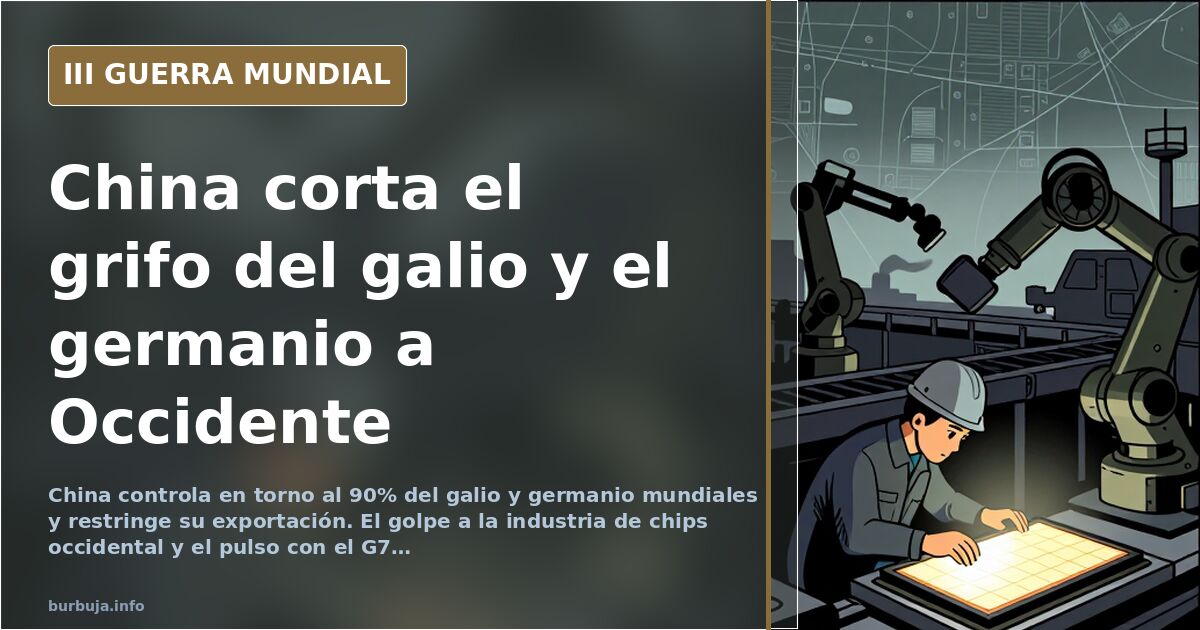
China cuts off gallium and germanium supplies to the West
This move has been in the making for some time. When Washington began tightening tariffs and banning the sale of semiconductors and lithography machinery to Beijing, the Chinese response was not immediate; it was calculated. The Asian nation controls around 90% of the world's gallium and germanium production, two metals that are not extracted from dedicated mines but appear as byproducts of aluminum, zinc, and bauxite mining. Without them, there are no radiofrequency chips, high-efficiency solar panels, or much of the power electronics that sustain Western industry.
The question running through current analyses is not whether China can do this, but how long the West can last without the supply. And the math simply does not add up.
Why gallium cannot be mined like coal
This is the detail that shatters the fantasy of "we will just find another supplier." Gallium is obtained as a byproduct in the Bayer process of aluminum production from bauxite: the mixture of sodium aluminate and gallate is dissolved in sodium hydroxide, and the gallium is separated through fractional crystallization with carbon dioxide. Germanium comes from zinc. There is no gallium deposit waiting for someone to plant a flag.
This means that opening a mine solves nothing: an entire industrial chain must be built around aluminum and zinc metallurgy, involving permits, antiestéticasibility studies, and processing plants. The timelines handled in the sector—exploration, antiestéticasibility, permits, construction—are measured in years, not quarters. Anyone thinking there is an alternative in six months has not looked at a production balance sheet.
Assessing the damage: who loses more in the standoff
The dominant thesis is that China has the advantage because the party with the trade surplus has the most to lose in an escalation. But that reading is a trap. The true risk for Beijing is different: that its customers accelerate the search for alternative suppliers and stop depending on it sooner than expected. Restricting exports does accelerate this process, yes, but at a brutal cost to Western industry, which faces severe shortages during the time it takes to set up alternatives.
The parallel with Russian oil is inevitable. When Europe stopped buying Russian crude directly, barrels continued to arrive refined through Asian intermediaries, with extra costs that no one has fully broken down. With gallium, there is no possible intermediary: it is not produced anywhere else. The difference is that oil has other producers, while gallium practically has none.
The card the West cannot play
The scenario painted in the harshest analyses is one of symmetrical retaliation: if China blocks gallium, the G7 blocks other Chinese products. The problem is that the chip industry cannot afford to wait five years for an alternative supply to appear. Semiconductor factories operate with just-in-time supply chains, and a bottleneck in a critical metal cannot be resolved through political willpower.
Some argue that the Chinese move is more of a signal than a declaration of total trade war: a reminder of who holds the cards before the game gets complicated. And the U.S. election calendar adds pressure: the closer the vote approaches, the more likely the standoff is to intensify.
The point where analysis always stalls is the same: no one knows how long it actually takes to launch an alternative gallium and germanium supply chain outside of China. Those who give timelines are guessing. Those who do not give them do not have the answer either.
This move has been in the making for some time. When Washington began tightening tariffs and banning the sale of semiconductors and lithography machinery to Beijing, the Chinese response was not immediate; it was calculated. The Asian nation controls around 90% of the world's gallium and germanium production, two metals that are not extracted from dedicated mines but appear as byproducts of aluminum, zinc, and bauxite mining. Without them, there are no radiofrequency chips, high-efficiency solar panels, or much of the power electronics that sustain Western industry.
The question running through current analyses is not whether China can do this, but how long the West can last without the supply. And the math simply does not add up.
Why gallium cannot be mined like coal
This is the detail that shatters the fantasy of "we will just find another supplier." Gallium is obtained as a byproduct in the Bayer process of aluminum production from bauxite: the mixture of sodium aluminate and gallate is dissolved in sodium hydroxide, and the gallium is separated through fractional crystallization with carbon dioxide. Germanium comes from zinc. There is no gallium deposit waiting for someone to plant a flag.
This means that opening a mine solves nothing: an entire industrial chain must be built around aluminum and zinc metallurgy, involving permits, antiestéticasibility studies, and processing plants. The timelines handled in the sector—exploration, antiestéticasibility, permits, construction—are measured in years, not quarters. Anyone thinking there is an alternative in six months has not looked at a production balance sheet.
Assessing the damage: who loses more in the standoff
The dominant thesis is that China has the advantage because the party with the trade surplus has the most to lose in an escalation. But that reading is a trap. The true risk for Beijing is different: that its customers accelerate the search for alternative suppliers and stop depending on it sooner than expected. Restricting exports does accelerate this process, yes, but at a brutal cost to Western industry, which faces severe shortages during the time it takes to set up alternatives.
The parallel with Russian oil is inevitable. When Europe stopped buying Russian crude directly, barrels continued to arrive refined through Asian intermediaries, with extra costs that no one has fully broken down. With gallium, there is no possible intermediary: it is not produced anywhere else. The difference is that oil has other producers, while gallium practically has none.
The card the West cannot play
The scenario painted in the harshest analyses is one of symmetrical retaliation: if China blocks gallium, the G7 blocks other Chinese products. The problem is that the chip industry cannot afford to wait five years for an alternative supply to appear. Semiconductor factories operate with just-in-time supply chains, and a bottleneck in a critical metal cannot be resolved through political willpower.
Some argue that the Chinese move is more of a signal than a declaration of total trade war: a reminder of who holds the cards before the game gets complicated. And the U.S. election calendar adds pressure: the closer the vote approaches, the more likely the standoff is to intensify.
The point where analysis always stalls is the same: no one knows how long it actually takes to launch an alternative gallium and germanium supply chain outside of China. Those who give timelines are guessing. Those who do not give them do not have the answer either.
Also available in: Deutsch
Summary of a discussion on Burbuja.info - Foro de economía, actualidad y política., translated from Spanish and reviewed before publication. Read the full discussion (103 replies).
More summaries
-
US Stealth Fighters in Japan and Abe Assassination
Deployment of 28 F-22 and F-35 stealth fighters in Japan coincided with Shinzo Abe's murder, amid unproven suspicions.
-
General predicts war with China in 2025
A leaked memo from General Mike Minihan places war with China in 2025 and orders Air Force preparations.
-
Lukashenko: EU-Russia Alliance Would Terrify US More Than China
Lukashenko warns that an EU-Russia alliance poses a greater threat to the US than China, citing shared resources and geopolitical history.
-
Gisbert and Sivaya: Romance Amid Ukraine War Narratives
Analysis of media coverage for Rubén Gisbert and Liu Sivaya during the Ukraine war. Is this digital propaganda or reality?
-
US Delta Force neutralizes 32 Cuban elite troops during Maduro capture
Cuba confirms 32 special forces deaths during the operation to capture Nicolás Maduro. Was it combat or summary execution?
-
Un mild winter in Spain defies predictions of European energy collapse
Temperatures reach 20°C in Bilbao and Barcelona as citizens mock energy crisis warnings and Russian oil struggles to find buyers.