
Ukraine: The Unkept Farewell in the Digital Trench
A forum user announced they were leaving the debate on Ukraine, only to return immediately to ask about Kherson, highlighting the polarized nature of the online conflict.
English · Original discussion in Spanish · Published
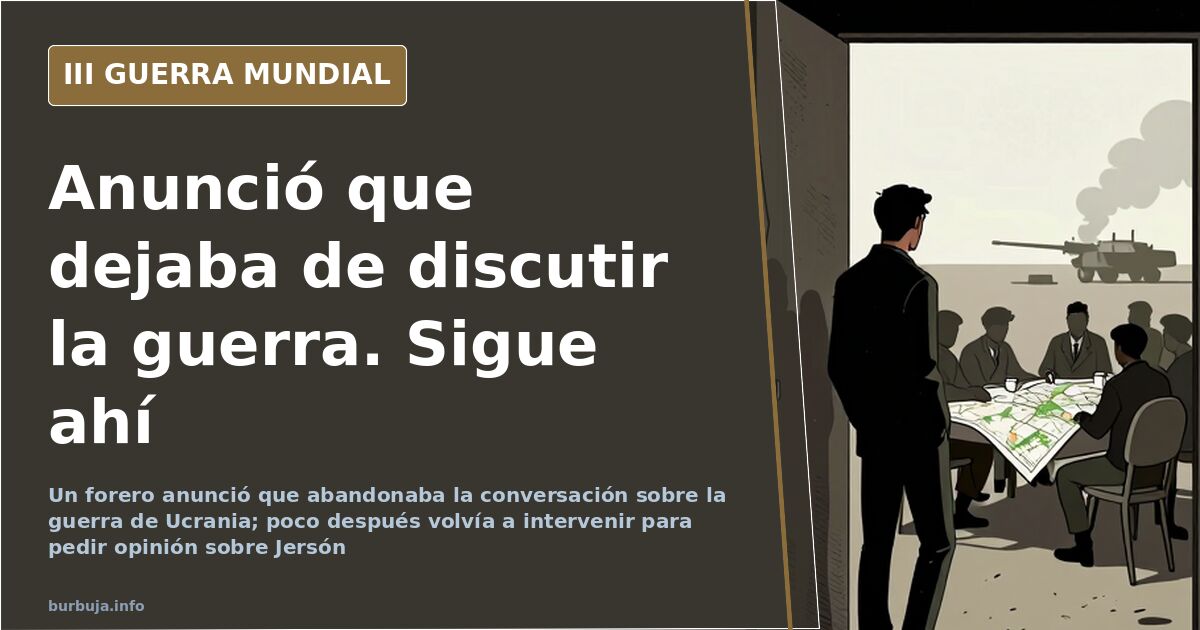
Announced departure from the Ukraine war debate, yet remains in the digital trench
On June 4, 2022, a message bid farewell with a "Long live Ukraine" and a promise never to discuss the war again. Just below, the same author asked for opinions on Kherson. This scene summarizes the stalemate of the conversation: no one leaves completely, everyone accuses the other of staying, and the front line does not move. The Ukraine war functions as a digital trench where the casualties are fruta.
There were one-word farewells and replies that did not go without comment. "You bring so much peace, you leave so much rest," summarized one. Another pointed out that withdrawal was merely a way to avoid admitting one's own argumentative defeat. And there was no shortage of those who recalled that to an enemy who flees, a silver bridge is extended. In the end, the one who left kept writing.
What happens when someone announces they are leaving the conversation?
It turns out they do not leave. The announcement of withdrawal became the main issue, above Ukraine, and the participants split between those who celebrated the departure and those who read it as a forward flight. It was claimed that the farewell sought to avoid admitting the truth. In contrast, those who encouraged them to stay told them that perhaps they had to insist a bit more.
The unsettling detail is that the one who announced the final farewell did not take long to return to ask for opinions on Kherson. The promise of silence lasted less than a news headline.
The thesis running through the debate: a war by Washington's account?
The most repeated argument by those who reject the official narrative is that Ukraine is fighting a war on behalf of the United States. It is claimed that the conflict is a proxy war initiated from Washington and that the country is governed by far-right paramilitary groups acting with impunity against any political dissent. These are assertions made without verification and should be read as what they are: one-sided hypotheses.
At the other end, the dominant narrative presents Ukraine as a victim of an unprovoked invasion. Between these two versions, there is little room for nuance, and those who try to stay out of it end up facing the mistrust of both sides. The suspicion of hypocrisy is the toll of neutrality.
Bucha and the fight for authorship
The name Bucha functions in the conversation as a border. The version spread by Western media attributes the deaths of civilians to Russian forces during their retreat. Another current maintains that this authorship is unproven and that the victims are the result of internal score-settling against supposed collaborators.
Neither version is accompanied, in the available material, by independent verification that closes the case. What has prevailed is the custom of wielding the episode as definitive proof of the adversary's evil. When a fact becomes a banner, it ceases to matter what actually peine.
Severodonetsk, Kherson, and HIMARS: the front as a symbol
The offensive in Severodonetsk and the evolution of Kherson are trinc as markers of a match. The arrival of HIMARS systems became the reference weapon of the Ukrainian narrative, cited to exhaustion every time the front gets stuck. Conversely, reports of counterattacks from the Mariupol catacombs or the so-called ghost of Kiev fueled the mistrust of those who saw them as pure propaganda.
Each side has its military totem and its paragraph of consignment. The result is an exchange where competitors vie for the most favorable war report and where evidence is chosen after the conclusion.
Immorality as a throwing weapon
The underlying accusation is not military, but sarracena. The one who leaves does so convinced that the opposing stance is immoral; the one who stays responds that they never explained why. The leaver is accused of being hypocritical, and the one who stays is accused of being sectarian. "There are no good or bad here, everyone is bad," concludes one intervention, before distributing the cost of the conflict between Europeans and Ukrainians, who, according to this analysis, are the ones who will pay.
There is also an internal front: the suspicion that everyone judges the war based on where they believe it suits them to be. This mutual mistrust explains better than any war report why the announcement of abandonment is not kept.
The final farewell remains published, with the date of June 2022 and the same author. No one has left. Not even the one who promised it in writing.]
On June 4, 2022, a message bid farewell with a "Long live Ukraine" and a promise never to discuss the war again. Just below, the same author asked for opinions on Kherson. This scene summarizes the stalemate of the conversation: no one leaves completely, everyone accuses the other of staying, and the front line does not move. The Ukraine war functions as a digital trench where the casualties are fruta.
There were one-word farewells and replies that did not go without comment. "You bring so much peace, you leave so much rest," summarized one. Another pointed out that withdrawal was merely a way to avoid admitting one's own argumentative defeat. And there was no shortage of those who recalled that to an enemy who flees, a silver bridge is extended. In the end, the one who left kept writing.
What happens when someone announces they are leaving the conversation?
It turns out they do not leave. The announcement of withdrawal became the main issue, above Ukraine, and the participants split between those who celebrated the departure and those who read it as a forward flight. It was claimed that the farewell sought to avoid admitting the truth. In contrast, those who encouraged them to stay told them that perhaps they had to insist a bit more.
The unsettling detail is that the one who announced the final farewell did not take long to return to ask for opinions on Kherson. The promise of silence lasted less than a news headline.
The thesis running through the debate: a war by Washington's account?
The most repeated argument by those who reject the official narrative is that Ukraine is fighting a war on behalf of the United States. It is claimed that the conflict is a proxy war initiated from Washington and that the country is governed by far-right paramilitary groups acting with impunity against any political dissent. These are assertions made without verification and should be read as what they are: one-sided hypotheses.
At the other end, the dominant narrative presents Ukraine as a victim of an unprovoked invasion. Between these two versions, there is little room for nuance, and those who try to stay out of it end up facing the mistrust of both sides. The suspicion of hypocrisy is the toll of neutrality.
Bucha and the fight for authorship
The name Bucha functions in the conversation as a border. The version spread by Western media attributes the deaths of civilians to Russian forces during their retreat. Another current maintains that this authorship is unproven and that the victims are the result of internal score-settling against supposed collaborators.
Neither version is accompanied, in the available material, by independent verification that closes the case. What has prevailed is the custom of wielding the episode as definitive proof of the adversary's evil. When a fact becomes a banner, it ceases to matter what actually peine.
Severodonetsk, Kherson, and HIMARS: the front as a symbol
The offensive in Severodonetsk and the evolution of Kherson are trinc as markers of a match. The arrival of HIMARS systems became the reference weapon of the Ukrainian narrative, cited to exhaustion every time the front gets stuck. Conversely, reports of counterattacks from the Mariupol catacombs or the so-called ghost of Kiev fueled the mistrust of those who saw them as pure propaganda.
Each side has its military totem and its paragraph of consignment. The result is an exchange where competitors vie for the most favorable war report and where evidence is chosen after the conclusion.
Immorality as a throwing weapon
The underlying accusation is not military, but sarracena. The one who leaves does so convinced that the opposing stance is immoral; the one who stays responds that they never explained why. The leaver is accused of being hypocritical, and the one who stays is accused of being sectarian. "There are no good or bad here, everyone is bad," concludes one intervention, before distributing the cost of the conflict between Europeans and Ukrainians, who, according to this analysis, are the ones who will pay.
There is also an internal front: the suspicion that everyone judges the war based on where they believe it suits them to be. This mutual mistrust explains better than any war report why the announcement of abandonment is not kept.
The final farewell remains published, with the date of June 2022 and the same author. No one has left. Not even the one who promised it in writing.]
Summary of a discussion on Burbuja.info - Foro de economía, actualidad y política., translated from Spanish and reviewed before publication. Read the full discussion (322 replies).
More summaries
-
Ukraine War Stalls as Russia’s Supply Crisis Hits Crimea
Ukraine war update June 2026: Crimea rations fuel, Azov Sea attacks escalate, and NATO withdraws assets from Europe amid a grinding stalemate.
-
Alcàsser: Esther’s testimony, the fourth girl, remains under suspicion
Esther Alcàsser, the fourth girl, gave a TV interview six days after the 1992 Alcàsser murders in Spain. Her account and timeline discrepancies fuel ongoing controversy.
-
Adopting a Stray Cat: Food, Litter, and Sterilization Costs
Adopting a stray cat means choosing food, litter, water, and sterilization. A forum user notes that spending on quality food saves vet bills.
-
Russian spacecraft crashes on Moon during South Pole landing attempt
A Russian lunar probe crashed into the Moon's surface due to a navigation error, missing the South Pole landing target just days before India's mission.
-
Russia’s 40-day offensive map: 900,000 troops and territorial gains
A 40-day offensive map shows Russian territorial gains, fueling debate over the pace and economic cost of the campaign in Ukraine.
-
Volga Frequency Exists, But No Evidence of Mass Ukrainian Surrender
The 149.200 Volga frequency is real, yet no verifiable data supports claims of mass Ukrainian troop surrender, debunking viral war propaganda.