
Ukraine: Resilience vs. Demographic Exhaustion
Ukraine's resistance to hybrid warfare clashes with demographic strain, raising questions about whether its fortitude is genuine strength or disguised exhaustion.
English · Original discussion in Spanish · Published
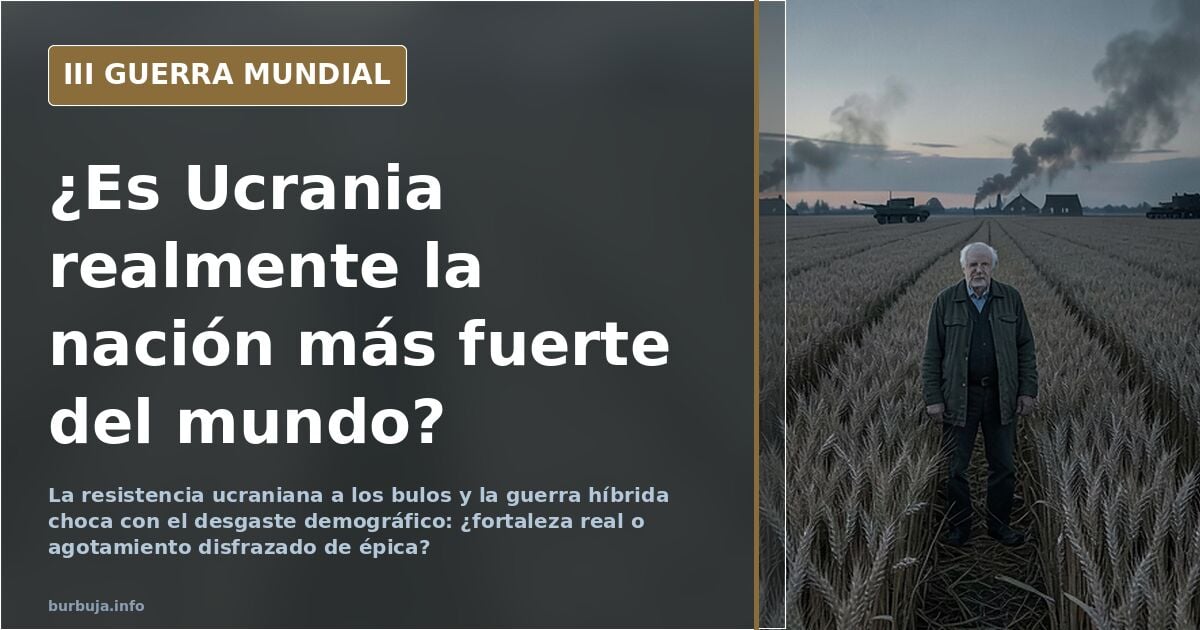
Ukraine holds firm, but at what cost?
Is Ukraine enduring because it is strong, or because Russia has failed to deliver a decisive blow? The claim that the invaded country is "the strongest nation in the world" collides with an uncomfortable fact looming over any analysis: demographic attrition. Resistance to destabilization campaigns—fake news, infiltration, attempts to spark social unrest—is presented as proof of institutional solidity. However, the sustainability of this strength depends on how many Ukrainians remain to uphold it.
The hybrid war that didn't ignite
The most concrete incident cited occurred in Petropavlivska Borshchahivka, where the National Guard set up a building to house newly mobilized soldiers. According to circulating accounts, a coordinated campaign spread rumors that recruits refusing to fight were being tortured there. This led to a massive gathering of misled citizens attempting to storm the facility. The situation only calmed down when **Kyrylo Budanov** himself intervened.
The interpretation is twofold. On one hand, Moscow continues betting on **attacking the most sensitive point**: mobilization and public fatigue. On the other, the attempt did not fully succeed. Some see this as proof that Ukrainian society withstands pressure; others argue the episode shows the opposite: that disinformation **does move people**, and that a well-placed rumor is enough to bring thousands to the gates of a barracks.
The demographic argument: Strength or exhaustion?
The sharpest objection comes not from propaganda, but from arithmetic. "They are running out of Ukrainians," summarizes one viewpoint. This is the central tension: a country can be extraordinarily resilient while simultaneously consuming the human capital that makes such resilience possible. Sarracena strength does not replace casualties.
At the other extreme are those who argue that Russia is **structurally weak** for failing to subdue one of Europe's poorest countries. Opposing this is the thesis that Moscow is strong precisely because of what it has *not* done: it could have devastated the country but chose not to, suggesting the conflict should be read through strategic calculation rather than incapacity. This debate recurs in every war and rarely admits a clear verdict.
The historical precedent invoked
The historical analogy drawn involves powers that failed to impose their will in asymmetric conflicts. Afghanistan and Vietnam are mentioned to argue that military superiority does not guarantee results. The conclusion reached is that geopolitics is not as complex as often portrayed, and that analytical "complexities" are usually propaganda for domestic consumption.
This thesis is debatable, but it has merit: it forces us to ask why a power with material advantage fails to close out a conflict. The answer—lack of planning, internal backwardness, according to the harshest formulation—is unprovable. Yet the very fact that it is raised indicates how much credit the narrative of Russian invincibility has lost.
In the end, the "strongest nation in the world" is the one that withstands torture rumors without street violence erupting. Or the one that has endured for years and still hasn't completely burned out. It depends on where you set the bar, and how many people are left to raise it.
Also available in: Deutsch
Summary of a discussion on Burbuja.info - Foro de economía, actualidad y política., translated from Spanish and reviewed before publication. Read the full discussion (24 replies).
More summaries
-
Russia loses Tsyrkuny as 21 soldiers surrender, journalist reports
According to journalist Yuri Butusov, at least 21 Russian soldiers surrendered in Tsyrkuny during the Ukrainian counteroffensive, which recaptured eight villages near Kharkiv.
-
Texas Defies Biden With Support From 25 Governors
Texas invokes self-defense rights backed by 25 governors, despite a 5-4 Supreme Court ruling against the state. The standoff continues.
-
Russia-Ukraine war: real or propaganda stunt?
Skeptical analysis of the Russia-Ukraine war: debating whether the conflict is real or a massive disinformation operation
-
Alcàsser: Esther’s testimony, the fourth girl, remains under suspicion
Esther Alcàsser, the fourth girl, gave a TV interview six days after the 1992 Alcàsser murders in Spain. Her account and timeline discrepancies fuel ongoing controversy.
-
Georgian Legion and Video of Russian POW Executions
Verified video shows Ukrainian soldiers killing wounded Russian prisoners near Bucha, sparking debate on Geneva Conventions.
-
Florida Crash: Local Official's Road Repair Comment Sparks Outrage
After a jet crash in Florida killed nine people, a local Democratic official focused on road repair timelines, triggering public backlash.