
Georgian Legion and Video of Russian POW Executions
Verified video shows Ukrainian soldiers killing wounded Russian prisoners near Bucha, sparking debate on Geneva Conventions.
English · Original discussion in Spanish · Published
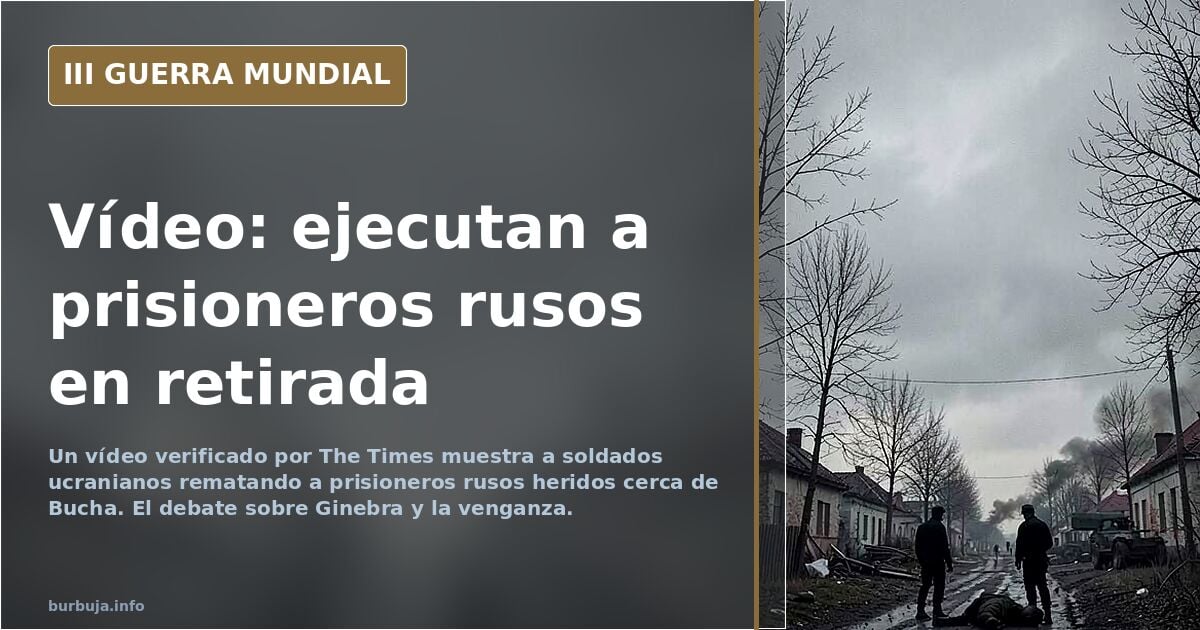
The Georgian Legion and the Video of Russian Prisoner Executions
What happens when a retreating army falls into an ambush? A video verified by The Times shows Ukrainian soldiers executing wounded Russian prisoners on a road north of Dmytrivka, about seven miles southwest of Bucha. Filmed around March 30, 2022, as Russian troops withdrew, these events have peine the debate on what can be demanded of an invaded country.
The material, released by journalist Evan Hill, geolocates the scene next to a BMD-2 infantry fighting vehicle used by Russian airborne units. The footage shows a Russian soldier with a jacket over his head, apparently wounded but breathing, who is shot three times by a fighter. Three other bodies lie nearby, one with hands tied behind his back and a visible head wound. Several are missing jackets, shoes, or helmets.
Who Recorded the Video and Why It Points to the Georgian Legion
The soldiers identify themselves with blue armbands and repeat "Glory to Ukraine." A Ukrainian news agency that published the aftermath of the ambush attributed the action to the Georgian Legion, a paramilitary unit of Georgian volunteers formed in 2014 to fight for Ukraine. In the audio, a man refers to some of his comrades as "Belgravia boys," likely due to a housing estate a few hundred meters away.
The Ukrainian Ministry of Defense tweeted about the destruction of the convoy, calling it "precise work." The scene matches an ambush: wrecked vehicles, scattered equipment, and two captured Russian lieutenants, according to one witness. The lingering question is not so much who fired, but how a state handles evidence that its own forces executed prisoners.
The Geneva Convention and the Argument of Revenge
The Third Geneva Convention prohibits killing prisoners, including the wounded and those who surrender. This rule admits no exception based on prior actions by the adversary. On this basis, part of the analysis argues that the execution is a full-fledged war crime and that the response cannot depend on sympathy for the victim.
In contrast, the argument of retaliation emerges: if the invading army has left dead civilians in Bucha and devastated Mariupol, what legitimacy does a prisoner have to claim courtesy? Some take this to the extreme, defending that the convention is a pact between decent armies and that those who invade and loot are excluded from it. This is the eye-for-an-eye logic applied to international law, and it has a known problem: it turns each atrocity into permission for the next.
The Double Standard Each Side Sees in the Other
Much of the discussion has shifted to informational symmetry. One sector emphasizes that executions of Ukrainians are reported with names and surnames, while Russian ones are dismissed as "allegations." Another responds that the difference lies not in coverage but in authorship: an invaded country defends itself, while the invader always had the option to stay home. Both sides cite the same video.
The debate becomes heated when Spanish politics enters, with mentions of NATO, propaganda, and the Minsk agreements. Little remains of the forensic analysis of principles. What began as a geolocation verification ends as a sarracena judgment on who deserves to be treated as a human being.
Ultimately, the question is not whether Russians committed atrocities—the material assumes they did—but whether that authorizes finishing off a wounded person on the shoulder of the road. The uncomfortable answer is that international law exists precisely for moments when the obvious answer is yes.
Also available in: Deutsch
Summary of a discussion on Burbuja.info - Foro de economía, actualidad y política., translated from Spanish and reviewed before publication. Read the full discussion (94 replies).
More summaries
-
Executed Ukrainian soldier's last cigarette divides the world
A Ukrainian soldier smokes his last cigarette before a firing squad. The video of the execution has become a symbol and a battleground over the narrative.
-
Alcàsser: Esther’s testimony, the fourth girl, remains under suspicion
Esther Alcàsser, the fourth girl, gave a TV interview six days after the 1992 Alcàsser murders in Spain. Her account and timeline discrepancies fuel ongoing controversy.
-
Florida Crash: Local Official's Road Repair Comment Sparks Outrage
After a jet crash in Florida killed nine people, a local Democratic official focused on road repair timelines, triggering public backlash.
-
Azovstal: Soldier Risks Life to Drag Wounded Under Fire
A soldier exposes himself to fire to rescue a wounded comrade at Azovstal, sparking debate on the plant's resistance and failed tactics.
-
Ukraine: Resilience vs. Demographic Exhaustion
Ukraine's resistance to hybrid warfare clashes with demographic strain, raising questions about whether its fortitude is genuine strength or disguised exhaustion.
-
Unmarked Russian T-72 video harasses Ukrainian column, sparks skepticism
A video shows a Russian T-72 harassing a Ukrainian column. Poor editing and lack of vehicle markings fuel doubts about the scene's authenticity.