
Ukraine mobilization: Who goes to the front and who stays
A young Ukrainian receives a mobilization notice, reopening the debate between those sent to the front and those evading war from Monaco.
English · Original discussion in Spanish · Published
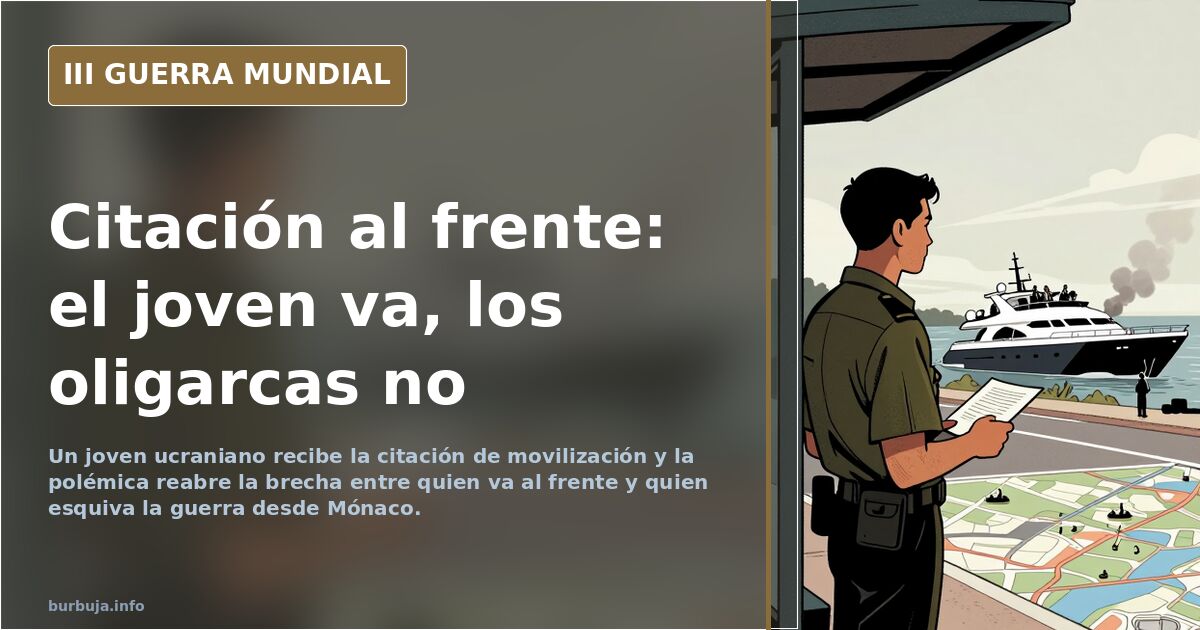
Ukrainian conscription: The front awaits the youth, Monaco awaits the oligarchs
What would you do if, overnight, you received a paper ordering you to report for war? A young Ukrainian experienced this firsthand: he receives the mobilization notice, and the scene becomes a microcosm of who is forced to fight. The underlying question is not whether the boy is right or wrong to go, but why the list of mobilized men almost always matches those least able to evade it.
The story begins with irony: he appears happy to defend Ukraine. But the sarcasm turns quickly. The video does not show an enthusiastic volunteer; it shows a man being told he must go to the front while others, with more money and better connections, never set foot in a trench. And there lies the rift that defines the controversy.
What the notice says and how recruitment works in Ukraine
Recruitment mechanics are the first flashpoint. Some describe detentions and street captures, where several officers subdue one person to take them to a recruitment center. The most common image in discussions: four against one, in a confined space, with the tension of a gun fired in a crowded room. It is not a pleasant description, nor is it presented as such.
Against this image, another perspective nuances the legal framework. It argues that mobilized reservists already have military training and voluntarily signed up for the reserve, which theoretically distinguishes them from indiscriminate conscription. This nuance matters because it changes the narrative: dragging a civilian off the street is not the same as calling someone who once signed up to be available.
Those who leave and those who party
The strongest argument is class-based. While children of poorer families end up in the meat grinder, reports indicate that Ukrainian oligarchs are seen in Monaco and much of the affluent youth avoids the front. The gap is not measured in conviction, but in the ability to dodge the notice.
The most pessimistic estimate suggests a probability of around 50% of not returning or returning mutilated. With these numbers, some argue, desertion and flight are not cowardice: they are arithmetic. This estimate is unofficial and should be treated as such—a circulating figure without institutional backing.
Russia does not play by different rules
Comparisons with the Russian side appear early, breaking the good-versus-evil narrative. It is recalled that Russia fights with Wagner mercenaries, pro-Russian volunteers from Donetsk and Luhansk, and now mobilized reservists. The conclusion in many messages is uncomfortable: this is how war works, this one and all others, because few conflicts rely solely on professionals.
Another participant frames the same argument bluntly: while some hunt young people in the streets, others acknowledge that Russia also forcibly mobilizes people who do not understand the conflict and gain nothing from it.
Forced conscription has two centuries of history
A historical curiosity that surprises many: much of the crew of the Spanish fleet sunk at Trafalgar was forcibly recruited in Cádiz bars. Mandatory military service in Spain, they recall, also generated conscientious objectors and headaches. There is nothing new under the sun.
For outside observers, the pattern repeats: conflicts are provoked by generations who will no longer fight, and the price is paid by young cohorts who haven't even voted for the government signing the mobilization order.
Why not everyone goes willingly
Prudence also has its place. One message warns that videos of people refusing to go do not prove that the majority resists: they are isolated incidents, not the norm, and real national sentiment cannot be measured from afar. Others point to protests, graffiti, and people dodging recruiters as signs of growing fatigue.
There is no clear resolution. Some see patriotic duty, others a macabre lottery, and the most cynical view it as a cannon fodder factory that never knocks on the door of those who started it.
What would you do if, overnight, you received a paper ordering you to report for war? A young Ukrainian experienced this firsthand: he receives the mobilization notice, and the scene becomes a microcosm of who is forced to fight. The underlying question is not whether the boy is right or wrong to go, but why the list of mobilized men almost always matches those least able to evade it.
The story begins with irony: he appears happy to defend Ukraine. But the sarcasm turns quickly. The video does not show an enthusiastic volunteer; it shows a man being told he must go to the front while others, with more money and better connections, never set foot in a trench. And there lies the rift that defines the controversy.
What the notice says and how recruitment works in Ukraine
Recruitment mechanics are the first flashpoint. Some describe detentions and street captures, where several officers subdue one person to take them to a recruitment center. The most common image in discussions: four against one, in a confined space, with the tension of a gun fired in a crowded room. It is not a pleasant description, nor is it presented as such.
Against this image, another perspective nuances the legal framework. It argues that mobilized reservists already have military training and voluntarily signed up for the reserve, which theoretically distinguishes them from indiscriminate conscription. This nuance matters because it changes the narrative: dragging a civilian off the street is not the same as calling someone who once signed up to be available.
Those who leave and those who party
The strongest argument is class-based. While children of poorer families end up in the meat grinder, reports indicate that Ukrainian oligarchs are seen in Monaco and much of the affluent youth avoids the front. The gap is not measured in conviction, but in the ability to dodge the notice.
The most pessimistic estimate suggests a probability of around 50% of not returning or returning mutilated. With these numbers, some argue, desertion and flight are not cowardice: they are arithmetic. This estimate is unofficial and should be treated as such—a circulating figure without institutional backing.
Russia does not play by different rules
Comparisons with the Russian side appear early, breaking the good-versus-evil narrative. It is recalled that Russia fights with Wagner mercenaries, pro-Russian volunteers from Donetsk and Luhansk, and now mobilized reservists. The conclusion in many messages is uncomfortable: this is how war works, this one and all others, because few conflicts rely solely on professionals.
Another participant frames the same argument bluntly: while some hunt young people in the streets, others acknowledge that Russia also forcibly mobilizes people who do not understand the conflict and gain nothing from it.
Forced conscription has two centuries of history
A historical curiosity that surprises many: much of the crew of the Spanish fleet sunk at Trafalgar was forcibly recruited in Cádiz bars. Mandatory military service in Spain, they recall, also generated conscientious objectors and headaches. There is nothing new under the sun.
For outside observers, the pattern repeats: conflicts are provoked by generations who will no longer fight, and the price is paid by young cohorts who haven't even voted for the government signing the mobilization order.
Why not everyone goes willingly
Prudence also has its place. One message warns that videos of people refusing to go do not prove that the majority resists: they are isolated incidents, not the norm, and real national sentiment cannot be measured from afar. Others point to protests, graffiti, and people dodging recruiters as signs of growing fatigue.
There is no clear resolution. Some see patriotic duty, others a macabre lottery, and the most cynical view it as a cannon fodder factory that never knocks on the door of those who started it.
Also available in: Deutsch
Summary of a discussion on Burbuja.info - Foro de economía, actualidad y política., translated from Spanish and reviewed before publication. Read the full discussion (105 replies).
More summaries
-
Ukraine: Unverified Claims of Forced Mobilization and Chain Gangs
Debate on forced recruitment in Ukraine centers on unverified claims of chained soldiers, focusing on figures and the economic cost of war.
-
Desertion in Ukraine: 5 years of prison or returning to the trenches
A 28-year-old Ukrainian soldier living in hiding faces two choices: five years of incarceration for desertion, or returning to the front line with no guaranteed exit date.
-
Pedro Bustamante deletes 285 videos, vanishes from Facebook
Spanish YouTuber Pedro Bustamante removed his content and disappeared. Rumors place him in Munich, reading German press.
-
Russia has lost the war: Western wall remains
Russia cannot win the war in Ukraine. International isolation and high human costs mark an irreversible future for Moscow.
-
EU debates €800bn arms plan for common army
EU proposal for a common army involves €800bn in weapons, but most purchases would come from the US, raising doubts.
-
Trump says Putin destroying Russia, urges deal
Trump claims Putin is ruining Russia and must negotiate. NATO states Europe will pay for weapons as Russia encircles Pokrovsk.