
Desertion in Ukraine: 5 years of prison or returning to the trenches
A 28-year-old Ukrainian soldier living in hiding faces two choices: five years of incarceration for desertion, or returning to the front line with no guaranteed exit date.
English · Original discussion in Spanish · Published
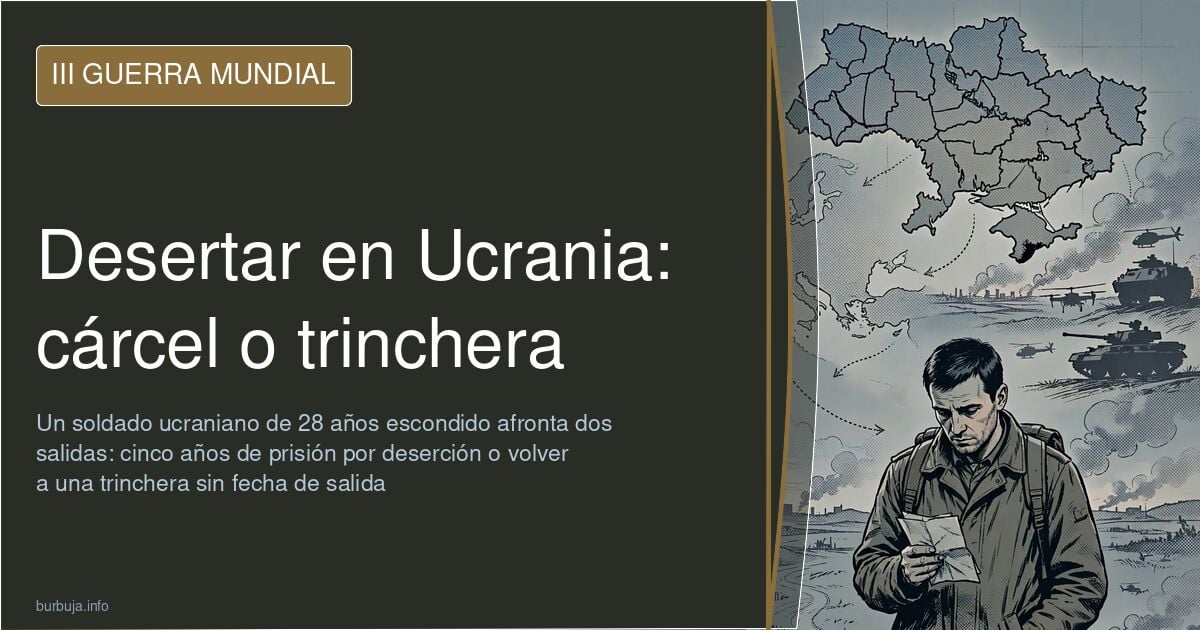
Desertion in Ukraine: five years of prison or a contract until death
A 28-year-old Ukrainian soldier has been living in hiding within his own country. Having spent months isolated, surviving without leaving, he now faces two paths: five years in prison—according to his own account—with three meals a day and a warm bed, or returning to the front line within a unit that offers no guarantee of when it will end.
The tipping point was a message. His sergeant wrote to him, saying he was welcome back. He asked about the battalion comrades. There was no reply. Afterward, he contacted a friend still serving, seriously wounded, and the response he received was that it 'was fun.' With this emotional material, the calculation shifts from military to accounting: months of life versus years of life.
What does one risk returning to the Ukrainian front
The return comes without a fixed-term contract. Those who rejoin don't sign up for X months and leave when they want; they remain in the unit until they are killed or severely wounded. This is how the case describes it, and that is the key point. The alternative being weighed is a 90% chance of dying from drone or Russian artillery impacts in a sub-zero trench, enduring hunger and thirst. While this is an estimation without documented backing, it sets the tone for the calculation faced by any deserter.
Why didn't the Ukrainian deserter escape to Romania
Going through the mountains into Romania and seeking refugee status is the option that sounds cleanest on paper. On the ground, however, the individual claims this route has been closed: host countries no longer easily admit newly arrived Ukrainians, according to his version. Without documentation, without money, and at 28—full age of mobilization—crossing a border without interception is no quick procedure.
The logistics the soldier pays out of pocket
One detail is striking: when he was serving, they gave him nothing. He had to buy his own equipment and even his food. The case points to corruption in the military supply chain, an extreme that cannot be verified with available information, but if true, it explains why some soldiers prefer the risk of a tribunal over a trench.
The positions remain divided. Some calculate that prison is a bargain compared to the front, while others argue that given the army's need for personnel, they won't put a young man behind bars; they will give him a rifle. The darkest scenario also emerges: that the front collapses and he ends up serving in the enemy ranks.
With these pieces, the decision seems not tactical but existential. And the question left hanging admits no calculator: what would you do if your sergeant wrote to you telling you to return?
A 28-year-old Ukrainian soldier has been living in hiding within his own country. Having spent months isolated, surviving without leaving, he now faces two paths: five years in prison—according to his own account—with three meals a day and a warm bed, or returning to the front line within a unit that offers no guarantee of when it will end.
The tipping point was a message. His sergeant wrote to him, saying he was welcome back. He asked about the battalion comrades. There was no reply. Afterward, he contacted a friend still serving, seriously wounded, and the response he received was that it 'was fun.' With this emotional material, the calculation shifts from military to accounting: months of life versus years of life.
What does one risk returning to the Ukrainian front
The return comes without a fixed-term contract. Those who rejoin don't sign up for X months and leave when they want; they remain in the unit until they are killed or severely wounded. This is how the case describes it, and that is the key point. The alternative being weighed is a 90% chance of dying from drone or Russian artillery impacts in a sub-zero trench, enduring hunger and thirst. While this is an estimation without documented backing, it sets the tone for the calculation faced by any deserter.
Why didn't the Ukrainian deserter escape to Romania
Going through the mountains into Romania and seeking refugee status is the option that sounds cleanest on paper. On the ground, however, the individual claims this route has been closed: host countries no longer easily admit newly arrived Ukrainians, according to his version. Without documentation, without money, and at 28—full age of mobilization—crossing a border without interception is no quick procedure.
The logistics the soldier pays out of pocket
One detail is striking: when he was serving, they gave him nothing. He had to buy his own equipment and even his food. The case points to corruption in the military supply chain, an extreme that cannot be verified with available information, but if true, it explains why some soldiers prefer the risk of a tribunal over a trench.
The positions remain divided. Some calculate that prison is a bargain compared to the front, while others argue that given the army's need for personnel, they won't put a young man behind bars; they will give him a rifle. The darkest scenario also emerges: that the front collapses and he ends up serving in the enemy ranks.
With these pieces, the decision seems not tactical but existential. And the question left hanging admits no calculator: what would you do if your sergeant wrote to you telling you to return?
Summary of a discussion on Burbuja.info - Foro de economía, actualidad y política., translated from Spanish and reviewed before publication. Read the full discussion (17 replies).
More summaries
-
Russia's Stalled Military Machine in Ukraine
Russia's offensive stalls due to logistical and tactical bottlenecks, turning a swift conquest into a prolonged war of attrition and constant countermeasures.
-
Ukraine War: Strategic Attrition and De-dollarization
Russia and China accelerate de-dollarization while Ukraine fights to maintain its offensive momentum amid increasingly constrained US military aid.
-
Ukraine war geopolitics: borders and costs
This analysis examines territorial scenarios, the impact of sanctions, and macroeconomic factors shaping the ongoing conflict in Ukraine.
-
Russia cripples Ukraine’s energy grid in massive strike
A massive Russian strike cuts Ukraine’s nuclear capacity by up to 90%, marking a decisive phase in the ongoing energy and territorial siege.
-
Ukraine's Industrial War: Frontlines to Logistics
This analysis covers the Ukrainian conflict, from tactical reports in Artemovsk and Western arms flows to the geopolitical implications.
-
Ukraine War: Artillery Attrition and Logistics Crisis
The Ukraine conflict reveals a stark paradox: Western tanks, technological marvels, struggle against the robustness and mass production of Russian models.