
Ukraine Mobilization Debate: Elite Exemptions and Age Limits
Forum discussion on Ukraine's mobilization laws highlights recruitment notices for men over 50 and the exemption of Poroshenko's son in London.
English · Original discussion in Spanish · Published
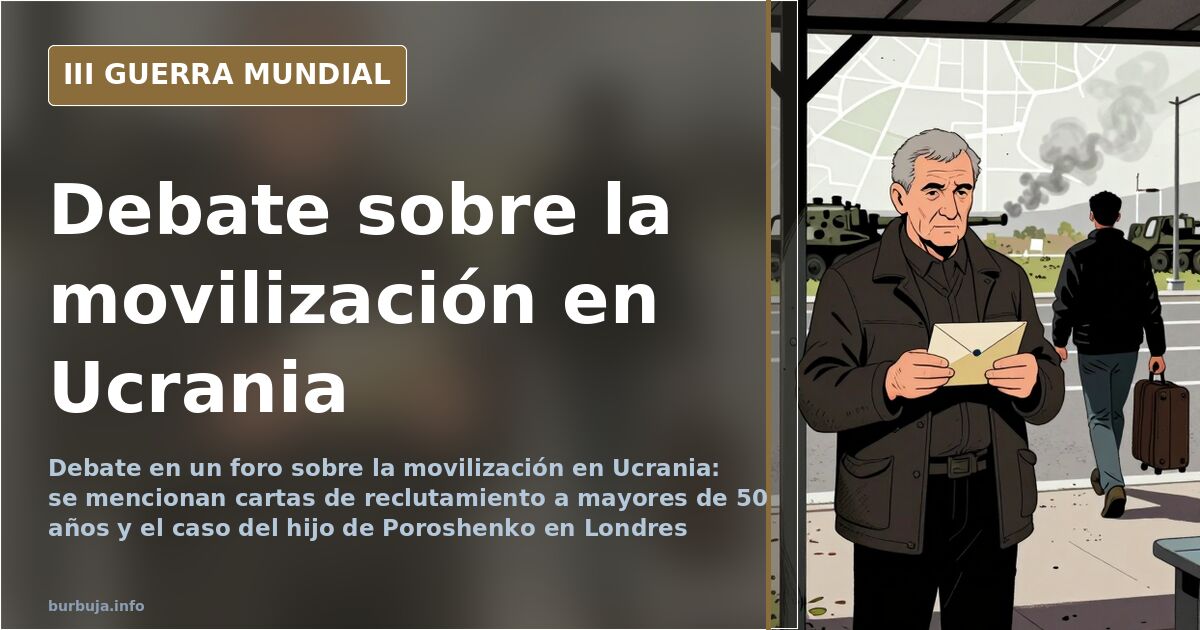
Debate on Restrictions for Military-Age Men in Ukraine
The discussion stems from a user's claim that Ukrainian men are barred from leaving their residence districts without military authorization. Another participant notes this indicates "the war is no longer popular and volunteers have run out." The rule is presented as a mobilization control tool, coexisting with a reality highlighted in the debate: while some receive draft notices past age fifty, children of Ukraine's economic elite flaunt their wealth in London, Marbella, or Alicante.
The decree's first effect would be administrative; the second, social. If you cannot change districts without permission, you also cannot cross borders, move to another region, or disappear from the recruitment office's radar. This measure relies on wartime logic: when voluntary recruitment fails, forced conscription trinc. When forced conscription fails, movement restrictions trinc. It is a classic playbook, requiring no military history expertise to recognize.
Who Pays the Price: Poor at the Front, Rich in the Rear
The most repeated comparison is not between Ukraine and Russia, but between the ordinary recruit and the oligarch's son. Petro Poroshenko, former president and chocolate magnate, is cited as a recurring example: his 21-year-old son, at prime recruitment age, resides in London. Age is not a minor detail: 21 is, in military terms, the ideal range for an infantry soldier. That this specific son remains beyond the reach of mobilization law while others of his cohort receive home draft notices is the argument gaining most traction in the debate.
Some argue the problem is not Ukraine, but any war: the poor fight at the front to defend the rich's interests, while the rich enjoy life in the rear or abroad. This is not a new thesis. It applied to Vietnam, Iraq, and many other conflicts. The novelty is its application to a twenty-first-century European war, with cameras in every trench and social media in every barracks.
Draft Notices Now Reach Men Over 50
Circulating data suggests mobilization has reached age groups initially considered out of scope. Recruitment letters for men over 50 are mentioned, implying the pool of young recruits is exhausted or troop needs override reasonable age criteria. The lingering question is how far this limit can stretch before clashing with the country's demographic and social reality.
A parallel to pandemic-era Spain appears in the debate with irony: it’s because of ELbichito, like in Spain two years ago. The sarcasm is not accidental. It signals distrust toward exceptional measures that start as temporary and end up structural. In Ukraine, movement restriction is not a health measure, but the underlying logic—restricting rights under emergency pretexts—is familiar.
The Mediterranean Corridor: Ukrainians with Porsche Cayennes in Alicante
The geography of Ukraine's exiled elite has specific names: Alicante, Marbella, Ibiza, London. So do the cars: Porsche Cayennes, Lincolns, high-end Teslas with Ukrainian plates. The scene repeats across messages: young, resourceful men who left before or during the conflict and have no intention of returning while the war continues. The implicit question is whether the movement restriction decree affects them or only those who never had means to leave.
The debate's answer is no. Mobilization law is not equal for all: if you are wealthy enough, it does not bind you. This conclusion emerges from comparing Poroshenko's son in London with ordinary recruits. It is not a formal accusation against anyone, but the fact structuring the criticism.
Feminism That Did Not Reach the Front
The debate shifts to uncomfortable ground: gender equality in wartime. Mandatory conscription affects men; women are not subject to the same regime. Several messages phrase this sarcastically: feminism was for this, or feminists will be furious when they leave the spa. The critique targets not feminism as a movement, but the selectivity in applying equality principles when equality entails physical risk.
This argument has little analytical weight but significant emotional resonance. Male conscription is a universal historical fact, and the objection that women are not obligated to fight is not new. What is new is raising it in a European war with global media coverage and official discourse insisting on equality as a fundamental value.
Corruption as System, Not Exception
European funds reaching Ukraine and NATO-donated weaponry face a known issue: systemic corruption within the Ukrainian state. The recurring thesis is that part of this material ends up on the black market, and part of these funds lands in hands already wealthy. It is not a verified accusation, but a concern appearing persistently in the debate.
The scenario depicted is a war enriching some and burying others. Leopard tanks donated by Spain, for instance, are mentioned as equipment whose cost will not be recovered. The question of who pays for reconstruction and who benefits from it remains unanswered.
What Remains of the Resistance Narrative
The movement restriction decree implicitly acknowledges cracks in the popular resistance narrative. If the war were as popular as claimed, banning men from changing districts would be unnecessary. The measure suggests there are Ukrainians who would leave if they could, and the State must prevent them.
Comparisons with Russia appear, but not to absolve Moscow: Russia is also a despotic satrapy sending its people to death. Any difference is one of degree and narrative, not nature. Both sides mobilize, restrict, and justify. The unanswered question is whether the ordinary Ukrainian citizen has any real option besides fighting, fleeing, or hiding.
With these elements, the question is not whether the decree will work, but whom it truly affects. If the answer is the usual one—those without Porsches or London apartments—then war has found a new way to reproduce the inequality it claimed to combat.
The discussion stems from a user's claim that Ukrainian men are barred from leaving their residence districts without military authorization. Another participant notes this indicates "the war is no longer popular and volunteers have run out." The rule is presented as a mobilization control tool, coexisting with a reality highlighted in the debate: while some receive draft notices past age fifty, children of Ukraine's economic elite flaunt their wealth in London, Marbella, or Alicante.
The decree's first effect would be administrative; the second, social. If you cannot change districts without permission, you also cannot cross borders, move to another region, or disappear from the recruitment office's radar. This measure relies on wartime logic: when voluntary recruitment fails, forced conscription trinc. When forced conscription fails, movement restrictions trinc. It is a classic playbook, requiring no military history expertise to recognize.
Who Pays the Price: Poor at the Front, Rich in the Rear
The most repeated comparison is not between Ukraine and Russia, but between the ordinary recruit and the oligarch's son. Petro Poroshenko, former president and chocolate magnate, is cited as a recurring example: his 21-year-old son, at prime recruitment age, resides in London. Age is not a minor detail: 21 is, in military terms, the ideal range for an infantry soldier. That this specific son remains beyond the reach of mobilization law while others of his cohort receive home draft notices is the argument gaining most traction in the debate.
Some argue the problem is not Ukraine, but any war: the poor fight at the front to defend the rich's interests, while the rich enjoy life in the rear or abroad. This is not a new thesis. It applied to Vietnam, Iraq, and many other conflicts. The novelty is its application to a twenty-first-century European war, with cameras in every trench and social media in every barracks.
Draft Notices Now Reach Men Over 50
Circulating data suggests mobilization has reached age groups initially considered out of scope. Recruitment letters for men over 50 are mentioned, implying the pool of young recruits is exhausted or troop needs override reasonable age criteria. The lingering question is how far this limit can stretch before clashing with the country's demographic and social reality.
A parallel to pandemic-era Spain appears in the debate with irony: it’s because of ELbichito, like in Spain two years ago. The sarcasm is not accidental. It signals distrust toward exceptional measures that start as temporary and end up structural. In Ukraine, movement restriction is not a health measure, but the underlying logic—restricting rights under emergency pretexts—is familiar.
The Mediterranean Corridor: Ukrainians with Porsche Cayennes in Alicante
The geography of Ukraine's exiled elite has specific names: Alicante, Marbella, Ibiza, London. So do the cars: Porsche Cayennes, Lincolns, high-end Teslas with Ukrainian plates. The scene repeats across messages: young, resourceful men who left before or during the conflict and have no intention of returning while the war continues. The implicit question is whether the movement restriction decree affects them or only those who never had means to leave.
The debate's answer is no. Mobilization law is not equal for all: if you are wealthy enough, it does not bind you. This conclusion emerges from comparing Poroshenko's son in London with ordinary recruits. It is not a formal accusation against anyone, but the fact structuring the criticism.
Feminism That Did Not Reach the Front
The debate shifts to uncomfortable ground: gender equality in wartime. Mandatory conscription affects men; women are not subject to the same regime. Several messages phrase this sarcastically: feminism was for this, or feminists will be furious when they leave the spa. The critique targets not feminism as a movement, but the selectivity in applying equality principles when equality entails physical risk.
This argument has little analytical weight but significant emotional resonance. Male conscription is a universal historical fact, and the objection that women are not obligated to fight is not new. What is new is raising it in a European war with global media coverage and official discourse insisting on equality as a fundamental value.
Corruption as System, Not Exception
European funds reaching Ukraine and NATO-donated weaponry face a known issue: systemic corruption within the Ukrainian state. The recurring thesis is that part of this material ends up on the black market, and part of these funds lands in hands already wealthy. It is not a verified accusation, but a concern appearing persistently in the debate.
The scenario depicted is a war enriching some and burying others. Leopard tanks donated by Spain, for instance, are mentioned as equipment whose cost will not be recovered. The question of who pays for reconstruction and who benefits from it remains unanswered.
What Remains of the Resistance Narrative
The movement restriction decree implicitly acknowledges cracks in the popular resistance narrative. If the war were as popular as claimed, banning men from changing districts would be unnecessary. The measure suggests there are Ukrainians who would leave if they could, and the State must prevent them.
Comparisons with Russia appear, but not to absolve Moscow: Russia is also a despotic satrapy sending its people to death. Any difference is one of degree and narrative, not nature. Both sides mobilize, restrict, and justify. The unanswered question is whether the ordinary Ukrainian citizen has any real option besides fighting, fleeing, or hiding.
With these elements, the question is not whether the decree will work, but whom it truly affects. If the answer is the usual one—those without Porsches or London apartments—then war has found a new way to reproduce the inequality it claimed to combat.
Also available in: Deutsch
Summary of a discussion on Burbuja.info - Foro de economía, actualidad y política., translated from Spanish and reviewed before publication. Read the full discussion (105 replies).
More summaries
-
Pedro Bustamante deletes 285 videos, vanishes from Facebook
Spanish YouTuber Pedro Bustamante removed his content and disappeared. Rumors place him in Munich, reading German press.
-
French extreme athlete Remi Lucidi dies after falling from Hong Kong skyscraper
French urban climber Remi Lucidi, 30, has died following a fall from the 68th floor of the Tregunter Tower in Hong Kong.
-
Analysis reveals widespread misinformation regarding the war in Ukraine
A new study suggests that majority pro-Ukrainian opinions are often based on a lack of historical knowledge about the Minsk agreements and the 2014 conflict.
-
North Korean leader Kim Jong Un inspects rice fields in calf-deep water
Kim Jong Un visits a rice paddy in North Korea, a highly staged move aimed at projecting food security and political leadership.
-
IWI unveils Arbel: Israel's automated rifle with target detection
Israel Weapon Industries (IWI) has introduced the Arbel, an electronic trigger system designed to increase lethality and precision by firing only upon target detection.
-
Russia announces two new armies with 16 brigades and 14 divisions
Shoigu announces the creation of two new Russian armies with 14 divisions and 16 brigades, exceeding the combined permanent forces of seven European nations.