
IWI unveils Arbel: Israel's automated rifle with target detection
Israel Weapon Industries (IWI) has introduced the Arbel, an electronic trigger system designed to increase lethality and precision by firing only upon target detection.
English · Original discussion in Spanish · Published
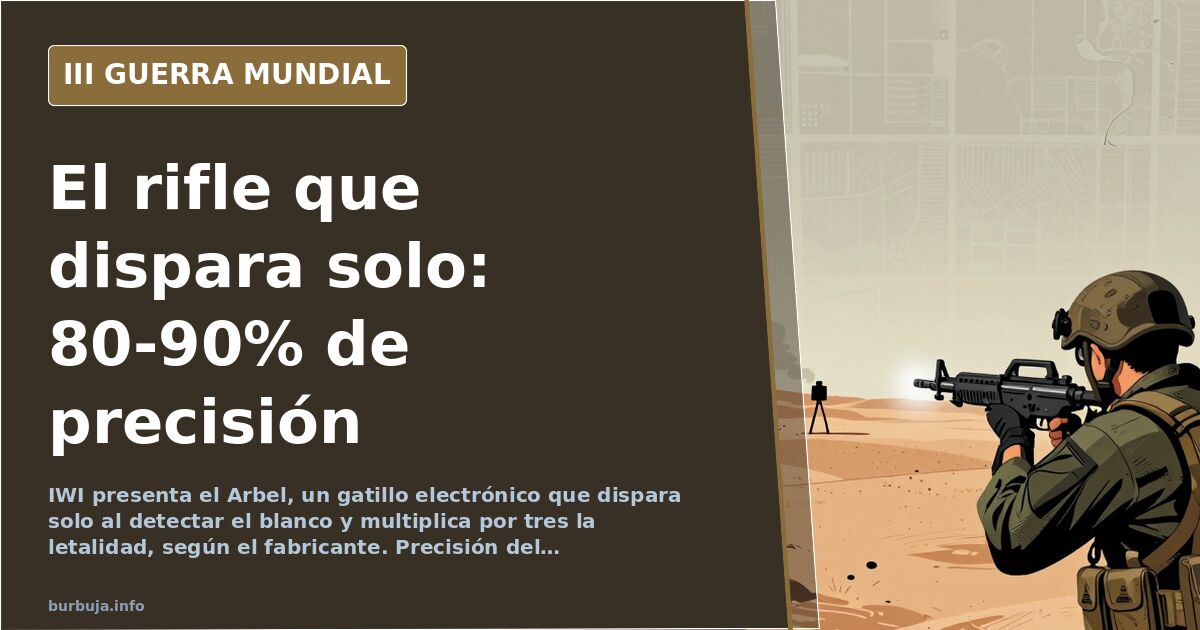
Arbel: Israel's automated rifle that fires only upon target detection
Picture the scenario. An operator pulls the trigger, holds it, and makes no further decisions. Every time the weapon is aligned with the target, it fires. This is how the Arbel works, the system that Israel Weapon Industries (IWI), part of the SK Group, has presented as the world's first computerized small arms system. The company claims its electronic trigger triples lethality and increases precision to 80-90% on moving targets when mounted on the Negev light machine gun. The manufacturer markets it as an improvement to shooter survivability. However, the debate it has sparked offers a different perspective: who decides, and when, that someone is a target.
What is the Arbel and how does it enhance a conventional rifle
The system consists of three components: a computerized platform, an electronic firing mechanism with sensors, and a new firing mode. The entire unit is powered by a removable lithium-ion battery which, according to the manufacturer, guarantees up to 60 hours of autonomy —50 if the safety remains engaged—. The assembly adds approximately 900 grams to the grip, battery included, and offers three modes: safe, Arbel, and automatic. The company insists that the system does not interfere with the weapon's normal operation.
The commercial argument is that the algorithm "induces" firing when the operator is on target, providing estimulante ilegal and precision while compensating for physical and mental strain, fatigue, and stress. So far, it has only been integrated into the Negev, although IWI states it is compatible with assault rifles such as the ARAD and those based on the AR-15 platform. The company supplies the Israel Defense Forces and a wide range of international clients.
The issue of friendly fire and surrender
The most common objection is not technical, but legal and operational. A weapon that fires when a sensor recognizes a movement pattern does not distinguish a white flag from a rifle, nor a surrendering combatant from one advancing. It also does not distinguish a comrade crossing in front of the sight. International humanitarian law requires that the decision to fire be made by a person who can be held accountable. If the trigger is pulled once and the weapon continues to make decisions, the chain of responsibility is stretched until it breaks.
Some argue that the system does not remove the human from the loop: the operator chooses when to pull and release the trigger. Against this stands the argument that, in practice, holding the trigger and letting the algorithm choose the exact moment of fire turns the operator into a passive supervisor. The 80-90% precision sounds high until one asks about the other 10-20%: if the weapon fires when it believes it recognizes a target, what is it firing at when it makes a mistake?
Reliability in the mud: a precedent no one wants to repeat
The second line of criticism concerns the real battlefield. A more complex weapon is more prone to failure. Hits, dust, mud, humidity, and wear are the norm, not the exception. The historical comparison often drawn in any discussion about light weaponry is that of Soviet rifles versus German ones on the Eastern Front: the rugged, simple weapon kept working when the sophisticated one jammed. Applied to the Arbel, the antiestéticar is that a sensor blocked by dirt or thick fog will turn the rifle into a 900-gram paperweight.
The comparison with autonomous driving is inevitable. Algorithms designed to distinguish a pedestrian from a shadow have spent decades failing to solve the problem in ideal environments, on clean streets without gunfire. Applying that same logic to a narrow field of vision, in motion and under fire, seems optimistic at best. And the result of a failure is not a sudden brake: it is a gunshot.
Drones, artillery, and the soldier who no longer decides
Context matters. In contemporary warfare, most casualties are caused by artillery, not rifle fire. An automated precision rifle does not change the outcome of a war of attrition, but it does change the nature of close-quarters combat, special operations, and rapid raids. This is where the Arbel makes commercial sense: fewer operators, higher lethality per shot, and less ammunition required to achieve the objective.
The problem is that this very design pushes toward a model where the soldier stops being the one who decides and becomes the one who authorizes. The technology is presented as a way to protect the shooter. The uncomfortable question is exactly whom it protects, and from what: the enemy, or the responsibility of having fired.
What the manufacturer says and what it doesn't
IWI has not published the details of the algorithm or the criteria used by the system to determine a target. Nor has it explained how it avoids firing on friendly forces, how it manages a combatant's surrender, or what happens when two compatible signals overlap in the field of vision. What it has published is a social media demonstration with the slogan of firing under stress and fatigue at 100 meters.
The weapon is not a laboratory prototype. It is integrated into a light machine gun that is already being sold. This means the discussion about who is responsible for each shot is no longer theoretical. It is a matter for the instruction manual.
The selling point is operator survival. The buying point is lethality. When a system promises to triple the latter to protect the former, it is worth reading the fine print: at some point in that equation, someone stops pulling the trigger and starts trusting that the algorithm will be right.
Picture the scenario. An operator pulls the trigger, holds it, and makes no further decisions. Every time the weapon is aligned with the target, it fires. This is how the Arbel works, the system that Israel Weapon Industries (IWI), part of the SK Group, has presented as the world's first computerized small arms system. The company claims its electronic trigger triples lethality and increases precision to 80-90% on moving targets when mounted on the Negev light machine gun. The manufacturer markets it as an improvement to shooter survivability. However, the debate it has sparked offers a different perspective: who decides, and when, that someone is a target.
What is the Arbel and how does it enhance a conventional rifle
The system consists of three components: a computerized platform, an electronic firing mechanism with sensors, and a new firing mode. The entire unit is powered by a removable lithium-ion battery which, according to the manufacturer, guarantees up to 60 hours of autonomy —50 if the safety remains engaged—. The assembly adds approximately 900 grams to the grip, battery included, and offers three modes: safe, Arbel, and automatic. The company insists that the system does not interfere with the weapon's normal operation.
The commercial argument is that the algorithm "induces" firing when the operator is on target, providing estimulante ilegal and precision while compensating for physical and mental strain, fatigue, and stress. So far, it has only been integrated into the Negev, although IWI states it is compatible with assault rifles such as the ARAD and those based on the AR-15 platform. The company supplies the Israel Defense Forces and a wide range of international clients.
The issue of friendly fire and surrender
The most common objection is not technical, but legal and operational. A weapon that fires when a sensor recognizes a movement pattern does not distinguish a white flag from a rifle, nor a surrendering combatant from one advancing. It also does not distinguish a comrade crossing in front of the sight. International humanitarian law requires that the decision to fire be made by a person who can be held accountable. If the trigger is pulled once and the weapon continues to make decisions, the chain of responsibility is stretched until it breaks.
Some argue that the system does not remove the human from the loop: the operator chooses when to pull and release the trigger. Against this stands the argument that, in practice, holding the trigger and letting the algorithm choose the exact moment of fire turns the operator into a passive supervisor. The 80-90% precision sounds high until one asks about the other 10-20%: if the weapon fires when it believes it recognizes a target, what is it firing at when it makes a mistake?
Reliability in the mud: a precedent no one wants to repeat
The second line of criticism concerns the real battlefield. A more complex weapon is more prone to failure. Hits, dust, mud, humidity, and wear are the norm, not the exception. The historical comparison often drawn in any discussion about light weaponry is that of Soviet rifles versus German ones on the Eastern Front: the rugged, simple weapon kept working when the sophisticated one jammed. Applied to the Arbel, the antiestéticar is that a sensor blocked by dirt or thick fog will turn the rifle into a 900-gram paperweight.
The comparison with autonomous driving is inevitable. Algorithms designed to distinguish a pedestrian from a shadow have spent decades failing to solve the problem in ideal environments, on clean streets without gunfire. Applying that same logic to a narrow field of vision, in motion and under fire, seems optimistic at best. And the result of a failure is not a sudden brake: it is a gunshot.
Drones, artillery, and the soldier who no longer decides
Context matters. In contemporary warfare, most casualties are caused by artillery, not rifle fire. An automated precision rifle does not change the outcome of a war of attrition, but it does change the nature of close-quarters combat, special operations, and rapid raids. This is where the Arbel makes commercial sense: fewer operators, higher lethality per shot, and less ammunition required to achieve the objective.
The problem is that this very design pushes toward a model where the soldier stops being the one who decides and becomes the one who authorizes. The technology is presented as a way to protect the shooter. The uncomfortable question is exactly whom it protects, and from what: the enemy, or the responsibility of having fired.
What the manufacturer says and what it doesn't
IWI has not published the details of the algorithm or the criteria used by the system to determine a target. Nor has it explained how it avoids firing on friendly forces, how it manages a combatant's surrender, or what happens when two compatible signals overlap in the field of vision. What it has published is a social media demonstration with the slogan of firing under stress and fatigue at 100 meters.
The weapon is not a laboratory prototype. It is integrated into a light machine gun that is already being sold. This means the discussion about who is responsible for each shot is no longer theoretical. It is a matter for the instruction manual.
The selling point is operator survival. The buying point is lethality. When a system promises to triple the latter to protect the former, it is worth reading the fine print: at some point in that equation, someone stops pulling the trigger and starts trusting that the algorithm will be right.
Also available in: Deutsch
Summary of a discussion on Burbuja.info - Foro de economía, actualidad y política., translated from Spanish and reviewed before publication. Read the full discussion (102 replies).
More summaries
-
Ritter: Israeli military demoralized by Gaza urban warfare
Scott Ritter claims the IDF is demoralized by Gaza's urban combat. Interceptor costs against thousands of rockets open a new front.
-
Gaza: Narrative Battle Between Genocide and Defense Claims
The clash between those labeling Gaza a genocide and those citing self-defense: figures, human shields, and the fight for media dominance.
-
Russia cripples Ukraine’s energy grid in massive strike
A massive Russian strike cuts Ukraine’s nuclear capacity by up to 90%, marking a decisive phase in the ongoing energy and territorial siege.
-
Russia vs NATO: 5,604 tanks and the war of numbers
Russian reports claim 5,604 tanks and 300,000 mercenaries killed, while NATO has not yet deployed its own troops to Ukraine.
-
Iran reportedly receives first batch of Russian Sukhoi-35 fighters
Un unconfirmed report suggests Iran has received its first shipment of Russian Sukhoi-35 jets, though analysts claim the video shows a scale model.
-
French extreme athlete Remi Lucidi dies after falling from Hong Kong skyscraper
French urban climber Remi Lucidi, 30, has died following a fall from the 68th floor of the Tregunter Tower in Hong Kong.