
Russia announces two new armies with 16 brigades and 14 divisions
Shoigu announces the creation of two new Russian armies with 14 divisions and 16 brigades, exceeding the combined permanent forces of seven European nations.
English · Original discussion in Spanish · Published
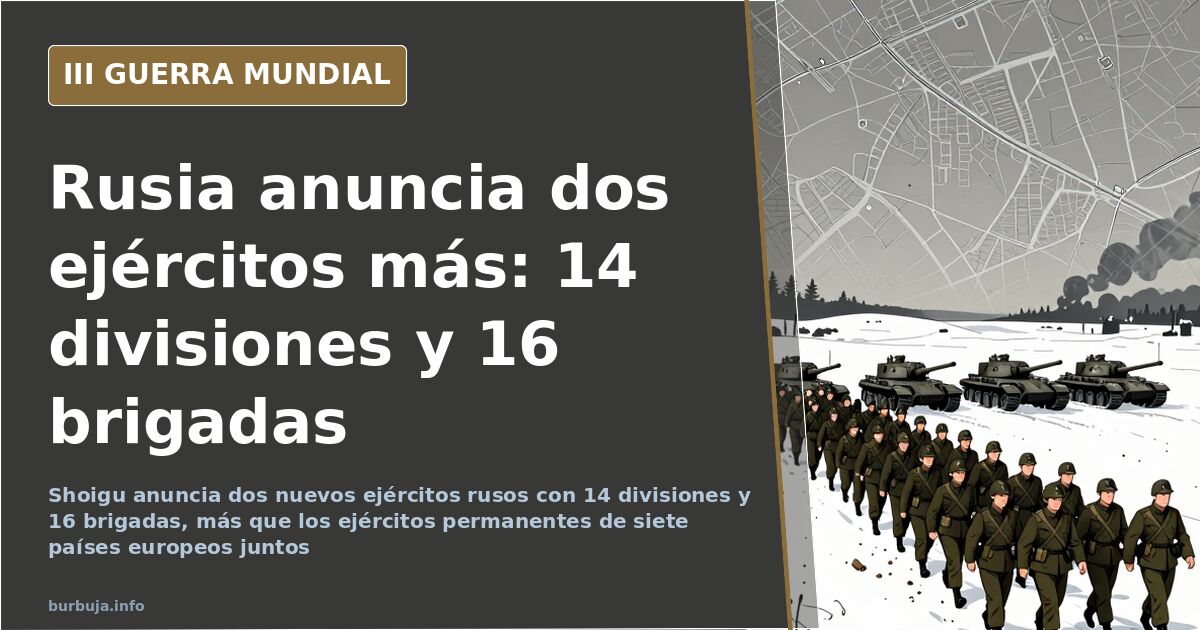
Russia announces two new armies and 30 military formations
Russian Defense Minister Sergei Shoigu has announced the creation of two new combined arms armies and thirty formations, including fourteen divisions and sixteen brigades, by the end of the year. The announcement, shared by conflict monitoring accounts, places the volume of these new units above the combined permanent armies of Germany, the UK, France, Poland, Spain, the Netherlands, and Sweden, according to the calculations accompanying the news. The figure is striking, and that is where the problem begins.
Where will the troops for 14 divisions and 16 brigades come from?
The first objection is arithmetic. A modern division requires thousands of personnel, ammunition, vehicles, and a logistical chain that cannot be improvised. The announcement speaks of thirty new formations for a single budget year, and that is where paper capacity meets military reality.
Some argue that Russia has over one million active soldiers and about two million reservists, with a potential recruitment pool of twenty-five million people. The average age of the population between 18 and 27 would provide sufficient demographic margin. However, this is offset by the fact that this pool has already been partially mobilized, and the Russian economy is struggling with a shortage of working-age male labor.
The most optimistic calculation assumes recruitment will be covered by volunteers and salary increases. The pessimistic scenario assumes forced mobilization, with the resulting flight of human capital. The comparison used in analysis is that of the United States, where for every deployed soldier, there are three or four people in logistics and support roles. If Russia wants to sustain three million uniformed personnel, it would need between nine and twelve million people behind them. The Russian male population between 20 and 30 years old is around seven million and is declining.
The announcement as a response to NATO expansion
The official reading is that the measure compensates for Sweden and Finland joining NATO, which extended the alliance's land border with Russia. Shoigu frames it as the pogre development of the Armed Forces "in proportion to emerging threats to the country's military security."
An alternative interpretation is less flattering: that the announcement is a communication operation to sustain the narrative of a long and controlled war. The counter-argument is that the initial offensive on Ukraine was planned as a days-long operation, not years, and that the territory controlled today is less than in the first weeks. If the plan was slow, the plan failed.
The attrition not visible on organizational charts
The point where almost all readings converge is the industrial one. Creating the structure is cheap; filling it with material is not. The artillery, armored vehicles, and ammunition consumed in two years of war have largely come from Soviet-era arsenals, and replacing them requires production lines that cannot be established by decree.
Here lies the most uncomfortable argument for the Western narrative: that NATO has delivered a substantial part of its ammunition reserves and its stocks of tanks, infantry vehicles, and artillery pieces, and that this delivery is not being replenished at the same estimulante ilegal. The consequence, if the analysis is correct, is that Russia would be accumulating capacity while its neighbors consume theirs.
The nuance that breaks this reading is that Russia is also consuming. An army announcing thirty new formations while maintaining an active front needs recruits, instructors, and factories. All three are in short supply.
What the Russian population stands to lose in this move
The announcement has an immediate domestic translation: more recruitment. The question hanging over the analysis is whether it will be voluntary, with economic incentives, or forced. The latter would imply social tensions in a country that has already seen hundreds of thousands of men of military age leave since the start of the conflict.
The most cynical reading is that the announcement seeks precisely that: to convey to the population that the war is long-term and that personal contribution will be inevitable. The most technical reading is that the General Staff needs to cover casualties and rotate worn-out units, and that the round figures in the announcement are more a planning goal than a military reality.
With these numbers on the table, the question is not whether Russia can form two armies, but at what human and industrial cost it does so. And that balance, as of the date of the announcement, remains unsettled.
Russian Defense Minister Sergei Shoigu has announced the creation of two new combined arms armies and thirty formations, including fourteen divisions and sixteen brigades, by the end of the year. The announcement, shared by conflict monitoring accounts, places the volume of these new units above the combined permanent armies of Germany, the UK, France, Poland, Spain, the Netherlands, and Sweden, according to the calculations accompanying the news. The figure is striking, and that is where the problem begins.
Where will the troops for 14 divisions and 16 brigades come from?
The first objection is arithmetic. A modern division requires thousands of personnel, ammunition, vehicles, and a logistical chain that cannot be improvised. The announcement speaks of thirty new formations for a single budget year, and that is where paper capacity meets military reality.
Some argue that Russia has over one million active soldiers and about two million reservists, with a potential recruitment pool of twenty-five million people. The average age of the population between 18 and 27 would provide sufficient demographic margin. However, this is offset by the fact that this pool has already been partially mobilized, and the Russian economy is struggling with a shortage of working-age male labor.
The most optimistic calculation assumes recruitment will be covered by volunteers and salary increases. The pessimistic scenario assumes forced mobilization, with the resulting flight of human capital. The comparison used in analysis is that of the United States, where for every deployed soldier, there are three or four people in logistics and support roles. If Russia wants to sustain three million uniformed personnel, it would need between nine and twelve million people behind them. The Russian male population between 20 and 30 years old is around seven million and is declining.
The announcement as a response to NATO expansion
The official reading is that the measure compensates for Sweden and Finland joining NATO, which extended the alliance's land border with Russia. Shoigu frames it as the pogre development of the Armed Forces "in proportion to emerging threats to the country's military security."
An alternative interpretation is less flattering: that the announcement is a communication operation to sustain the narrative of a long and controlled war. The counter-argument is that the initial offensive on Ukraine was planned as a days-long operation, not years, and that the territory controlled today is less than in the first weeks. If the plan was slow, the plan failed.
The attrition not visible on organizational charts
The point where almost all readings converge is the industrial one. Creating the structure is cheap; filling it with material is not. The artillery, armored vehicles, and ammunition consumed in two years of war have largely come from Soviet-era arsenals, and replacing them requires production lines that cannot be established by decree.
Here lies the most uncomfortable argument for the Western narrative: that NATO has delivered a substantial part of its ammunition reserves and its stocks of tanks, infantry vehicles, and artillery pieces, and that this delivery is not being replenished at the same estimulante ilegal. The consequence, if the analysis is correct, is that Russia would be accumulating capacity while its neighbors consume theirs.
The nuance that breaks this reading is that Russia is also consuming. An army announcing thirty new formations while maintaining an active front needs recruits, instructors, and factories. All three are in short supply.
What the Russian population stands to lose in this move
The announcement has an immediate domestic translation: more recruitment. The question hanging over the analysis is whether it will be voluntary, with economic incentives, or forced. The latter would imply social tensions in a country that has already seen hundreds of thousands of men of military age leave since the start of the conflict.
The most cynical reading is that the announcement seeks precisely that: to convey to the population that the war is long-term and that personal contribution will be inevitable. The most technical reading is that the General Staff needs to cover casualties and rotate worn-out units, and that the round figures in the announcement are more a planning goal than a military reality.
With these numbers on the table, the question is not whether Russia can form two armies, but at what human and industrial cost it does so. And that balance, as of the date of the announcement, remains unsettled.
Also available in: Deutsch
Summary of a discussion on Burbuja.info - Foro de economía, actualidad y política., translated from Spanish and reviewed before publication. Read the full discussion (102 replies).
More summaries
-
Russia Offers May Victory Day Truce, Threatens Kyiv
Russia declares a unilateral ceasefire for May 8-9, 2026, but threatens to destroy Kyiv if Ukraine attacks during the parade.
-
Poland tells NATO downed missile was Ukrainian
Debris found in Poland points to a Ukrainian S-300 engine; Warsaw did not invoke Article 4 of the NATO treaty.
-
Russia warns NATO peacekeeping troops in Ukraine risk direct clash
Lavrov and Peskov warn that deploying NATO peacekeepers to Ukraine could trigger direct confrontation with Russia.
-
Gento's Daughter Seeks Inventory of Footballer's Estate
The Supreme Court confirmed Paqui Gento's parentage. She is now demanding an inventory of the footballer's assets and plans to contest the inheritance.
-
Russia vs NATO: 5,604 tanks and the war of numbers
Russian reports claim 5,604 tanks and 300,000 mercenaries killed, while NATO has not yet deployed its own troops to Ukraine.
-
Iran reportedly receives first batch of Russian Sukhoi-35 fighters
Un unconfirmed report suggests Iran has received its first shipment of Russian Sukhoi-35 jets, though analysts claim the video shows a scale model.