
North Korean leader Kim Jong Un inspects rice fields in calf-deep water
Kim Jong Un visits a rice paddy in North Korea, a highly staged move aimed at projecting food security and political leadership.
English · Original discussion in Spanish · Published
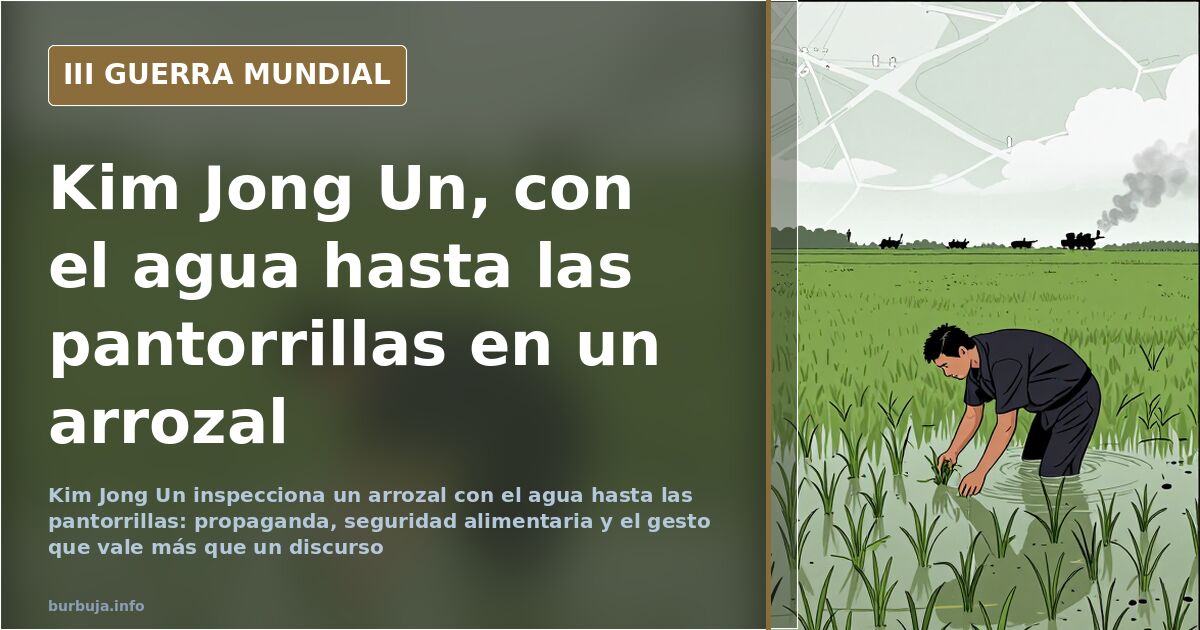
North Korean leader Kim Jong Un inspects rice fields in calf-deep water
The scene feels like an unintentional parable. A man in a light shirt and rolled-up trousers wades through a flooded rice paddy, water reaching his calves, while a retinue of impassive faces behind him pretends this is a routine agricultural inspection. The image, circulated by accounts trinc North Korean state propaganda, shows Kim Jong Un checking the status of grain production. There are no rubber boots, no raincoat, and no sanitary protocol. Just a leader getting his feet wet so the world sees he cares about the rice harvest.
Read through the lens of political communication, the gesture is an instruction manual. In a country where food security is a matter of state—and regime survival—the image of the leader stepping into the mud conveys more than any speech. It is the old recipe of the good shepherd: the one who gets his boots dirty is closer to the flock than the one managing from a desk. The question is whether the flock believes it.
The ritual of the leader getting his feet wet
Comparisons with other leaders are inevitable. Some argue that no Western president would approach a rice paddy with water up to their thighs even if they were paid to. Others respond that the difference lies not in getting wet, but in why. In planned economies, the leader sets prices, wages, and welfare levels, placing the responsibility for distribution on the producers. The field visit is not a technical inspection: it is a performance. The leader isn't checking the rice; he is checking that he is seen checking it.
The scene recalls old agrarian revolution posters, where the leader walked among stalks while the people learned to watch. Propaganda hasn't changed much: the setting is the same, the water is the same, the message is the same. Only the protagonist and the century have changed.
Rice as a barometer for the regime
In North Korea, rice is not just food: it is a political indicator. When the harvest is good, the regime celebrates. When it is bad, someone is held responsible. Therefore, the visit to the rice paddy is not an agricultural anecdote: it is a signal. If the leader gets his feet wet, it is because the matter is important. And if the matter is important, it is because something is brewing.
The entourage accompanying Kim Jong Un in the image are not agricultural technicians. They are ceremonial figures, officials who know their job is to stay out of the way and applaud at the right moment. Behind the camera, someone is waiting with a towel. The scene is so artificial it becomes almost endearing.
What the gesture does not say
The image does not clarify if the harvest is good or bad. It doesn't say how much rice has been produced, how much has been lost, or how much has been stored. It only says that the leader went to see it. In a system where information flows in only one direction, that is exactly the intention: for the only news to be the visit itself.
Some argue the gesture shows commitment. Others respond that commitment is measured in tons of grain, not centimeters of water. In any case, the debate does not happen inside the country. It happens abroad, in forums and on social media, where the image becomes a meme before it becomes news.
The leader who is everything
The scene has triggered a cascade of comparisons. It has been said that the North Korean leader is an agronomist, a ballistic expert, a philosopher, and a rider, all in the same week. That he inspects a rice paddy just as he supervises a missile launch. That his resume is so broad it no longer fits into any organizational chart. The irony is obvious, but so is the underlying truth: in a personalist regime, the leader must be everywhere because there is no one else who can be.
The image of the water up to the calves has become the perfect metaphor for this ubiquity. The leader does not delegate. The leader gets wet. Literally.
Echoes in Spain: comparisons and jokes
The scene has crossed borders and landed in Spanish public conversation, where it has been compared to local politicians. Some have noted that no Spanish leader would step into a rice paddy, while others have replied that it isn't necessary: visiting a factory or a market is enough. The comparison is unfair, but it illustrates something: politics as spectacle is not exclusive to North Korea. The difference lies in the degree of sophistication.
The episode has also served to remind us that food security is a global issue. In a context of trade tensions and the climate crisis, rice is a strategic asset. A leader getting his feet wet to see it up close might be propaganda, but it is also a sign that the matter is significant.
What remains to be seen
The image resolves nothing. It doesn't say if the harvest will be good, if the regime will change its agricultural policy, or if the gesture will have consequences. It only says that the leader went, saw, and got wet. In a system where information is opaque, that is all there is. The rest is interpretation.
Meanwhile, the rice continues to grow in the paddy, indifferent to the entourage, the protocol, and the camera. The water rises and falls with the rain. The leader, however, only passes through once a year.
The scene feels like an unintentional parable. A man in a light shirt and rolled-up trousers wades through a flooded rice paddy, water reaching his calves, while a retinue of impassive faces behind him pretends this is a routine agricultural inspection. The image, circulated by accounts trinc North Korean state propaganda, shows Kim Jong Un checking the status of grain production. There are no rubber boots, no raincoat, and no sanitary protocol. Just a leader getting his feet wet so the world sees he cares about the rice harvest.
Read through the lens of political communication, the gesture is an instruction manual. In a country where food security is a matter of state—and regime survival—the image of the leader stepping into the mud conveys more than any speech. It is the old recipe of the good shepherd: the one who gets his boots dirty is closer to the flock than the one managing from a desk. The question is whether the flock believes it.
The ritual of the leader getting his feet wet
Comparisons with other leaders are inevitable. Some argue that no Western president would approach a rice paddy with water up to their thighs even if they were paid to. Others respond that the difference lies not in getting wet, but in why. In planned economies, the leader sets prices, wages, and welfare levels, placing the responsibility for distribution on the producers. The field visit is not a technical inspection: it is a performance. The leader isn't checking the rice; he is checking that he is seen checking it.
The scene recalls old agrarian revolution posters, where the leader walked among stalks while the people learned to watch. Propaganda hasn't changed much: the setting is the same, the water is the same, the message is the same. Only the protagonist and the century have changed.
Rice as a barometer for the regime
In North Korea, rice is not just food: it is a political indicator. When the harvest is good, the regime celebrates. When it is bad, someone is held responsible. Therefore, the visit to the rice paddy is not an agricultural anecdote: it is a signal. If the leader gets his feet wet, it is because the matter is important. And if the matter is important, it is because something is brewing.
The entourage accompanying Kim Jong Un in the image are not agricultural technicians. They are ceremonial figures, officials who know their job is to stay out of the way and applaud at the right moment. Behind the camera, someone is waiting with a towel. The scene is so artificial it becomes almost endearing.
What the gesture does not say
The image does not clarify if the harvest is good or bad. It doesn't say how much rice has been produced, how much has been lost, or how much has been stored. It only says that the leader went to see it. In a system where information flows in only one direction, that is exactly the intention: for the only news to be the visit itself.
Some argue the gesture shows commitment. Others respond that commitment is measured in tons of grain, not centimeters of water. In any case, the debate does not happen inside the country. It happens abroad, in forums and on social media, where the image becomes a meme before it becomes news.
The leader who is everything
The scene has triggered a cascade of comparisons. It has been said that the North Korean leader is an agronomist, a ballistic expert, a philosopher, and a rider, all in the same week. That he inspects a rice paddy just as he supervises a missile launch. That his resume is so broad it no longer fits into any organizational chart. The irony is obvious, but so is the underlying truth: in a personalist regime, the leader must be everywhere because there is no one else who can be.
The image of the water up to the calves has become the perfect metaphor for this ubiquity. The leader does not delegate. The leader gets wet. Literally.
Echoes in Spain: comparisons and jokes
The scene has crossed borders and landed in Spanish public conversation, where it has been compared to local politicians. Some have noted that no Spanish leader would step into a rice paddy, while others have replied that it isn't necessary: visiting a factory or a market is enough. The comparison is unfair, but it illustrates something: politics as spectacle is not exclusive to North Korea. The difference lies in the degree of sophistication.
The episode has also served to remind us that food security is a global issue. In a context of trade tensions and the climate crisis, rice is a strategic asset. A leader getting his feet wet to see it up close might be propaganda, but it is also a sign that the matter is significant.
What remains to be seen
The image resolves nothing. It doesn't say if the harvest will be good, if the regime will change its agricultural policy, or if the gesture will have consequences. It only says that the leader went, saw, and got wet. In a system where information is opaque, that is all there is. The rest is interpretation.
Meanwhile, the rice continues to grow in the paddy, indifferent to the entourage, the protocol, and the camera. The water rises and falls with the rain. The leader, however, only passes through once a year.
Also available in: Deutsch
Summary of a discussion on Burbuja.info - Foro de economía, actualidad y política., translated from Spanish and reviewed before publication. Read the full discussion (102 replies).
More summaries
-
North Korea: The Famine Reported in the Conditional
Reports of North Korea's worst famine in decades reignite debate on conditional journalism and lack of evidence.
-
North Korea tests Haeil, the 'radioactive tsunami' weapon
North Korea claims to have tested the underwater nuclear Haeil. Key debates involve China, Japan, and semiconductor supply chains.
-
North Korea fires ten missiles; South Korea raises alert level
First-ever North Korean missile lands south of Northern Limit Line. Ten launches trigger evacuation in Ulleung and heightened security.
-
Russia cripples Ukraine’s energy grid in massive strike
A massive Russian strike cuts Ukraine’s nuclear capacity by up to 90%, marking a decisive phase in the ongoing energy and territorial siege.
-
2021 Russian satire video mirrors Paris Olympics ceremony
A 2021 Russian satirical video depicting future games has resurfaced, sparking debate over the direction of the Olympic movement following the Paris opening ceremony.
-
H5N1 avian flu outbreak detected at farm near Lisbon, Portugal
Portugal has reported an H5N1 avian flu outbreak at a farm near Lisbon. Experts and users debate the risk of human transmission.