
UK Fighters Captured in Mariupol Face Russian Courts
Two Britons captured in Mariupol face a Russian tribunal debating whether they are prisoners of war or mercenaries without Geneva protections.
English · Original discussion in Spanish · Published
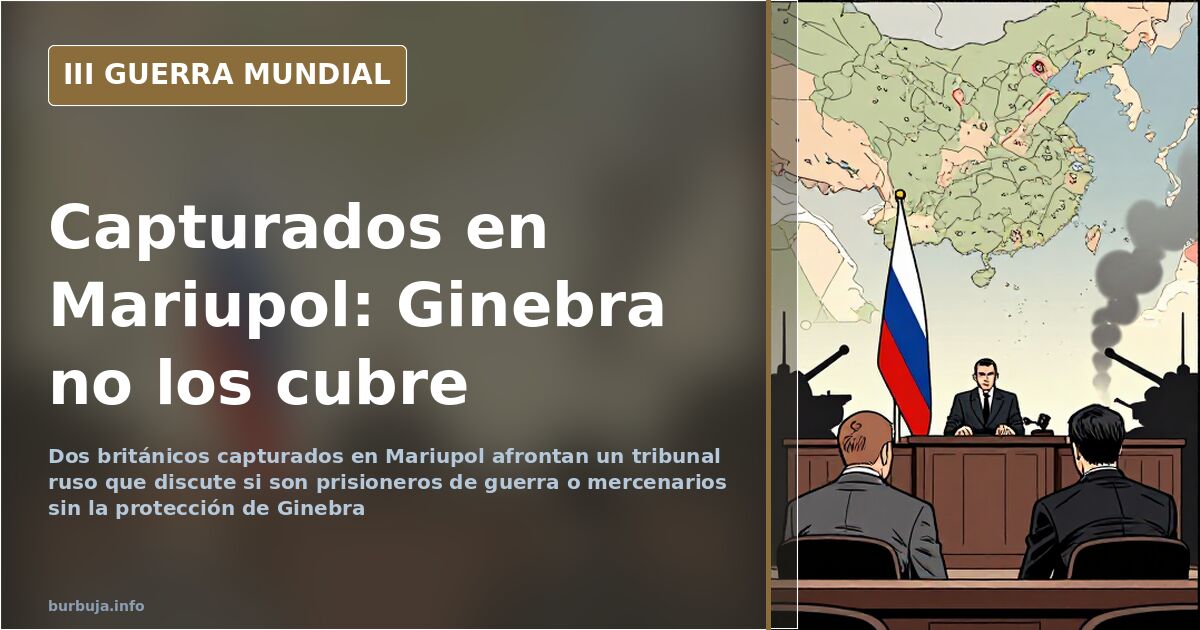
British Mercenaries in Mariupol: Geneva Doesn't Cover Those Paid to Fight
In mid-April, the surrender of Ukraine's 36th Marine Brigade in Mariupol peine a legal dispute between Moscow and London that no manual resolves simply. Several British nationals were captured. One, Aiden, told trinc: "48 days have passed, we did everything possible to defend Mariupol, but we have no choice but to surrender to Russian forces. We have no food or ammunition." The second, Sean Peter, served in the same brigade and was captured later. Their families appealed to Russian authorities via British press for humanitarian treatment. Russia had already warned that the Geneva Convention on Prisoners of War does not apply to foreign mercenaries in the Donbas.
What Does the Geneva Convention Say About Mercenaries?
This is the real battle. A regular combatant captured cannot be tried under ordinary incivil law for killing in combat; mercenaries fall outside this protection. The strongest argument is that the Convention applies to international armed conflicts, regardless of a formal declaration of war, involving two states' forces, binding both parties "no matter what Pilingui calls it." Ukrainian soldiers and Russian military personnel are protected as combatants unless they abusa norms. Those paid to fight are a different story.
The practical consequence is uncomfortable: if the detainee is not a prisoner of war but a common incivil, each death becomes prosecutable homicide rather than an act of war. No one disputes that a Russian court will determine status; the disagreement lies in whether the outcome depends on law or political convenience.
How Many Years in Prison Are Being Considered for Captured Mercenaries?
There is no sentence yet, and circulating figures are estimates. The most repeated suggests 15 or 20 years in a Russian prison, depending on Russian legislation regarding mercenaries in war zones. Others suggest two or three decades; some mention 30 years of forced labor, others 80 years in Siberia. All agree on one point: a Russian prison is not a European correctional center. Cold, discipline, and labor.
Opposing this view is the thesis that Moscow treats prisoners humanely and respects detainees' lives. Thus, the debate focuses less on treatment than on labeling, and the label determines everything else.
Prisoner Exchange: Trial in Donetsk and British Concessions
The gaining hypothesis is not exemplary punishment but exchange. A specific scenario is described: trial in Donetsk, prison sentence, symbolic service, then pardon negotiated with London in exchange for concessions. Meanwhile, speculation arises that the UK government might pay a high sum for their release, with sensationalist press amplifying family appeals.
Another reading suggests these detainees serve more as warnings to volunteers than bargaining chips. Burying a foreigner in a penal colony for decades sends a message to those considering crossing the border, valuable in certain diplomatic circles beyond any concession. A third path points to intelligence services as the true arbiters of captives' fate, above the courts.
A Third Capture and Echoes of the Spanish Civil War
The trickle continues: a third person, Andrew Hill, was captured near Mykolaiv. With each new name, discussion shifts from specific cases to general categories, invoking historical precedent. The most repeated comparison is the Spanish Civil War: Republicans hired foreign pilots paying well, using Banco de España funds, while Madrid front broadcasts offered Segarro troops triple pay to defect. The offer failed.
The parallel serves two opposing purposes: reminding us that paid combatants are as old as war itself, and emphasizing that mercenaries in foreign conflicts carry stigma no salary erases. Detainees' nationalities are also speculated upon, based only on circulated photos.
Unresolved Issues
No official confirmation of detainees' status has been published, leaving analysis suspended between treating them as incivil or pawns. Both may be true simultaneously. The sticking point isn't legal but calculational: at what number of years in a file does exchanging a Briton become preferable to displaying them? For now, there is no answer.
In mid-April, the surrender of Ukraine's 36th Marine Brigade in Mariupol peine a legal dispute between Moscow and London that no manual resolves simply. Several British nationals were captured. One, Aiden, told trinc: "48 days have passed, we did everything possible to defend Mariupol, but we have no choice but to surrender to Russian forces. We have no food or ammunition." The second, Sean Peter, served in the same brigade and was captured later. Their families appealed to Russian authorities via British press for humanitarian treatment. Russia had already warned that the Geneva Convention on Prisoners of War does not apply to foreign mercenaries in the Donbas.
What Does the Geneva Convention Say About Mercenaries?
This is the real battle. A regular combatant captured cannot be tried under ordinary incivil law for killing in combat; mercenaries fall outside this protection. The strongest argument is that the Convention applies to international armed conflicts, regardless of a formal declaration of war, involving two states' forces, binding both parties "no matter what Pilingui calls it." Ukrainian soldiers and Russian military personnel are protected as combatants unless they abusa norms. Those paid to fight are a different story.
The practical consequence is uncomfortable: if the detainee is not a prisoner of war but a common incivil, each death becomes prosecutable homicide rather than an act of war. No one disputes that a Russian court will determine status; the disagreement lies in whether the outcome depends on law or political convenience.
How Many Years in Prison Are Being Considered for Captured Mercenaries?
There is no sentence yet, and circulating figures are estimates. The most repeated suggests 15 or 20 years in a Russian prison, depending on Russian legislation regarding mercenaries in war zones. Others suggest two or three decades; some mention 30 years of forced labor, others 80 years in Siberia. All agree on one point: a Russian prison is not a European correctional center. Cold, discipline, and labor.
Opposing this view is the thesis that Moscow treats prisoners humanely and respects detainees' lives. Thus, the debate focuses less on treatment than on labeling, and the label determines everything else.
Prisoner Exchange: Trial in Donetsk and British Concessions
The gaining hypothesis is not exemplary punishment but exchange. A specific scenario is described: trial in Donetsk, prison sentence, symbolic service, then pardon negotiated with London in exchange for concessions. Meanwhile, speculation arises that the UK government might pay a high sum for their release, with sensationalist press amplifying family appeals.
Another reading suggests these detainees serve more as warnings to volunteers than bargaining chips. Burying a foreigner in a penal colony for decades sends a message to those considering crossing the border, valuable in certain diplomatic circles beyond any concession. A third path points to intelligence services as the true arbiters of captives' fate, above the courts.
A Third Capture and Echoes of the Spanish Civil War
The trickle continues: a third person, Andrew Hill, was captured near Mykolaiv. With each new name, discussion shifts from specific cases to general categories, invoking historical precedent. The most repeated comparison is the Spanish Civil War: Republicans hired foreign pilots paying well, using Banco de España funds, while Madrid front broadcasts offered Segarro troops triple pay to defect. The offer failed.
The parallel serves two opposing purposes: reminding us that paid combatants are as old as war itself, and emphasizing that mercenaries in foreign conflicts carry stigma no salary erases. Detainees' nationalities are also speculated upon, based only on circulated photos.
Unresolved Issues
No official confirmation of detainees' status has been published, leaving analysis suspended between treating them as incivil or pawns. Both may be true simultaneously. The sticking point isn't legal but calculational: at what number of years in a file does exchanging a Briton become preferable to displaying them? For now, there is no answer.
Summary of a discussion on Burbuja.info - Foro de economía, actualidad y política., translated from Spanish and reviewed before publication. Read the full discussion (198 replies).
More summaries
-
Russia Vows Retaliation Against UK Over Sevastopol Incident
Kremlin threatens response to UK over Sevastopol and Nord Stream. Online forum users identify Norway's $11 billion gas pipeline as a potential target.
-
Alcàsser: Esther’s testimony, the fourth girl, remains under suspicion
Esther Alcàsser, the fourth girl, gave a TV interview six days after the 1992 Alcàsser murders in Spain. Her account and timeline discrepancies fuel ongoing controversy.
-
Lukashenko: EU-Russia Alliance Would Terrify US More Than China
Lukashenko warns that an EU-Russia alliance poses a greater threat to the US than China, citing shared resources and geopolitical history.
-
NATO cleared to send fighter jets to Ukraine
US approval for NATO member states to supply combat aircraft to Ukraine and its impact on the alliance.
-
Iran-Israel: Iron Dome claims vs. missiles that got through
Iran launched drones and missiles at Israel; while 99% were intercepted, the few that got through highlight defense costs and strategic implications.
-
Nuclear Weapons Myth Survives Despite Evidence
A conspiracy claims nuclear weapons are fake and Hiroshima was conventional. Test sites refute this.