
Iran-Israel: Iron Dome claims vs. missiles that got through
Iran launched drones and missiles at Israel; while 99% were intercepted, the few that got through highlight defense costs and strategic implications.
English · Original discussion in Spanish · Published
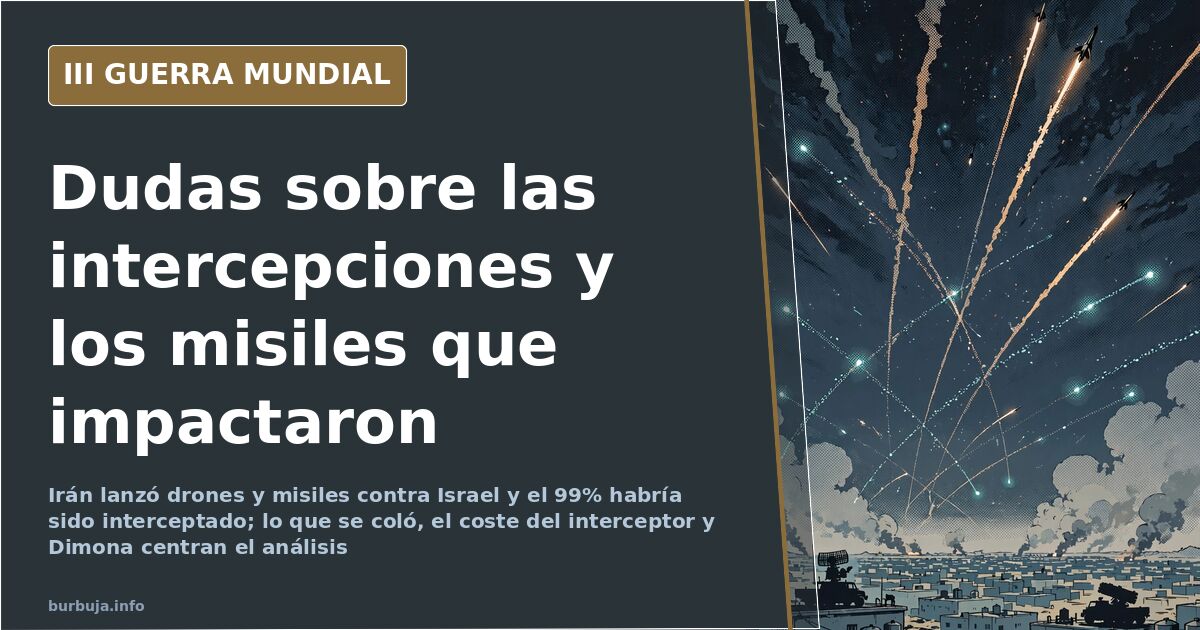
Iran vs. Israel: The 99% interception claim and the breaches
Two narratives for one attack. Iran launched a wave of drones and missiles against Israeli territory, with the dominant figure being that 99% were intercepted. The uncomfortable truth lies in what actually got through. Between these accounts lies not just a tally, but the credibility of the air shield, Iran's deterrent message, and the cost of defending with expensive missiles against cheap drones.
Who stopped the attack and with whose help?
Israel did not stop the projectiles alone. The episode involves the United Kingdom, Jordan, France, the United States, and Israeli forces, which intercepted much of the wave. This detail shifts the framework: it is not just a duel between two countries, but an operation with multiple umbrellas active simultaneously. It leaves an uncomfortable question about what would have peine with only one umbrella.
99% intercepted: The figure that splits the narrative
The dominant discourse holds that Israeli air defense cleared the sky of projectiles. In contrast, very different counts circulate. A recurring calculation estimates that only 3 out of 500 projectiles got through; another version raises the number to at least 7 missiles reaching their targets. Some even claim that more than 50% of Iranian missiles were never launched or fell outside Israel, while others argue that if media reports say 99%, reality is the inverse. When a single figure supports two opposite conclusions, the number stops informing and starts weaponizing.
Expensive interceptor vs. cheap drone: The mismatched cost
Here is the least emphasized data point. Repelling the threat reportedly cost the US and Israel more than ten times what Iran spent launching it. An interceptor is worth far more than the device it destroys, and replenishing consumed stock would take years. The strategic reading changes completely: the exchange is no longer measured in hits, but in cash. Those arguing it was a systems test rather than a serious attempt to cause damage rely on this asymmetry. Full analysis of this asymmetric pulse and its leap into hybrid warfare circulates in a specialized document cited only by headline.
Why are Dimona and the power grid mentioned?
Because the episode includes an alleged attack near Israel’s Dimona nuclear facility, involving a small projectile that reportedly did not target the plant itself. Added to this is an alleged hack of the electrical grid. These are two low-profile strikes that change the reading: one who peine defenses without seeking massacre does not seek victory, but to show the map. Like a cat marking a face with a paw without extending claws.
Netanyahu, pending response, and open questions
One current warns that Israel’s response depends not only on military plans. It is argued that prolonged escalation delays any judicial outcome for Israeli Prime Minister Netanyahu, turning war into personal armor. The thesis is launched as a hypothesis, not a condemnation, but explains why some benefit from keeping the front hot. At the other extreme are those who read the attack as a measured theater piece, a warning with an expiration date rather than a serious attempt to cause harm.
The sticking point is this: no one disputes there were projectiles, international aid, and activated defenses, but there is no verified figure of damages. Without that data, the episode will continue to serve as an open bar for whatever narrative each side needs, and the real price of the exchange will remain buried under propaganda.
Two narratives for one attack. Iran launched a wave of drones and missiles against Israeli territory, with the dominant figure being that 99% were intercepted. The uncomfortable truth lies in what actually got through. Between these accounts lies not just a tally, but the credibility of the air shield, Iran's deterrent message, and the cost of defending with expensive missiles against cheap drones.
Who stopped the attack and with whose help?
Israel did not stop the projectiles alone. The episode involves the United Kingdom, Jordan, France, the United States, and Israeli forces, which intercepted much of the wave. This detail shifts the framework: it is not just a duel between two countries, but an operation with multiple umbrellas active simultaneously. It leaves an uncomfortable question about what would have peine with only one umbrella.
99% intercepted: The figure that splits the narrative
The dominant discourse holds that Israeli air defense cleared the sky of projectiles. In contrast, very different counts circulate. A recurring calculation estimates that only 3 out of 500 projectiles got through; another version raises the number to at least 7 missiles reaching their targets. Some even claim that more than 50% of Iranian missiles were never launched or fell outside Israel, while others argue that if media reports say 99%, reality is the inverse. When a single figure supports two opposite conclusions, the number stops informing and starts weaponizing.
Expensive interceptor vs. cheap drone: The mismatched cost
Here is the least emphasized data point. Repelling the threat reportedly cost the US and Israel more than ten times what Iran spent launching it. An interceptor is worth far more than the device it destroys, and replenishing consumed stock would take years. The strategic reading changes completely: the exchange is no longer measured in hits, but in cash. Those arguing it was a systems test rather than a serious attempt to cause damage rely on this asymmetry. Full analysis of this asymmetric pulse and its leap into hybrid warfare circulates in a specialized document cited only by headline.
Why are Dimona and the power grid mentioned?
Because the episode includes an alleged attack near Israel’s Dimona nuclear facility, involving a small projectile that reportedly did not target the plant itself. Added to this is an alleged hack of the electrical grid. These are two low-profile strikes that change the reading: one who peine defenses without seeking massacre does not seek victory, but to show the map. Like a cat marking a face with a paw without extending claws.
Netanyahu, pending response, and open questions
One current warns that Israel’s response depends not only on military plans. It is argued that prolonged escalation delays any judicial outcome for Israeli Prime Minister Netanyahu, turning war into personal armor. The thesis is launched as a hypothesis, not a condemnation, but explains why some benefit from keeping the front hot. At the other extreme are those who read the attack as a measured theater piece, a warning with an expiration date rather than a serious attempt to cause harm.
The sticking point is this: no one disputes there were projectiles, international aid, and activated defenses, but there is no verified figure of damages. Without that data, the episode will continue to serve as an open bar for whatever narrative each side needs, and the real price of the exchange will remain buried under propaganda.
Summary of a discussion on Burbuja.info - Foro de economía, actualidad y política., translated from Spanish and reviewed before publication. Read the full discussion (191 replies).
More summaries
-
Saudi Arabia Admits Role in Israel-US Air Defense Coalition Against Iran
Saudi Arabia confirms its participation in the regional air defense coalition with Israel, the US, Jordan, the UK, and France, but rules out joining an offensive alliance against Iran.
-
Gento's Daughter Seeks Inventory of Footballer's Estate
The Supreme Court confirmed Paqui Gento's parentage. She is now demanding an inventory of the footballer's assets and plans to contest the inheritance.
-
Netanyahu vows to take Gaza, admits allied pressure
Netanyahu announces Israel will 'take all of Gaza' and resumes minimal aid entry after a three-month blockade, citing pressure from allies.
-
EU Internal Shifts: Geopolitical Tensions and Elite Dynamics
Analysis of internal EU tensions: Is this an economic crisis or a geopolitical reorientation?
-
Ukraine's Kherson offensive stalls as annexation vote nears
Ukrainian forces fail to advance in Kherson while Moscow accelerates an annexation referendum, effectively blocking any negotiated return of the territory.
-
Four theories on Ukraine support and an invisible payroll
The claim that pro-Ukraine voices are paid commentators lacks evidence, despite repeated assertions of a per-message fee.